The Hersey-Blanchard Model (Situational Leadership)
Hersey and Blanchard propose adapting leadership to an employee’s competence and commitment for the task. Their four styles are instructing, coaching, supporting, and delegating.
THE IDEA
The Hersey-Blanchard Model (Situational Leadership)
Paul Hersey and Ken Blanchard proposed adapting leadership to the task and to the employee’s competence and commitment. Their “situational leadership model” distinguishes between:
1. Instructing. When they are starting a job, employees need strong leadership. When they are new their level of commitment is usually high, but their level of expertise is still low. Employees are given orders and instructions.
2. Coaching. The employees’ level of expertise has risen. Because of stress and the loss of the initial euphoria at starting a new job, their motivation and commitment levels have fallen. The employees are asked questions, and they look for the answers themselves.
3. Supporting. The level of expertise has risen sharply. The level of motivation can vary: either it has gone down (employees may resign) or it has gone up as a result of being given more independence (employees are encouraged to come up with their own ideas).
4. Delegating. Employees are fully in control of their work. The level of motivation is high. They are given their own projects and lead their own teams.
Lead your employees in such a way that you yourself become superfluous. And lead your employees to be successful, so that one day they will be in a leadership position themselves.
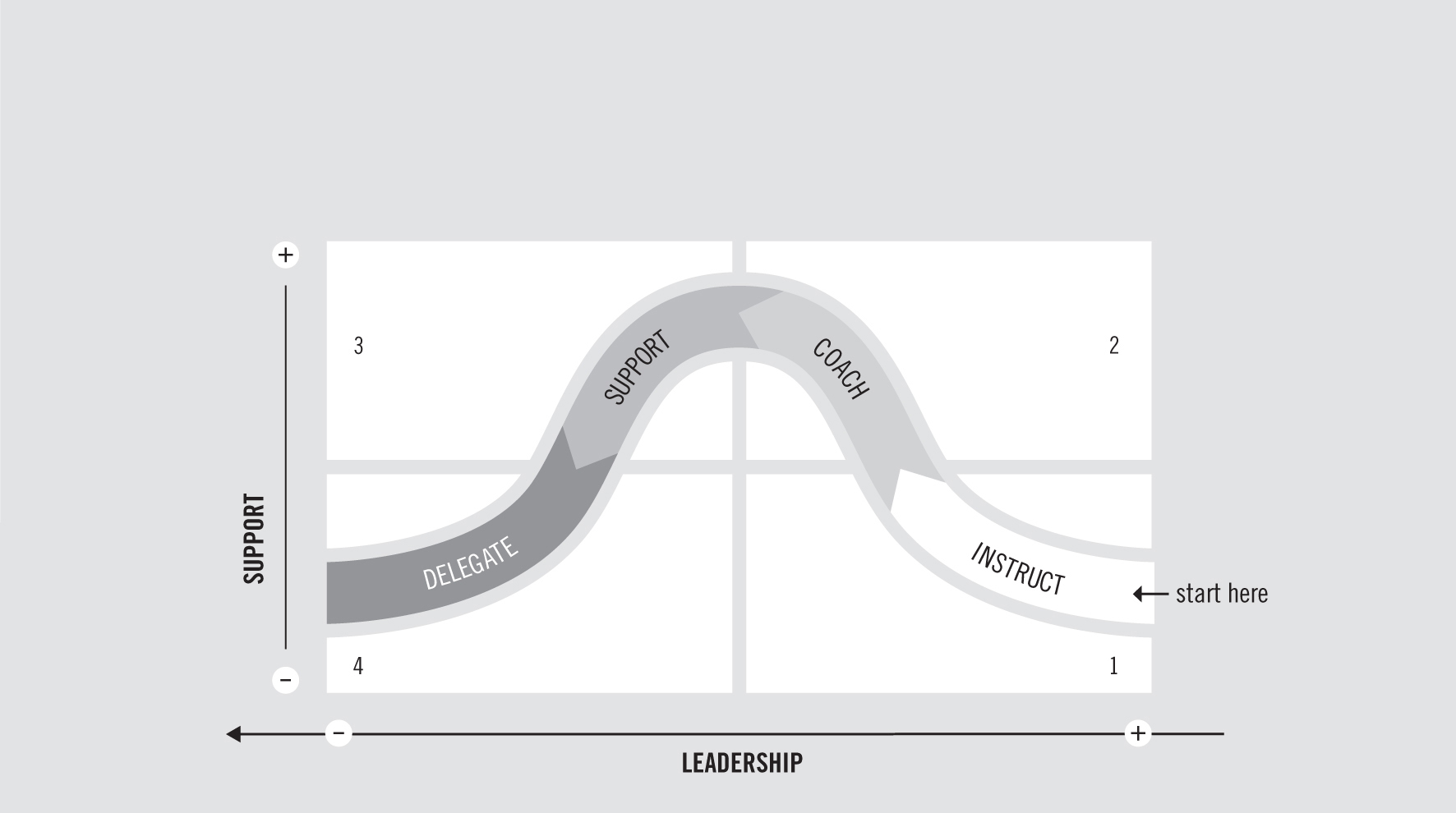
Read from right to left. The diagram presents a progression from instruction through coaching and support to delegation. The appropriate style depends on the employee’s needs for the task, rather than time served alone.
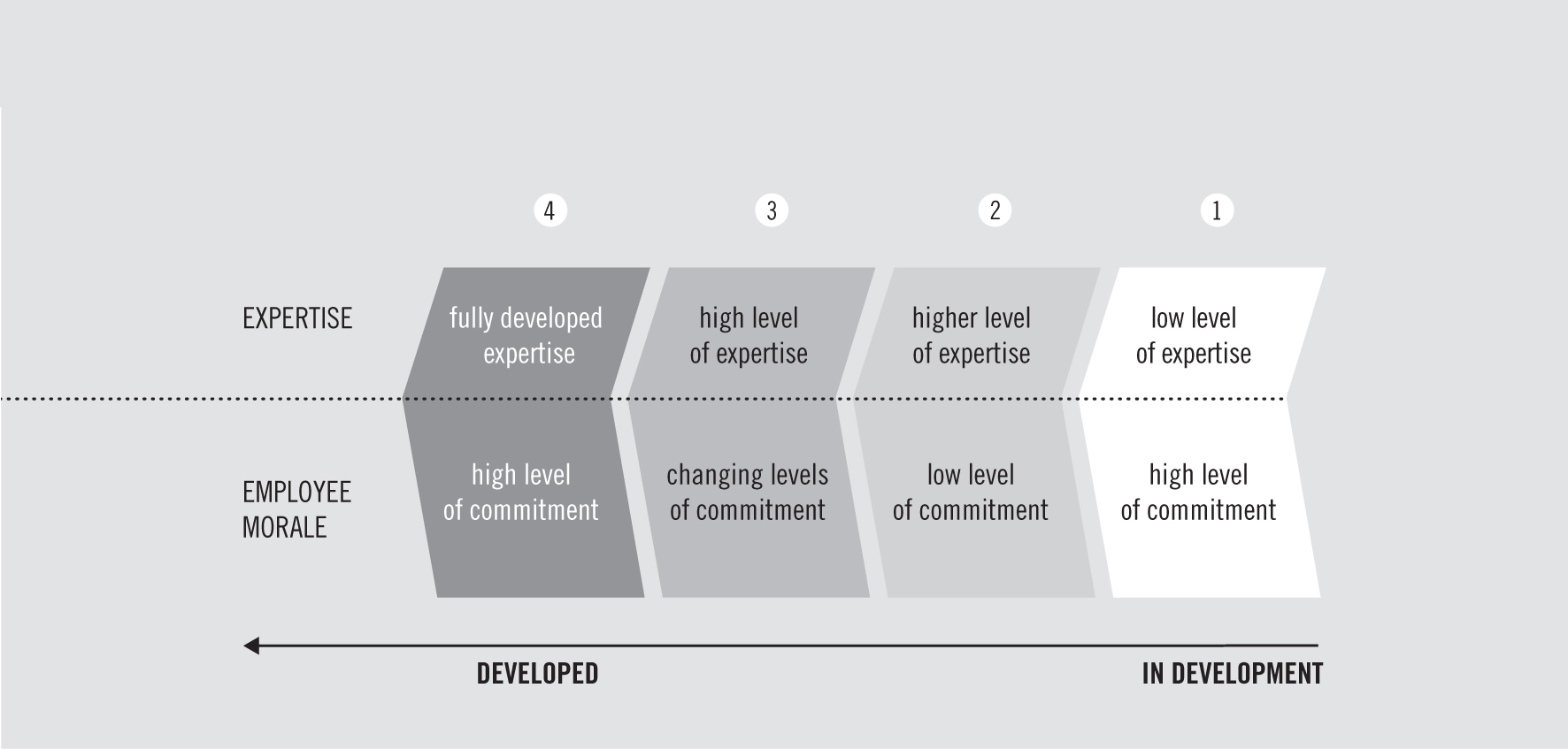
Read from right to left. Competence and commitment shown over time.
When to use it
Onboarding a team member: assess their experience with the task, provide needed instruction, and adjust support as their competence and commitment change.
Managing a team member who is experienced but demotivated: switch from delegating to a supporting or coaching style to re-engage them.
Leading a high-performing team of experts: apply delegating style, giving them autonomy and ownership of projects.
Dealing with a crisis or tight deadline: temporarily revert to instructing style to ensure quick, coordinated action.
FROM THEORY TO EVERYDAY LIFE
In practice
Instructing a New Hire
A new employee joining a company has high commitment but low competence. The manager provides clear instructions and closely supervises their work until they gain basic skills.
Coaching a Demotivated Team Member
After initial enthusiasm fades, an employee with rising competence experiences falling motivation. The manager shifts from giving orders to asking questions and helping them find their own solutions.
A MOMENT TO REFLECT
Put it to work.
Think of a direct report you currently manage. Which of the four leadership styles—instructing, coaching, supporting, or delegating—best fits their current competence and commitment level?
When have you seen a mismatch between a leader's style and an employee's maturity lead to poor performance? How could situational leadership have improved the outcome?
Consider a time you were managed well. Did your leader adapt their style as you grew more competent? How did that affect your motivation and development?
CONTINUE THE CONVERSATION
Source texts
- The Decision Book Fifty Models for Strategic Thinking