The Generation of Alternatives
Lateral thinking emphasizes generating as many different alternatives as possible, not just the best or most obvious one, to restructure patterns and provoke new insights.
THE IDEA
The generation of alternatives 7
The most basic principle of lateral thinking is that any particular way of looking at things is only one from among many other possible ways. Lateral thinking is concerned with exploring these other ways by restructuring and rearranging the information that is available. The very word ‘lateral’ suggests the movement sideways to generate alternative patterns instead of moving straight ahead with the development of one particular pattern. This is indicated in the diagrams below.
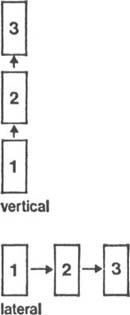
It may seem that the search for alternative ways of looking at something is a natural search. Many people feel that this is something that they always do. To some extent it is, but the lateral search for alternatives goes far beyond the natural search.
- In the natural search for alternatives one is looking for the best possible approach, in the lateral search for alternatives one is trying to produce as many alternatives as possible. One is not looking for the best approach but for as many different approaches as possible.
- In the natural search for alternatives one stops when one comes to a promising approach. In the lateral search for alternatives one acknowledges the promising approach and may return to it later but one goes on generating other alternatives.
- In the natural search for alternatives one considers only reasonable alternatives. In the lateral search for alternatives these do not have to be reasonable.
- The natural search for alternatives is more often an intention than a fact. The lateral search for alternatives is deliberate.
The main difference is the purpose behind the search for alternatives. The natural inclination is to search for alternatives in order to find the best one. In lateral thinking however the purpose of the search is to loosen up rigid patterns and to provoke new patterns. Several things may happen with this search for alternatives.
- One may generate a number of alternatives and then return to the original most obvious one.
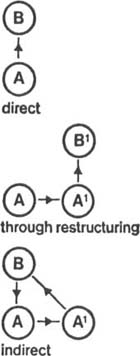
- A generated alternative might prove a useful starting point.
- A generated alternative might actually solve the problems without further effort.
- A generated alternative might serve to rearrange things so that the problem is solved indirectly.
- Even if the search for alternatives proves to be a waste of time in a particular case it helps develop the habit of looking for alternatives instead of blindly accepting the most obvious approach.
The search for alternatives in no way prevents one from using the most obvious approach. The search merely delays the use of the most probable approach. The search merely adds a list of alternatives to the most probable approach but detracts nothing from it. In fact the search adds to the value of the most probable approach; Instead of this approach being chosen because it seems the only one, it is chosen because it is obviously the best from among many other possibilities.
When to use it
When brainstorming creative solutions in a group setting, use this principle to avoid premature convergence on one idea.
During strategic planning, generate multiple alternative scenarios instead of just the most likely one to prepare for uncertainty.
In design thinking, generate varied concepts before selecting a few to prototype.
When stuck in a rut on a personal project, deliberately list alternative approaches that seem silly or counterintuitive to break out of fixed thinking.
FROM THEORY TO EVERYDAY LIFE
In practice
Brainstorming new features for a product
Instead of immediately selecting the most obvious feature improvement, a team uses lateral thinking to generate as many alternative feature ideas as possible, including wild or impractical ones, before evaluating them.
Solving a supply chain bottleneck
A logistics manager is tempted to simply increase inventory to fix a bottleneck. Using the generation of alternatives, they deliberately list other approaches: rerouting shipments, cross-training staff, changing suppliers, or even redesigning the packaging to reduce volume.
A MOMENT TO REFLECT
Put it to work.
In a current problem you're facing, what is the most obvious solution? Now list at least five completely different alternatives, no matter how unreasonable they seem.
Think of a time you stopped searching for alternatives because you found a promising approach. How might the outcome have changed if you had generated more alternatives first?
How can you deliberately force yourself to consider unreasonable alternatives in your next decision?
Often confused with
CONTINUE THE CONVERSATION
Source texts
- Lateral Thinking A Textbook of Creativity (Edward de Bono)