The Fragility Detection Rule
Fragile systems exhibit nonlinear harm: as the intensity of a shock increases, the damage grows more than proportionally. This asymmetry—where larger shocks cause disproportionately greater harm than smaller ones—provides a simple heuristic to identify fragility across domains.
THE IDEA
A SIMPLE RULE TO DETECT THE FRAGILE
A story present in the rabbinical literature (Midrash Tehillim), probably originating from earlier Near Eastern lore, says the following. A king, angry at his son, swore that he would crush him with a large stone. After he calmed down, he realized he was in trouble, as a king who breaks his oath is unfit to rule. His sage advisor came up with a solution. Have the stone cut into very small pebbles, and have the mischievous son pelted with them.
The difference between a thousand pebbles and a large stone of equivalent weight is a potent illustration of how fragility stems from nonlinear effects. Nonlinear? Once again, “nonlinear” means that the response is not straightforward and not a straight line, so if you double, say, the dose, you get a lot more or a lot less than double the effect—if I throw at someone’s head a ten-pound stone, it will cause more than twice the harm of a five-pound stone, more than five times the harm of a one-pound stone, etc. It is simple: if you draw a line on a graph, with harm on the vertical axis and the size of the stone on the horizontal axis, it will be curved, not a straight line. That is a refinement of asymmetry.
Now the very simple point, in fact, that allows for a detection of fragility:
For the fragile, shocks bring higher harm as their intensity increases (up to a certain level).
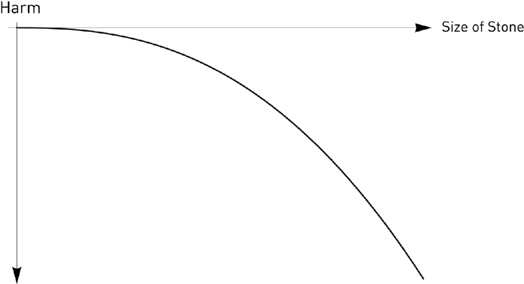
FIGURE 9. The King and His Son. The harm from the size of the stone as a function of the size of the stone (up to a point). Every additional weight of the stone harms more than the previous one. You see nonlinearity (the harm curves inward, with a steeper and steeper vertical slope).
Let us generalize. Your car is fragile. If you drive it into the wall at 50 miles per hour, it would cause more damage than if you drove it into the same wall ten times at 5 mph. The harm at 50 mph is more than ten times the harm at 5 mph.
Other examples. Drinking seven bottles of wine (Bordeaux) in one sitting, then purified water with lemon twist for the remaining six days is more harmful than drinking one bottle of wine a day for seven days (spread out in two glasses per meal). Every additional glass of wine harms you more than the preceding one, hence your system is fragile to alcoholic consumption. Letting a porcelain cup drop on the floor from a height of one foot (about thirty centimeters) is worse than twelve times the damage from a drop from a height of one inch (two and a half centimeters).
Jumping from a height of thirty feet (ten meters) brings more than ten times the harm of jumping from a height of three feet (one meter).
Note that this is a simple expansion of the foundational asymmetry we saw two chapters ago, as we used Seneca’s thinking as a pretext to talk about nonlinearity. Asymmetry is necessarily nonlinearity. More harm than benefits: simply, an increase in intensity brings more harm than a corresponding decrease offers benefits.
When to use it
Risk management in finance: evaluating whether a portfolio or asset is fragile by comparing small vs. large market drops.
Health and safety: examining how concentrating an exposure into a short period changes its risks, rather than assuming the same total dose causes the same harm.
Engineering and product design: stress-testing materials or components by applying increasing force and observing whether damage accelerates nonlinearly.
Personal productivity: determining if a work schedule that crams many tasks into a short period leads to burnout (nonlinear harm) versus spreading tasks evenly.
FROM THEORY TO EVERYDAY LIFE
In practice
Car Crash Damage
A collision at 50 mph carries far more kinetic energy than ten collisions at 5 mph in the same car. A tenfold increase in speed produces a hundredfold increase in kinetic energy. Actual damage also depends on how the car and wall absorb the impact.
Wine Consumption
Drinking seven bottles of wine in one sitting harms the body much more than drinking one bottle per day over seven days. Each additional glass in a binge causes increasingly severe effects due to the body's limited ability to process alcohol, illustrating fragility to concentrated doses.
A MOMENT TO REFLECT
Put it to work.
Identify a system or process in your life (e.g., sleep, exercise, work) where small changes are safe but large changes cause disproportionate harm. How does this show fragility?
Think of a decision you face that involves scaling up an activity. Can you use the rule of nonlinear harm to test whether the system is fragile? What would be the safe incremental approach?
Consider an investment or business strategy. If small losses are minor but large losses are catastrophic, what does that imply about fragility? How would you redesign the strategy to be more robust?
CONTINUE THE CONVERSATION
Source texts
- Antifragile (Nassim Nicholas Taleb)