The Flow Model
Flow is deep absorption in an activity. The model connects it with a demanding task matched to one’s abilities, a clear objective, and immediate feedback. It describes a particular experience rather than happiness in every form.
THE IDEA
THE FLOW MODEL
WHAT MAKES YOU HAPPY?
Over two thousand years ago, Aristotle came to the unsurprising conclusion that what a person wants above all is to be happy. The source dates this statement by psychologist Mihály Csíkszentmihályi to 1961; that date and attribution are not established here: “While happiness itself is sought for its own sake, every other goal – health, beauty, money or power – is valued only because we expect that it will make us happy.” Csíkszentmihályi looked for a term that described the state of feeling happy. He called it “flow.” But when are we “in the flow”?
The account connects interviews about absorption and satisfaction with five features. It describes “flow,” as occurring when we are:
• intensely focused on an activity
• of our own choosing, that is
• neither too easy nor overwhelmingly difficult, that has
• a clear objective, and that receives
• immediate feedback.
Csíkszentmihályi discovered that people who are “in the flow” not only feel a profound sense of satisfaction, they also lose track of time and forget themselves completely because they are so immersed in what they are doing. Musicians, athletes, actors, doctors and artists describe how they are happiest when they are absorbed in an often exhausting activity . Absorption in a demanding activity can be satisfying, just as relaxation can be.
What is preventing you from being happy?
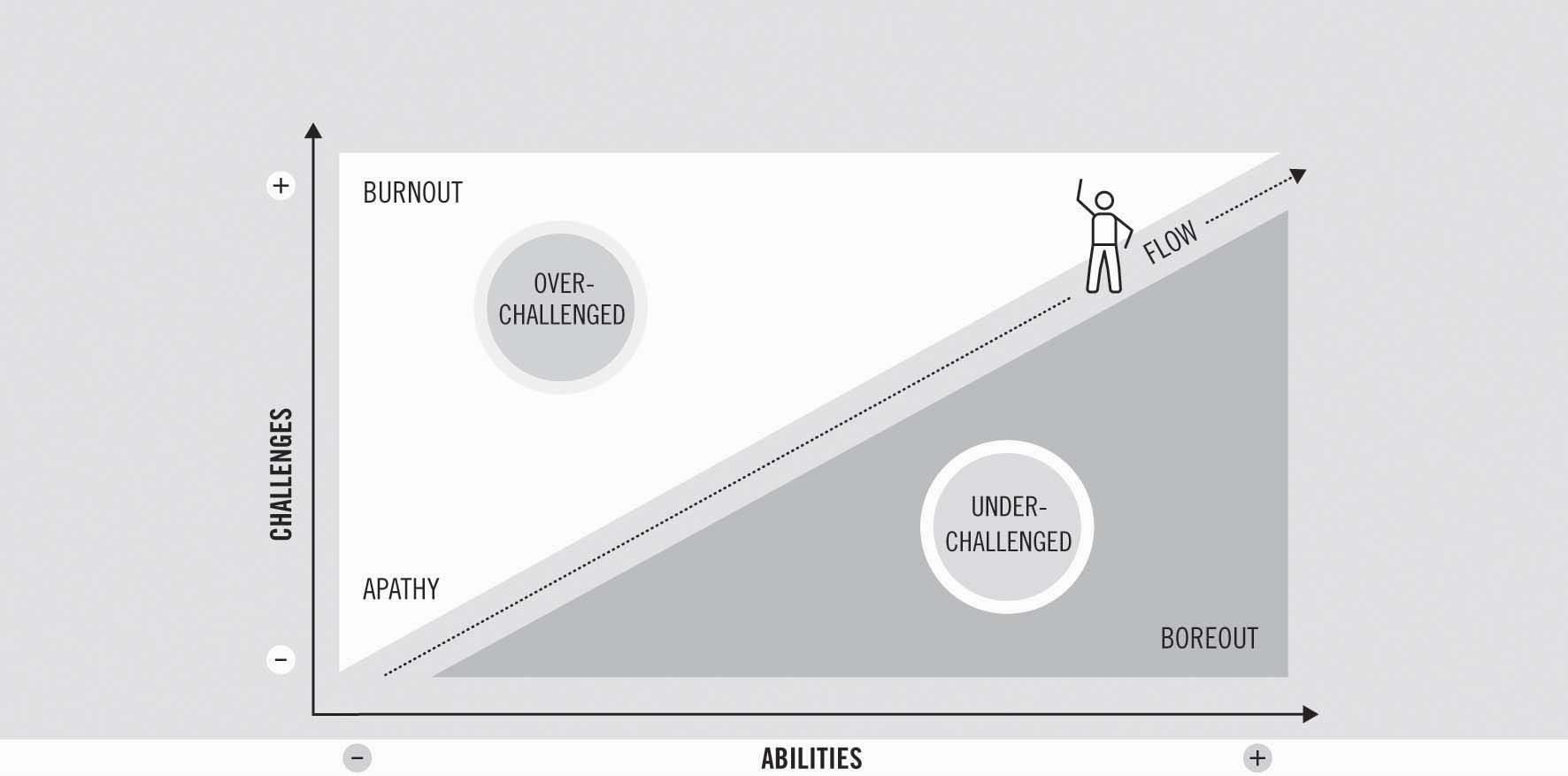
The model has two axes: the level of the challenge, and the level of your abilities. On the graph, write down the last three challenges you have faced, and how you felt about them.
When to use it
Designing a training program that matches employees' skills with appropriately challenging tasks to keep them engaged.
Creating video games with adaptive difficulty to keep players in the flow zone.
Planning personal projects to be challenging enough to avoid boredom but not so difficult as to cause anxiety.
Structuring educational curricula to provide clear objectives and immediate feedback for optimal learning.
FROM THEORY TO EVERYDAY LIFE
In practice
A programmer deep in code
A software developer works on a complex bug that is just within their skill level. They have a clear goal (fix the bug) and receive immediate feedback (the code compiles or fails). They lose track of time and feel deeply satisfied.
A musician playing a challenging piece
A pianist practices a new piece that stretches their abilities but is achievable. They concentrate intensely, receive instant auditory feedback, and experience a state of flow, forgetting their surroundings.
A MOMENT TO REFLECT
Put it to work.
Which activities absorb your attention, and what conditions help you become engaged in them?
Think of three recent challenges you faced. Plot them on the flow model: where do they fall relative to challenge and skill?
How can you adjust your daily activities to achieve more flow states?
Often confused with
References
- Beyond Boredom and Anxiety — Mihály Csíkszentmihályi (1961)
- Nicomachean Ethics — Aristotle (-350)
CONTINUE THE CONVERSATION
Source texts
- The Decision Book Fifty Models for Strategic Thinking