The Energy Model
The Energy Model asks how much attention you give to the past, present, and future. It can help you notice when regret or worry crowds out current action, while allowing room for reflection and planning.
THE IDEA
THE ENERGY MODEL
ARE YOU LIVING IN THE HERE AND NOW?
It is always said that we should live "in the here and now." But why? The Swiss author Pascal Mercier says this: "It is an error, a nonsensical act of violence, to concentrate on the here and now with the conviction of thus grasping the essential. What matters is to move surely and calmly, with the appropriate humor and the appropriate melancholy in the temporally and spatially internal landscape that we are."
Here is a nonjudgmental question: How much of your time do you spend thinking about the past, how much about the here and now, and how much about the future? Or to put it another way, how often do you think, wistfully or thankfully, about what has been? How often do you have the feeling that you are really concentrating on what you are doing at a particular moment? How often do you imagine what the future may hold, and how often do you worry about what lies ahead of you?
The authors use broad cultural analogies for the three orientations: memory-driven Europe, dream-driven USA as the “land of opportunity”, and reality-driven Asia. These are illustrative generalizations, not measurements of entire cultures.
You can’t change the past. But you can ruin the present by worrying about the future.
 See also: Crossroads model (p. 78)
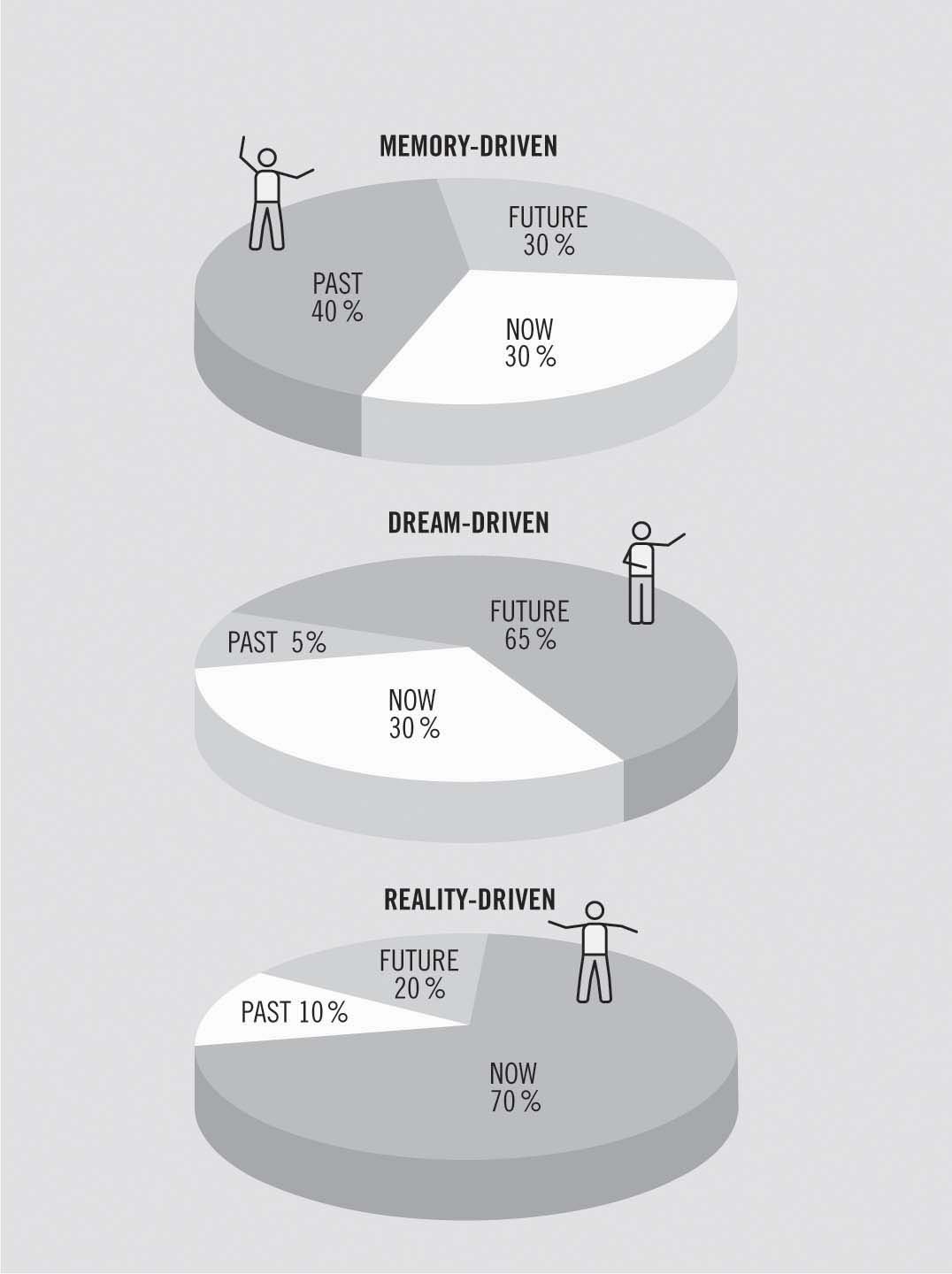
Fill in how much time you spend in the past, present and future.
When to use it
Identifying personal time orientation biases during therapy or coaching sessions.
Evaluating team culture and its focus on past achievements, present execution, or future innovation.
Improving decision-making by consciously reallocating attention from unchangeable past to actionable present.
Reducing anxiety by recognizing when future-oriented worry is overshadowing current enjoyment or effectiveness.
FROM THEORY TO EVERYDAY LIFE
In practice
Ruminating on Past Mistakes
A manager estimates that 80% of their attention goes to replaying a failed project decision. Keeping a brief record of these episodes helps them distinguish useful reflection from repetition that interrupts current work.
Future Anxiety and Productivity
An entrepreneur estimates that 90% of their thoughts concern next quarter’s revenue. They notice that repeatedly rehearsing the same worries takes time away from daily work and decide to separate a planning session from recurring rumination.
A MOMENT TO REFLECT
Put it to work.
How much of your time do you typically spend thinking about the past, present, and future? What would a balanced distribution look like for you?
In what situations does worrying about the future prevent you from taking productive action in the present?
How might shifting your mental energy from past regrets to present actions change your daily experience?
CONTINUE THE CONVERSATION
Source texts
- The Decision Book Fifty Models for Strategic Thinking