The Effects of Time Pressure on Self-Dispositional Inferences
People under time pressure or cognitive load often fail to correct their initial dispositional inferences about themselves, leading to biased self-judgments that ignore situational factors.
THE IDEA
Table 9.5. The Effects of Time Pressure on Inferences of One’s Own Dispositional Happiness
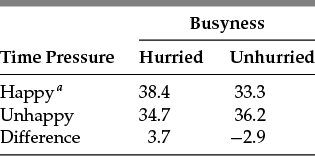
a The measure ranges from 10 to 50, and larger values indicate greater self-perceived dispositional happiness.
Source: Adapted from Gill, M. & Gilbert, D. T. (1999).
In the foregoing study, participants experienced a situation that altered their behavior, and either did or did not take that situation into account when drawing dispositional inferences about themselves. But situations do not always affect behavior per se; rather, they sometimes affect one’s interpretation of one’s behavior. For example, an English teacher may interpret his classroom performance as poor when he thinks about the teaching award that the drama coach just won, and he may go on to conclude that he has little talent for teaching. Conversely, he may interpret the same performance as outstanding when he thinks about the catcalls the math teacher received earlier that morning, and he may go on to conclude that he is indeed a natural communicator. In either case, the English teacher may need to remind himself that these colleagues teach different subjects than he does, and that they are therefore inappropriate standards for comparison.
We examined the possibility that people do indeed draw dispositional inferences about themselves from their own behaviors, and only subsequently consider the possibility that their interpretation of their action was inappropriately influenced by the behavior of another (Gilbert, Giesler, & Morris, 1995). In one study, participants expected to take a test of their “schizophrenia detection ability.” Before taking the test, they watched an instructional video in which a model took the same test. The model saw 18 pairs of photographs and was asked to guess which of the people in the photographs was schizophrenic. In the poor model condition, the model responded correctly on just 4 trials, and in the good model condition, the model responded correctly on 16 trials. In both instances, participants knew that the model’s performance was staged, and hence not a meaningful standard for comparison with their own. After viewing the instructional video, participants in the busy condition began rehearsing an eight-digit number, whereas participants in the non-busy condition did not. All participants then performed the schizophrenia-detection task themselves and were given bogus feedback indicating that they had responded correctly on 10 of the 18 trials. Participants then rated their competence at the task. As Table 9.6 shows, only busy participants were affected by the model’s performance. Apparently, all participants believed they performed poorly or well and inferred their abilities from their own performances (“I suck at this”), but non-busy participants then went on to correct those inferences (“Now that I think about it, the model’s performance was meaningless, and hence I really didn’t do that badly after all”).
When to use it
Performance reviews under time pressure
Immediate self-assessment after a speech or presentation
Making judgments about own abilities while multitasking
Evaluating personal performance in competitive environments
FROM THEORY TO EVERYDAY LIFE
In practice
English Teacher's Self-Evaluation
An English teacher may interpret his classroom performance as poor when thinking about a teaching award a drama coach won, or as outstanding when thinking about catcalls the math teacher received. He may need to remind himself that these colleagues teach different subjects, making them inappropriate standards for comparison.
Schizophrenia Detection Task
Participants watched a model perform poorly (4 correct) or well (16 correct) on a detection task. Under cognitive load (rehearsing an 8-digit number), participants rated their own competence based on the model's performance, failing to adjust for the fact that the model's performance was staged. Non-busy participants corrected for this.
A MOMENT TO REFLECT
Put it to work.
How might cognitive load affect your self-evaluations in high-pressure work situations?
Can you think of a time when you made a dispositional inference about yourself without considering situational factors? What was the outcome?
How can you become more aware of when you are under cognitive load and thus more susceptible to biased self-judgments?
References
- Gill, M. & Gilbert, D. T. (1999). — Gill, M. & Gilbert, D. T. (1999)
- Gilbert, D. T., Giesler, R. B., & Morris, K. A. (1995). — Gilbert, D. T., Giesler, R. B., & Morris, K. A. (1995)
CONTINUE THE CONVERSATION
Source texts
- Heuristics and Biases The Psychology of Intuitive Judgment (Thomas Gilovich, Dale Griffin, Daniel Kahneman)