The Effect of Random Stimulation
In de Bono’s model, holding a problem and an unrelated input in attention encourages connections between them. A random word or image can suggest an analogy, a new starting point, or a different arrangement of familiar ideas.
THE IDEA
The effect of random stimulation
Why should random stimulation have any effect? Why should a totally unrelated piece of information help to bring about the restructuring of an established pattern?
De Bono explains random stimulation through his model of the mind as a self-maximizing memory system. In such a system there is a limited and coherent attention span. This means that any two inputs cannot remain separate no matter how unconnected they are. Normally if there were two unconnected inputs one of them would be ignored and the other one would be attended to. But if both are deliberately held in attention (by deliberately arranging the setting) then a connection will eventually form between the two. At first there may be a rapid alternation of attention between the two items but soon the short term memory effect will establish some sort of link.
In this type of system nothing can be truly irrelevant.
The established patterns on the memory surface are stable patterns. That does not mean that they do not change but that the pattern of change is stable. The flow of thought is stable. This equilibrium state is altered by the sudden inclusion of some new information.
Sometimes the new equilibrium state is very similar to the old one with a slight alteration to include the new information. At other times a complete restructuring comes about. There is a game in which plastic discs are placed within a frame one side of which is being forced inward by a spring. The pressure of this spring forces the plastic discs together to give a stable structure. Each player in turn removes a plastic disc. Usually the pattern shifts slightly to achieve a new equilibrium state. But sometimes there is a big change and the whole pattern is restructured. With a random input one is putting something in instead of taking it out but the shift in equilibrium occurs in the same way.
Random stimulation can work in two other ways. The random input can bring about a new entry point to the problem under consideration. The diagram below suggests a situation and the natural way this situation would develop. A random input is then added and a connection develops between the situation and the random input. As a result a new entry point is provided and the line of development of the original situation may be altered.
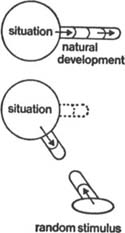
A random input can also work as an analogy. A single word from a dictionary provides a situation which has its own line of development. When this is related to the development of the problem being considered the resulting analogy can suggest a different approach.
When to use it
During a brainstorming session, introduce a random word or image to generate new connections and ideas.
When stuck on a design problem, randomly select a feature from another domain (e.g., nature, architecture) and force a link to your problem.
In education, use random stimuli to help students see connections between seemingly unrelated subjects.
FROM THEORY TO EVERYDAY LIFE
In practice
Plastic Disc Game
In a game where plastic discs are compressed by a spring, removing one disc causes a shift in equilibrium. Sometimes the pattern shifts slightly, other times it restructures completely. Similarly, random stimulation can cause a complete restructuring of thought patterns.
Random Word as Analogy
When stuck on a problem, choosing a random word from a dictionary and forcing a connection can provide an analogy that leads to a new solution. For example, using the word 'umbrella' to think about protection vs. coverage in a business strategy.
A MOMENT TO REFLECT
Put it to work.
Think of a current problem you are facing. What random element (a word, an image, a sound) could you introduce to break your current thinking pattern?
Describe a time when an unrelated piece of information unexpectedly helped you solve a problem. Why do you think it worked?
How can you deliberately structure your environment to include random inputs that might lead to creative breakthroughs?
CONTINUE THE CONVERSATION
Source texts
- Lateral Thinking A Textbook of Creativity (Edward de Bono)