The dark side of leverage
Leverage, when used unrestrainedly and systematically, can become a form of tyranny. The historical example of West Virginia coal company towns illustrates how economic leverage can be parlayed into total control over workers' lives and the state.
THE IDEA
The dark side of leverage
Leverage can improve your position, but using every advantage to its limit can create dependence and coercion.
When leverage becomes entrenched systematically it becomes more like the application of tyranny. This has happened more than a few times in history, including the 20th-century coal company towns in West Virginia.
When technological development allowed coal to be easily transported out of the West Virginia hills, coal operators bought up extensive land in the state. Coal became the most significant economic resource in the state by far. Coal operations required workers, and these miners lived in company towns. With no other industries or big cities nearby to offer alternatives, coal operators used their initial leverage to give themselves an exceptional amount of control over both the lives of their workers and the state in which the companies operated.
The company towns were effectively isolated from the rules and norms that prevailed in the rest of the country. Inhabitants did not own their houses or the land they were built on and could be kicked out with no notice. Workers were paid in “coal scrip,” a proprietary currency unique to each operation that could only be spent in the company store. There was no mayor or local political officials to represent the residents. Information was controlled. Any media the company didn’t approve of was banned, and the postmaster, a company employee, could read all incoming and outgoing mail.13
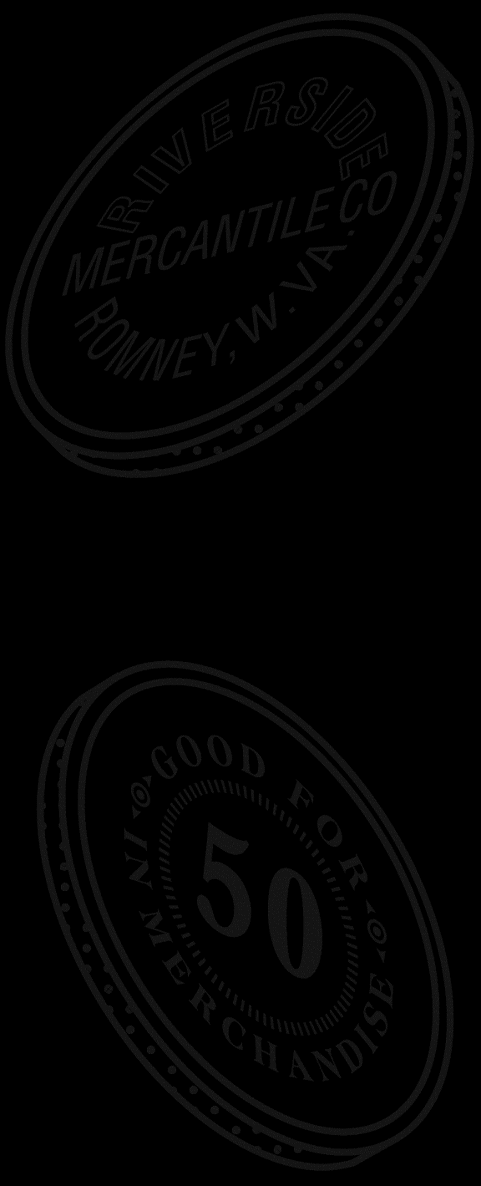
Coal scrip wages could only be spent in the company store, with each store being unique to each mining operation.
The issue of coal scrip in particular was a significant point of leverage. As David Corbin explains in Life, Work, and Rebellion in the Coal Fields, not only did it require that workers buy all their goods from the company store, but it allowed the coal operators to completely control the value of the work being performed. Wages were essentially recouped depending on the needs of the company, because the company store, being a monopoly, could charge whatever it wanted. In this way too any wage increases were immediately negated by corresponding price increases in the store.14
The control exercised by a company operator over the town inhabitants gave the company access to further points of leverage. Ballots for state elections were inspected by mine guards, so miners effectively had to vote for the interest of the company, and coal companies controlled county court and jury appointments. This leverage was used to exploit loopholes in safety, child labor, compensation, and even criminal laws, or even to disregard the laws altogether. In 1913,
a U.S. congressman from Wisconsin toured the coal fields of West Virginia and reported that “one cannot imagine the power of the mining companies. … It elects senators and judges. It owns both the Republican and Democratic parties in the state. All laws are made to suit the mine owners. All the judges are elected through their influence, even up to the judges of the Supreme Court.”15
How can one act against this kind of exceptional leverage? Often it’s only through widespread collective action that aggregates small amounts of power until enough is pooled so that there exists counter-leverage. Think strikes and unions. One person walking out on the job may not change much, but if everyone does, significantly more leverage is available to be exercised. Eventually, after brutal labor disputes, the miners of West Virginia formed and participated in unions.
Before that, however, individuals still had some basic degree of leverage. Some could move elsewhere, though relocation was not a feasible option for every worker or family. And many coal workers and their families supplemented their coal scrip income through cash from farming, gardening, and selling homemade alcohol, which gave them a small measure of independence from the coal companies. These sources of income offered limited alternatives to dependence on a single employer; collective action provided a different way to contest that power.
When to use it
A business owner who controls the only grocery store in a remote town might be tempted to inflate prices, but doing so could lead to community boycott or unionization.
A manager who wields hiring power to coerce employees into unfavorable conditions may face collective action or high turnover.
An industry body that lobbies to create regulations benefiting themselves at the expense of new entrants could face antitrust actions or public backlash.
FROM THEORY TO EVERYDAY LIFE
In practice
Coal Company Leverage in West Virginia
In the early 20th century, coal operators bought up land, created company towns, paid workers in scrip only usable at company stores, controlled mail and media, and even influenced elections and courts. This total leverage oppressed workers until they formed unions and used individual acts of resistance like farming and mobility to gain some counter-leverage.
A MOMENT TO REFLECT
Put it to work.
When have you been in a position of leverage and how did you use it? Could using it to the fullest extent have turned into tyranny?
How can you recognize when leverage is being used tyrannically in your workplace or community? What forms of counter-leverage exist?
In what ways can small acts of resistance accumulate to create significant counter-leverage against oppressive systems?
References
- Source on coal company towns and control — Unknown
- Life, Work, and Rebellion in the Coal Fields — David Corbin
- Report of U.S. Congressman from Wisconsin on West Virginia Coal Fields (1913) — Unknown U.S. Congressman (1913)
CONTINUE THE CONVERSATION
Source texts
- The Great Mental Models Volume 2 Physics, Chemistry and Biology