The Dao of Complexity
The legend of Gun’s failed dams and Yu’s irrigation canals illustrates an approach to complexity: work with a system’s existing flows and context. The authors use the story to contrast rigid control with constraints that allow adaptation.
THE IDEA
The Dao of Complexity
A Chinese legend set around 2000 BC depicts two lords attempting to tame the waters of the Yellow River. Archaeological evidence indicates that during this time, floods plagued the Chinese heartland through which the Yellow River runs. Floods prevented economic and social development. (2) At the time, the emperor assigned an official, Gun, to devise a system for controlling the floods. Gun spent a decade constructing an elaborate system of dams along the river. Gun’s approach was described as Confucian, emphasizing control, governance and order. However, all the barriers failed as the current of the Yellow River refused to be controlled.
Gun’s son, Yu the Great, was assigned to take over the task when he became an adult and adopted a markedly different approach. Instead of dams which seek to control the flow of water by applying a rigid boundary, Yu decided to “follow the water as his master... and followed the way of the water.” (3) He worked with agriculture masters, slept, and ate with common folk and sought to understand the context and landscape. Yu worked with them to construct an intricate system of irrigation canals. This system consisted of many dikes that ran parallel to the Yellow River and relieved flood water into agricultural fields. The overflow fed rice paddies and aquaculture. Working with the natural energy of the river’s current, he solved a flooding problem and created a surplus!
Yu’s approach echoes the naturalism of Daoism. A softer and more organic complex adaptive approach: meeting the system where it was, he followed the energy instead of seeking to control its flow. This system of irrigation can still be found across the world, spanning regions from the Yellow River to the Mekong, to the Nile.
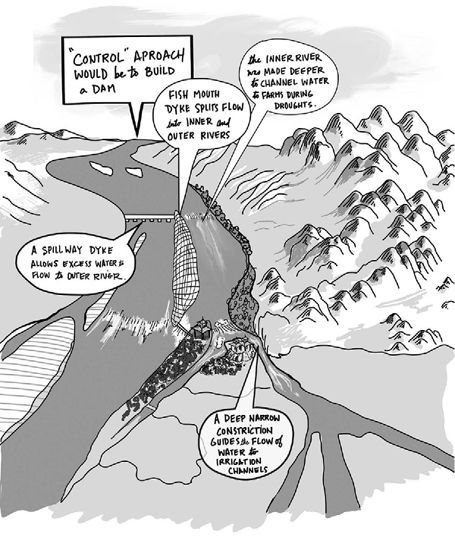
Figure 2. Dujiangyan Irrigation System. An illustration of the aerial view of the irrigation system, and the agricultural fields it feeds into together with pressure relieving river inlets. The oldest and only surviving no-dam irrigation system in the world. The irrigation system drains off floodwater, irrigates farms and provides water to more than 50 cities in the Sichuan province. This irrigation system was built for the Ming Jiang, by Li Bing in 3rd Century BC. Li has been compared to Yu the Great as he is seen to have followed in his approach of following the water. The Daoist style of irrigation canals, and enabling flow has allowed the system to evolve with new challenges, maintaining a similar pattern of flow channels since its initial build in 300 BC.
The contrast between the approaches taken by Gun (control and govern through rigid constraints that prevent flow) and Yu (modulate through permeable boundaries that encourage flow) represent interesting parallels for the Complicated and Clear (Ordered) and Complex domains, respectively.
When to use it
Managing a team with diverse skills and unpredictable work: instead of rigid schedules and strict rules, create flexible processes that adapt to changing circumstances.
Designing urban infrastructure to handle climate change: rather than building higher flood walls, create green spaces and permeable surfaces that absorb excess water.
Software development: instead of strict waterfall planning, use agile methodologies that iterate and adapt based on feedback.
Personal development: rather than forcing yourself into a rigid routine, find a rhythm that aligns with your natural energy and context.
FROM THEORY TO EVERYDAY LIFE
In practice
Gun's Dams vs Yu's Canals
In the legend, Gun’s barriers fail to contain the Yellow River. Yu works with local people to divert floodwater through irrigation channels, supplying farmland as well as relieving floods. The authors use the contrast as an analogy for adapting constraints to a system.
Dujiangyan Irrigation System
Built in the 3rd century BC by Li Bing, this no-dam irrigation system for the Ming Jiang used a Daoist approach of permeable channels that evolved with new challenges, still functioning today after over 2,300 years.
A MOMENT TO REFLECT
Put it to work.
In what areas of your life or work are you building dams (rigid constraints) when you should be building irrigation canals (adaptive structures)?
How can you identify whether a system is ordered (complicated/clear) or complex, and adjust your approach accordingly?
What would it look like to 'follow the water' in a current challenge you're facing?
CONTINUE THE CONVERSATION
Source texts
- Cynefin - Weaving Sense-Making into the Fabric of Our World ED02 (Dave Snowden Sonja Blignaut Zhen Goh)