The Conflict Resolution Model
This model distinguishes six responses to conflict: flight, fight, giving up, delegating the decision, compromise, and jointly developing a solution. It invites the parties to consider which response they are using and what alternatives remain.
THE IDEA
The Conflict Resolution Model
How to Resolve a Conflict Elegantly
The model distinguishes six ways of responding to conflict: escape, fight, give up, evade responsibility, compromise or reach a consensus.
-
Flight. Escaping is the same as avoiding. The conflict is not dealt with, and the situation remains the same. It can be assumed that neither side will gain anything. This is a lose–lose situation.
-
Fight. Those who deal with a conflict aggressively have only one aim: to win. But winning alone is not enough, as somebody also has to lose. This approach is about conquering the opponent, and asserting one’s own position in the face of resistance from others. The result is a win–lose situation.
-
Give up. Those who give up their own position in a conflict solve it by retreating, i.e., they lose. The result is a lose–win situation.
-
Evade responsibility. Those who feel overwhelmed by a conflict often delegate the decision – and thus also the confrontation – to another authority, usually a higher one. This authority solves the conflict for them, but not necessarily wisely, and not necessarily in the delegator’s interest. There is a risk that the parties on both sides of the conflict will lose (lose–lose situation).
-
Compromise. Depending on how it is perceived, a compromise is a solution acceptable to both parties. It is often felt that although the solution isn’t ideal, it is reasonable in the circumstances (win–lose/win–lose).
-
Reach a consensus. Here, consensus means developing a new solution together that addresses both parties’ underlying concerns. The model calls this a win–win outcome: a jointly developed “third way” rather than simply dividing the difference.
Our failures are due not to the defeats we suffer but to the conflicts we don’t participate in. Graffiti on a youth center in Bern, Switzerland
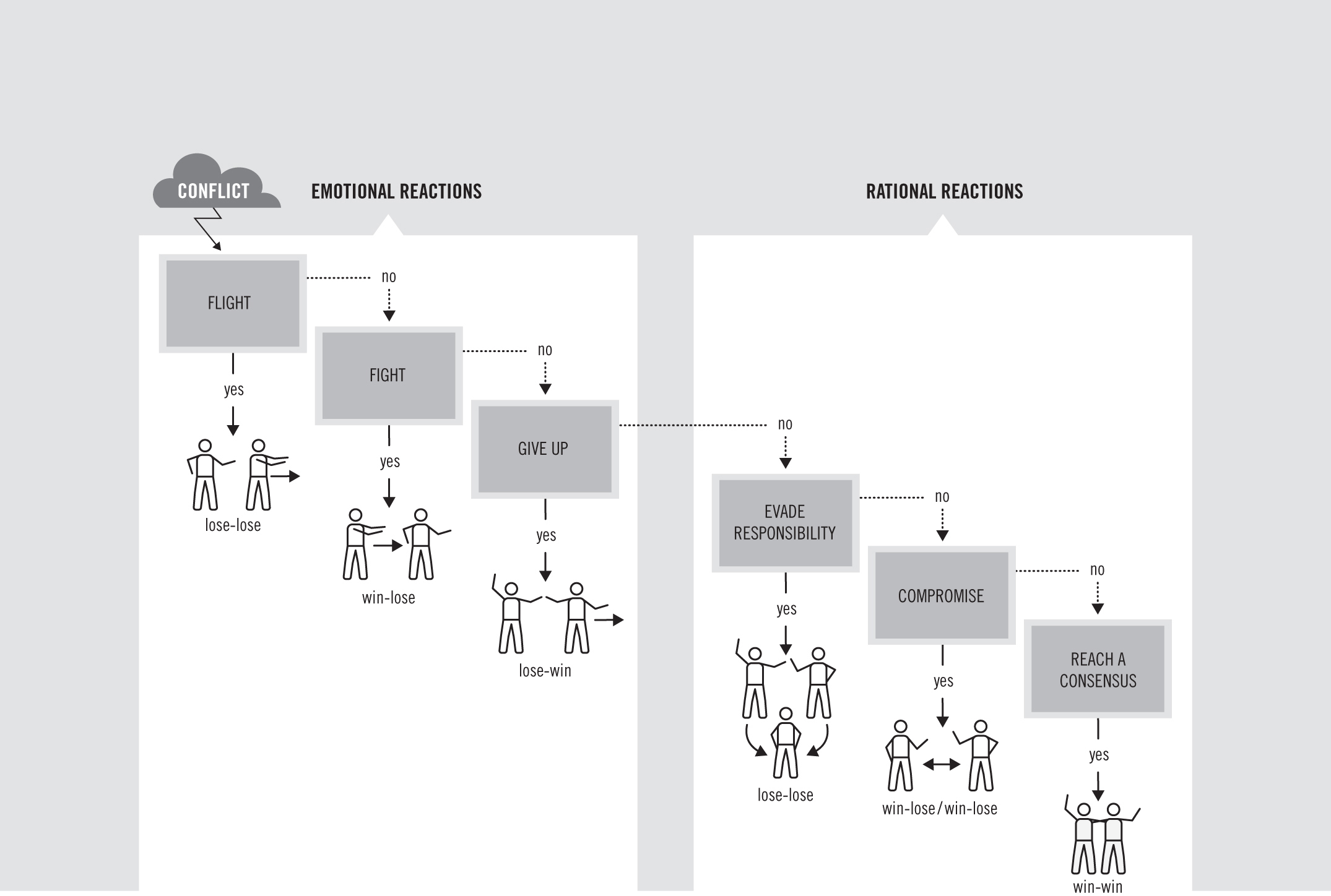
This model shows the six typical reactions to a conflict. What conflict type are you? What type is your adversary?
When to use it
Resolving interpersonal disputes in a team or organization by analyzing the current conflict strategy and aiming for consensus.
Mediating a disagreement between two parties, helping them see options beyond compromise or avoidance.
Self-reflection on personal conflict patterns to improve relationships and outcomes.
Training managers or leaders in conflict resolution techniques to foster healthier group dynamics.
FROM THEORY TO EVERYDAY LIFE
In practice
Team Disagreement on Project Direction
Two team members disagree on a technical approach. One might impose a choice, one might concede, or both might accept a compromise. They could also examine the concerns behind their preferred approaches and design another option together.
Conflict Between Roommates
Roommates argue about household chores. Flight would be ignoring the issue, leading to growing resentment. Fight would be aggressive demands. Evading responsibility could involve asking a landlord to decide. Compromise might mean splitting chores equally even if one person hates certain tasks. Consensus would be designing a fair system that both agree on, such as alternating tasks based on preferences.
A MOMENT TO REFLECT
Put it to work.
Think of a recent conflict you were involved in. Which of the six strategies did you use? Was it effective?
If you often use flight or fight, what would change if you aimed for consensus instead?
How can you encourage an adversary to move from a competitive stance to a collaborative one?
CONTINUE THE CONVERSATION
Source texts
- The Decision Book Fifty Models for Strategic Thinking