The Company of Man
The Company of Man uses business equity as a metaphor for how choices affect dating prospects, then applies SWOT analysis to personal goals. The metaphor can organize questions about effort and context, but its gender rankings and value curves are assumptions rather than measures of a person’s worth.
THE IDEA
The Company of Man
The account imagines a man’s life as a company whose equity changes through choices and effort. It claims that men build dating value over time while women begin with maximum value. This is a premise of the analogy, not a result established by the metaphor. It also shifts between a person’s worth, their achievements, and their appeal to potential partners—different things that cannot simply be placed on one balance sheet.
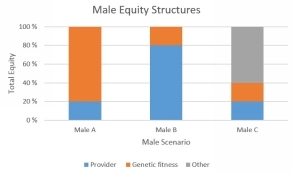

The useful question is how a chosen activity serves a particular goal in a particular setting. The account calls effort the "how", social calibration the "what", and increased dating opportunities the "why". Financial skill, athletic ability, and artistic interests may be appreciated differently in different communities. That does not imply that an interest has value only when it attracts a partner.
Graph 7 proposes different profiles: Male A emphasizes physical attributes, Male B emphasizes provision, and Male C emphasizes other pursuits. The account labels the first profiles Alpha and Beta. These are categories within its model, not evidence that people fall into fixed types or that the profiles predict an individual relationship.
Adding, subtracting, and sustaining equity
In the analogy, a man adds equity by developing traits that other people appreciate. The source uses teenage athletes and artists as examples of people whose interests can bring social attention. Such attention depends on the setting and on the people involved; it is not a universal return on a specified amount of effort.
The account contrasts a football captain with a mathematics captain and calls the latter’s effort a negative dating investment. At most, this illustrates an assumed difference in popularity in one social setting. It does not establish that mathematics lacks social value, that every prospective partner prefers an athlete, or that time spent on mathematics is wasted. The later possibility of a career in finance also does not supply a single scale that measures both activities.
To sustain equity, the source argues, a man must maintain valued traits and respond to changing expectations. It invokes Sean Connery and Jack Nicholson as examples of enduring appeal. Those celebrity examples do not establish a general relationship between age and attraction.
The account also assumes women favor the top 20% of men and that dating value follows a bell curve. Neither assumption is demonstrated here. Its numerical example supposes one man has a rating of six while nearby men have ratings of 7 or higher. This can illustrate a change in relative ranking under the assumed scale; it does not establish how attraction is measured or how people choose partners. Maintaining a skill and keeping a rank are different goals.
Being yourself and choosing goals
The account rejects "Just be yourself" when it means pursuing enjoyable activities without considering their consequences. It then limits "just be yourself" to men it calls natural or accidental alphas. This framing assumes that dating success is the goal against which every activity should be judged.
There is a more useful question behind the slogan "Just be yourself": which goals are yours, and what changes would help you pursue them? Being honest about your preferences can coexist with learning social skills, changing an unhelpful habit, or accepting that a particular attraction is not mutual. Enjoyment and self-development need not conflict.
SWOT analysis
SWOT separates strengths, weaknesses, opportunities, and threats. Strengths and weaknesses concern resources, skills, and limitations within the person or organization. Opportunities and threats concern the external setting. The framework helps connect a goal to actions; it does not provide an objective score of personal worth.
Start with a specific goal. Improving conversation, meeting people with shared interests, or deciding whether a relationship fits your priorities requires different information. Past attempts can reveal what helped, what failed, and what remains uncertain. Defining success only by a count of partners would conceal other goals, such as mutual interest or a stable relationship.

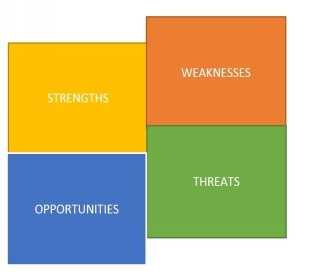
You can use SWOT before choosing a goal or while planning how to pursue one. A whole-life assessment may identify broad priorities, while a narrower assessment usually makes the next step easier to specify.
Strengths
List capabilities and resources relevant to the goal: experience, friendships, time, skills, or access to help. The account notes that money can buy specialist coaching. Access to coaching is a resource, but neither money nor a coach guarantees the desired outcome. Ask how a strength can be used in the situation at hand.
Weaknesses
Identify limitations that hinder the goal and distinguish those you can change from those you need to accommodate. Difficulty starting conversations, an unrealistic schedule, or a habit of postponing action calls for a more specific response than a general promise to improve.
The source calls people who remain fixated on an unavailable romantic prospect "orbiters". The practical issue is unreciprocated interest and the cost of waiting indefinitely. Time spent hoping does not create an obligation for the other person. Clarifying interest and accepting a refusal may reveal that the original goal needs to change.
Opportunities
Look for external openings relevant to your interests and goals. A local public-speaking club may offer practice; a cooking class may provide a setting for meeting people with a shared interest. A knowledgeable friend may be willing to help with a new activity. These are opportunities to participate and learn, not assurances of romantic attention.
Threats
Identify external circumstances that could obstruct the goal. A schedule change might prevent attendance at a club; a setting might make an unwanted habit harder to avoid. A weakness can make a threat more consequential, but the categories are not interchangeable.
In dating, another person’s lack of interest or a mismatch in goals may mean that a hoped-for relationship will not happen. Treating another potential partner as an enemy does not change that person’s choice. A useful plan recognizes what is within your control and when to move on.
When to use it
Turning a broad self-improvement goal into a specific action using a SWOT assessment.
A man in his 30s can examine whether financial goals serve his own priorities, rather than treating income as a guaranteed route to attraction.
Choosing a social activity that fits one’s interests and provides opportunities to meet people.
Recognizing when fixation on an unreciprocated attraction is crowding out other relationships and goals.
FROM THEORY TO EVERYDAY LIFE
In practice
Math team vs football team
The account assumes a football captain receives more dating interest than a mathematics captain in a particular setting. This illustrates a possible difference in local popularity, not a general measure of either person’s worth or the value of their interests.
Sustaining equity: Sean Connery and Jack Nicholson
The account cites Sean Connery and Jack Nicholson as celebrities whose appeal continued as they aged. Their examples illustrate its maintenance metaphor but do not establish a general dating-value curve.
A MOMENT TO REFLECT
Put it to work.
Choose a personal goal. Which strengths, weaknesses, opportunities, and threats matter to it?
Which parts of your assessment concern your own habits and resources, and which concern the external setting?
Do your current activities serve goals you chose, or are you judging them mainly by the approval you hope to receive?
Often confused with
CONTINUE THE CONVERSATION
Source texts
- Rolf Dobelli - The Art of Thinking Clearly-Harper Paperbacks (2014)