The Cleanest Man in School: On Considering Multiple Hypotheses
The same observation can fit explanations you have not considered. Ellenberg’s friend appeared to wear one dirty T-shirt every day but was using a fresh shirt from a box of identical stock. His discussion of design arguments extends the lesson: an inference depends on which hypotheses you include and what probabilities you assign them.
THE IDEA
THE CAT IN THE HAT, THE CLEANEST MAN IN SCHOOL, AND THE CREATION OF THE UNIVERSE
When I was in college, I had a friend with entrepreneurial habits who had the idea of making a little extra money at the beginning of the school year by selling T-shirts to first-year students. At that time you could buy a large lot of T-shirts from the screen-printing shop for about four dollars each, while the going rate on campus was ten bucks. It was the early 1990s, and it was fashionable to go to parties wearing a hat modeled after the one worn by the Cat in the Hat.* So my friend got together eight hundred dollars and printed up two hundred shirts with a picture of the Cat in the Hat drinking a mug of beer. These shirts sold fast.
My friend was entrepreneurial, but not that entrepreneurial. In fact, he was kind of lazy. And once he’d sold eighty shirts, making back his initial investment, he started to lose his desire to hang out on the quad all day making sales. So the box of shirts went under his bed.
A week later, laundry day came around. My friend, as I mentioned, was lazy. He really didn’t feel like washing his clothes. And then he remembered that he had a box of clean, brand-new beer-swigging-Cat-in-the-Hat T-shirts under his bed. So that solved the problem of laundry day.
As it turned out, it also solved the problem of the day after laundry day.
And so on.
So here was the irony. Everyone around thought my friend was the dirtiest man in school, because he wore the same T-shirt every single day. But in fact, he was the cleanest man in school, dressed every day in a new-from-the-store, never-worn shirt!
The lesson about inference: you have to be careful about the universe of theories you consider. Just as there may be more than one solution to a quadratic equation, there may be multiple theories that give rise to the same observation, and if we don’t consider them all, our inferences may lead us badly astray.
The same problem arises in arguments about the Creator of the Universe.
The most famous argument in favor of a God-made world is the so-called argument by design, which, in its simplest form, simply says, holy cow, just look around you—everything is so complex and amazing, and you think it just glommed together that way by dumb luck and physical law?
Or, phrased more formally, by the liberal theologian William Paley, in his 1802 book Natural Theology; or, Evidences of the Existence and Attributes of the Deity, Collected from the Appearances of Nature:
In crossing a heath, suppose I pitched my foot against a stone, and were asked how the stone came to be there: I might possibly answer that, for any thing I knew to the contrary, it had lain there for ever; nor would it perhaps be very easy to shew the absurdity of this answer. But suppose I had found a watch upon the ground, and it should be inquired how the watch happened to be in that place; I should hardly think of the answer which I had before given,—that, for any thing I knew, the watch might have always been there. . . . The inference, we think, is inevitable, that the watch must have had a maker: that there must have existed, at some time, and at some place or other, an artificer or artificers who formed it for the purpose which we find it actually to answer: who comprehended its construction, and designed its use.
If this is true of a watch, how much more so of a sparrow, or a human eye, or a human brain?
Paley’s book was a tremendous success, going through fifteen editions in fifteen years. Darwin read it closely in college, later saying, “I do not think I hardly ever admired a book more than Paley’s Natural Theology: I could almost formerly have said it by heart.” And updated forms of Paley’s argument form the backbone of the modern intelligent design movement.
It is, of course, a classic reductio ad unlikely:
- If there’s no God, it would be unlikely for things as complex as human beings to have developed;
- Humans have developed;
- Therefore, it’s unlikely there’s no God.
This is much like the argument that the Bible coders used; if God didn’t write the Torah, it’s unlikely that the text on the scroll would so faithfully record the birthdays of the rebbes!
Reductio ad unlikely doesn’t always work. If we really mean to compute in numerical terms how confident we should be that God created the universe, we’d better draw another Bayes box.
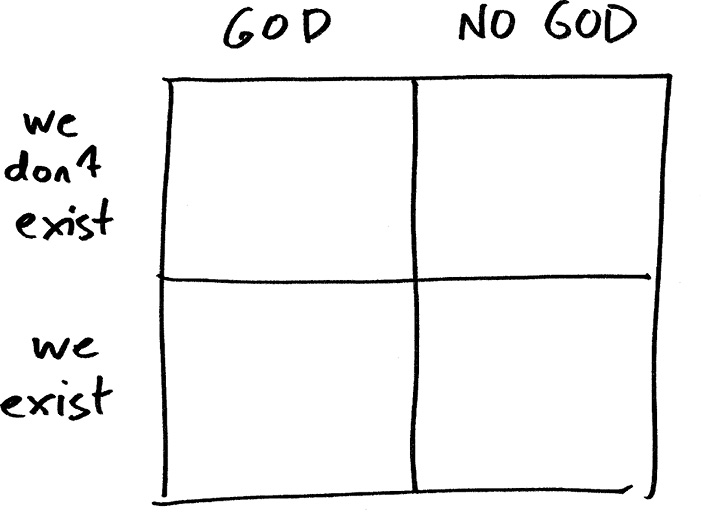
The first difficulty is to understand the priors. This is a hard thing to get your head around. In a roulette example, we might ask: How likely do we think it is that the wheel is rigged, before we see any of the spins? Now we’re asking: How likely would we think it was that there was a God, if we didn’t know that the universe, the earth, or we ourselves exist?
At this point, the usual move is to throw up one’s hands and invoke the charmingly named principle of indifference—since there can be no principled way to pretend we don’t know we exist, we just divvy up the prior probability evenly, 50% for GOD and 50% for NO GOD.
If NO GOD is true, then complex beings like humans must have arisen by pure chance, perhaps spurred along by natural selection. Designists then and now agree that this is phenomenally unlikely; let’s make up numbers and say it was a one-in-a-billion-billion shot. So what goes in the bottom right box is one-billion-billionth of 50%, or one in two billion billion.
What if GOD is true? Well, there are lots of ways God could be; we don’t know in advance that a God who made the universe would care to create human beings, or any thinking entities at all, but certainly any God worth the name would have the ability to whip up intelligent life. Perhaps if there’s a God there’s a one in a million chance God would make creatures like us.
So the box now looks like this:
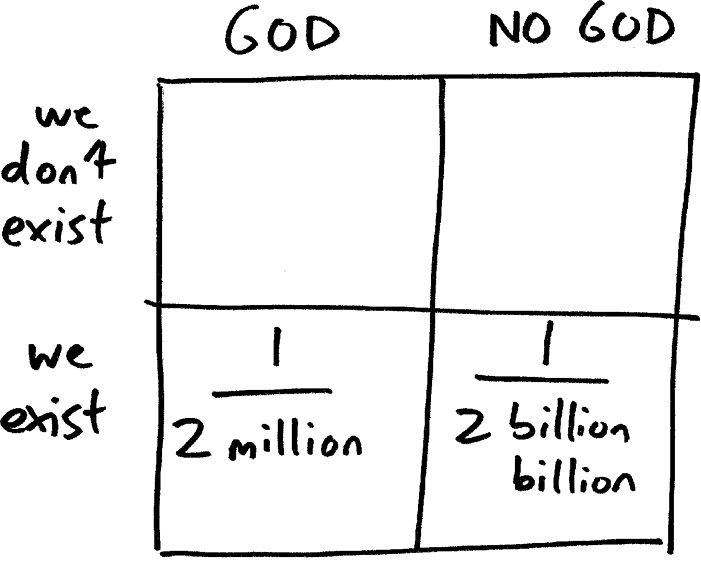
At this point we can examine the evidence, which is that we exist. So the truth lies somewhere in the bottom row. And in the bottom row, you can plainly see that there is a lot more probability—a trillion times more!—in the GOD box than in the NO GOD box.
This, in essence, is Paley’s case, the “argument by design,” as a modern Bayesian type would express it. There are many solid objections to the argument by design, and there are also two billion billion fighty books on the topic of “you should totally be a cool atheist like me” where you can read those arguments, so let me stick here to the one that’s closest to the math at hand: the “cleanest man in school” objection.
You probably know what Sherlock Holmes had to say about inference, the most famous thing he ever said that wasn’t “Elementary!”:
“It is an old maxim of mine that when you have excluded the impossible, whatever remains, however improbable, must be the truth.”
Doesn’t that sound cool, reasonable, indisputable?
But it doesn’t tell the whole story. What Sherlock Holmes should have said was:
“It is an old maxim of mine that when you have excluded the impossible, whatever remains, however improbable, must be the truth, unless the truth is a hypothesis it didn’t occur to you to consider.”
Less pithy, more correct. The people who inferred that my friend was the dirtiest man in school were considering only two hypotheses:
CLEAN: my friend was rotating through his shirts, washing them, then starting the rotation over, like a normal person
DIRTY: my friend was a filthy savage who wore dirty clothes.
You may start with some prior; based on my memory of college, assigning a probability of 10% to DIRTY is about right. But it doesn’t really matter what your prior is: CLEAN is ruled out by the observation that my friend wears the same shirt every day. “When you have excluded the impossible . . .”
But hold up, Holmes—the true explanation, LAZY ENTREPRENEUR, was a hypothesis not on the list.
The argument by design suffers from much the same problem. If the only two hypotheses you admit are NO GOD and GOD, the rich structure of the living world might well be taken as evidence in favor of the latter against the former.
But there are other possibilities. What about GODS, where the world was put together in a hurry by a squabbling committee? Many distinguished civilizations have believed as much. And you can’t deny that there are aspects of the natural world—I’m thinking pandas here—that seem more likely to have resulted from grudging bureaucratic compromise than from the mind of an all-knowing deity with total creative control. If we start by assigning the same prior probability to GOD and GODS—and why not, if we’re going with the principle of indifference?—then Bayesian inference should lead us to believe in GODS much more than GOD.*
Why stop there? There’s no end to the making of origin stories. Another theory with some adherents is SIMS, where we’re not actually people at all, but simulations running on an ultracomputer built by other people.* That sounds bizarre, but plenty of people take the idea seriously (most famously, the Oxford philosopher Nick Bostrom), and on Bayesian grounds, it’s hard to see why you shouldn’t. People like to build simulations of real-world events; surely, if the human race doesn’t extinguish itself, our power to simulate will only increase, and it doesn’t seem crazy to imagine that those simulations might one day include conscious entities that believe themselves to be people.
If SIMS is true, and the universe is a simulation constructed by people in a realer world, then it’s pretty likely there’d be people in the universe, because people are people’s favorite things to simulate! I’d call it a near certainty (for the sake of the example, let’s say an absolute certainty) that a simulated world created by technologically advanced humans would have (simulated) humans in it.
If we assign each of the four hypotheses we’ve met so far a prior probability of 1/4, the box looks something like this:
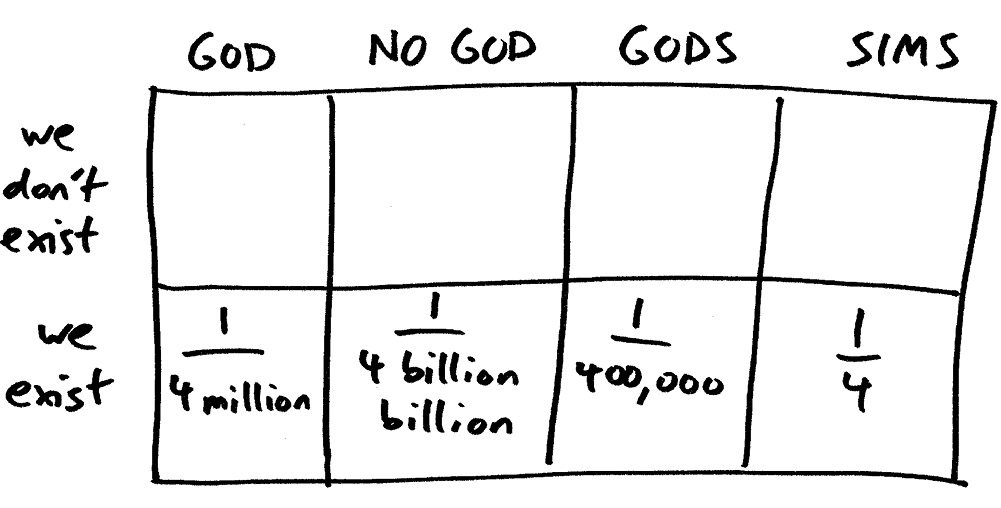
Given that we actually do exist, so that the truth is in the bottom row, almost all the probability in this invented model is sitting in SIMS. With these assumed priors and likelihoods, human life counts as much better evidence for a simulation than for the single-God hypothesis. That result follows from the assumptions; it does not establish that we live in a simulation.
Advocates of “scientific creationism” hold that we should argue in the classroom for the existence of a world designer, not because the Bible says so—that would be unconstitutionally naughty!—but on coolly reasonable grounds, founded on the astonishing unlikelihood of the existence of humanity under the NO GOD hypothesis.
But if we took this approach seriously, we would tell our tenth graders something like this: “Some have argued that it’s highly unlikely for something as complex as the Earth’s biosphere to have arisen purely by natural selection without any intervention from outside. By far the most likely such explanation is that we are actually not physical beings at all, but residents of a computer simulation being carried out by humans with unthinkably advanced technology, to what purpose we can’t exactly know. It’s also possible that we were created by a community of gods, something like those worshiped by the ancient Greeks. There are even some people who believe that one single God created the universe, but that hypothesis should be considered less strongly supported than the alternatives.”
Think the school board would go for this?
I had better hasten to point out that I don’t actually think this constitutes a good argument that we’re all sims, any more than I think Paley’s argument is a good one for the existence of the deity. Rather, I take the queasy feeling these arguments generate as an indication that we’ve reached the limits of quantitative reasoning. It’s customary to express our uncertainty about something as a number. Sometimes it even makes sense to do so. When the meteorologist on the nightly news says, “There’s a 20% chance of rain tomorrow,” what he means is that, among some large population of past days with conditions similar to those currently obtaining, 20% of them were followed by rainy days. But what can we mean when we say, “There’s a 20% chance that God created the universe?” It can’t be that one in five universes was made by God and the rest popped up on their own. The truth is, I’ve never seen a method I find satisfying for assigning numbers to our uncertainty about ultimate questions of this kind. As much as I love numbers, I think people ought to stick to “I don’t believe in God,” or “I do believe in God,” or just “I’m not sure.” And as much as I love Bayesian inference, I think people are probably best off arriving at their faith, or discarding it, in a non-quantitative way. On this matter, math is silent.
If you don’t buy it from me, take it from Blaise Pascal, the seventeenth-century mathematician and philosopher who wrote in his Pensées, “‘God is, or He is not.’ But to which side shall we incline? Reason can decide nothing here.”
When to use it
Evaluating competing scientific theories when multiple mechanisms can produce the same observed data.
Making business decisions: before concluding a product is failing, consider alternative explanations (e.g., marketing channels, user segment differences).
In legal reasoning: to avoid convicting the innocent, ensure all plausible alternative accounts of the evidence are considered.
When assessing personal performance: avoid jumping to conclusions about a colleague's behavior without considering hidden factors (e.g., they might have personal challenges).
FROM THEORY TO EVERYDAY LIFE
In practice
The Cat in the Hat T-Shirt Entrepreneur
A college student sells T-shirts then uses unsold ones as clean clothes, leading others to wrongly infer he never washes his shirt. The missing hypothesis (LAZY ENTREPRENEUR) shows the danger of incomplete hypothesis sets.
Paley's Watch and the Argument from Design
Paley compared the complexity of living things to a watch whose construction suggests a maker. Ellenberg’s response adds GODS and SIMS to the hypotheses under consideration. His invented probabilities favor SIMS, illustrating how strongly the result depends on the alternatives and assumptions rather than establishing any of these origin stories.
A MOMENT TO REFLECT
Put it to work.
Before accepting your leading explanation, what other plausible account could produce the same observation?
How does the 'cleanest man in school' story illustrate the limits of deductive reasoning even when you think you've excluded the impossible?
In what real-world situations might the principle of indifference mislead you by assigning equal priors to fundamentally different kinds of hypotheses?
References
- Natural Theology; or, Evidences of the Existence and Attributes of the Deity, Collected from the Appearances of Nature — William Paley (1802)
- Pensées — Blaise Pascal (1670)
- Are You Living in a Computer Simulation? — Nick Bostrom (2003)
CONTINUE THE CONVERSATION
Source texts
- How Not to Be Wrong The Power of Mathematical Thinking (Ellenberg, Jordan)