The Chemical Bond
A chemical bond is an attraction between atoms, ions, or molecules that enables the formation of chemical compounds, resulting from electrostatic forces in ionic bonds or electron sharing in covalent bonds.
THE IDEA
THE CHEMICAL BOND
The nature of the chemical bond is the problem at the heart of all chemistry.
—Bryce Crawford
A chemical bond is an attraction between atoms, ions, or molecules that enables the formation of chemical compounds. The bond may result from the electrostatic force of attraction between oppositely charged ions as in ionic bonds, or through the sharing of electrons as in covalent bonds.
The strength of chemical bonds varies considerably; there are strong bonds or primary bonds such as covalent, ionic and metallic bonds, and weak bonds, or secondary bonds such as dipole-dipole interactions, London dispersion force, and hydrogen bonding.
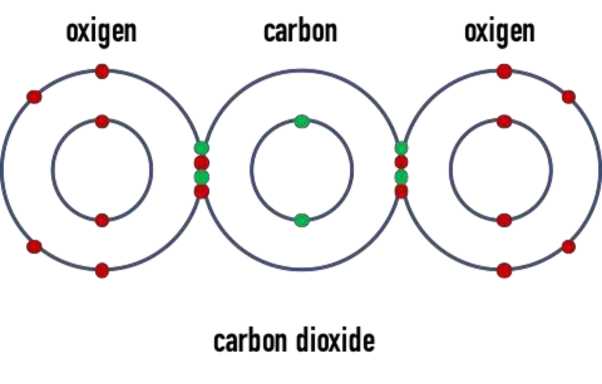
As an example, see the below representation of a carbon dioxide molecule. It is made up of two oxygen atoms and one carbon atom, so its chemical formula is CO2. The carbon dioxide molecule has linear and symmetric geometry, and the Lewis structure that represents it is: O = C = O.
Carbon dioxide is formed from various processes, such as combustion, fermentation, or respiration.
When to use it
Predicting solubility of substances based on bond polarity (like dissolves like)
Designing materials with specific conductivity by manipulating metallic or ionic bonding
Understanding why diamond (covalent network) is hard while graphite (layered covalent+van der Waals) is a lubricant
Explaining why water has a high boiling point due to hydrogen bonding
FROM THEORY TO EVERYDAY LIFE
In practice
Carbon Dioxide Molecule
Carbon dioxide (CO2) consists of one carbon atom double-bonded to two oxygen atoms, forming a linear and symmetric molecule (O=C=O). It is produced by combustion, fermentation, and respiration.
Sodium Chloride Ionic Bond
Table salt (NaCl) forms when sodium (Na) donates an electron to chlorine (Cl), creating Na+ and Cl− ions held together by electrostatic attraction—a classic ionic bond.
A MOMENT TO REFLECT
Put it to work.
How does electronegativity difference determine whether a bond is ionic or covalent?
Why does CO2 have a linear geometry while H2O is bent, considering both involve central atoms bonded to two others?
Compare the strength of a hydrogen bond with a typical covalent bond and explain why hydrogen bonds are still crucial in biological systems.
CONTINUE THE CONVERSATION
Source texts
- Wisdom Theory 100 Mental Models (2020) (Wisdom Theory)