The 3E Framework & Organizational Dynamics
The 3E Framework combines organizational data, research, benchmarks, and experience. It emphasizes checking evidence across sources and examining how culture, structure, individual judgment, and the purpose of learning affect its use.
THE IDEA
The 3E Framework & Organizational Dynamics
The 3E framework applies to both individual and group decisions because learning in organizations involves both. Some knowledge can be shared explicitly; some remains tacit and personal, a distinction discussed in Chapter 1 of the source. Its use depends on organizational culture and structure, on people’s cognition, behavior, and emotions, and on whether the intended learning is adaptive, generative, or transformative. Group decisions in the 3E framework therefore introduce considerations beyond those of an individual choice.
Figure 10.1 illustrates the 3E framework; a fuller source discussion appears in Chapter 7.
As shown in Figure 10.1, the 3E framework involves identifying, evaluating, and using evidence relevant to a decision. Banasiewicz gives operational data a central role in the 3E framework, arguing that other accounts of evidence-based practice understate its importance to business decisions.
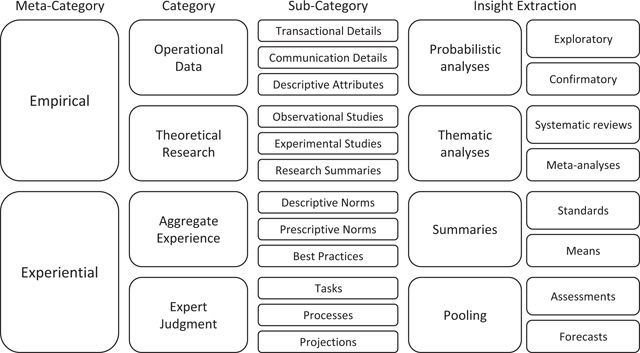
FIGURE 10.1 The Empirical & Experiential Evidence Framework.
Organizational data alone may be insufficient. Purchase records do not fully explain buying behavior, and reviews do not capture every customer’s experience. Both may contain errors or omit relevant cases. Analyses also depend on assumptions and measurement choices; a precise result can still be misleading if those assumptions or inputs are wrong.
Research, industry benchmarks, standards, and personal experience have limitations too. Informational triangulation compares sources to check agreement, investigate contradictions, and expose gaps. This is the rationale for considering all relevant knowledge in the 3E framework. Agreement is more informative when sources do not simply repeat the same underlying evidence or error. Culture, incentives, individual judgment, and the kind of learning sought also influence which evidence is gathered and how it is interpreted.
When to use it
Strategic planning in a corporation where leaders need to integrate internal performance data with industry benchmarks and employee insights.
Product development: compare observed user behavior with customer feedback, relevant experiments, and the team’s experience before choosing what to build.
Policy-making in a government agency where evidence from research studies, administrative data, and stakeholder experience must be synthesized for effective regulation.
Educational program design where student performance data, teaching experience, and pedagogical research are triangulated to improve curriculum.
FROM THEORY TO EVERYDAY LIFE
In practice
Using Transactional Data for Marketing Decisions
A retailer considers purchase records and customer reviews when planning promotions. Missing customer information and unreliable reviews leave gaps, so the team compares industry benchmarks and tests a promotion on a small scale. Comparing these sources in the 3E framework helps identify what the existing data cannot explain.
Balancing Hard Data and Expert Intuition in R&D
A tech startup evaluating two product features uses analytics from user behavior (data), published research on user preferences (empirical studies), and the team's own past experiences (individual experience). By synthesizing these sources through the 3E framework, they avoid over-reliance on any single source and make a more informed decision about which feature to prioritize.
A MOMENT TO REFLECT
Put it to work.
What are the key sources of evidence you typically use in your own decision-making? How might you incorporate informational triangulation to improve their reliability?
Think of a recent organizational decision. How did organizational culture and structure influence the learning and evidence-gathering process, and could the 3E framework have improved the outcome?
Reflect on a time when you relied heavily on organizational data but ignored other forms of evidence. What were the consequences, and how would the 3E framework have changed the approach?
CONTINUE THE CONVERSATION
Source texts
- Evidence-Based Decision-Making How to Leverage Available Data and Avoid Cognitive Biases (Andrew D. Banasiewicz)