The 10 Percent That’s Good
In any field, 90% of work is crap (Sturgeon's Law), so focus on the good 10%. In philosophy, this means engaging with classics and quality secondary literature, but also understanding the context to appreciate the good stuff.
THE IDEA
77. THE 10 PERCENT THAT’S GOOD
So if Sturgeon’s Law holds for philosophy as it does for everything else, what, in my view, is the good stuff? First of all, the classics really are classics for a good reason. From Plato to Russell, the standard fare in history-of-philosophy courses holds up well even after centuries of examination, and the best of the secondary literature about this primary literature is also very valuable. You will get something— a lot, really—out of reading Aristotle or Kant or Nietzsche on your own, without any background, but you’ll get a lot more if you accept some guidance from those who have specialized in these thinkers for their entire careers.
Not all historians of philosophy have the same goals and attitudes, and I for one see no good reason for disqualifying any of the contenders. Some insist on placing their thinkers in the historical context in which they wrote, which means, for instance, learning a lot of seventeenth-century science if you really want to understand Descartes, and a lot of seventeenth- and eighteenth-century political history if you really want to understand Locke or Hume, and always, of course, a lot of the philosophy of their lesser contemporaries as well. Why bother with the also-rans? There’s a good reason. I found I never really appreciated many of the painters of the sixteenth and seventeenth centuries until I visited European museums where I could see room after room full of second-rate paintings of the same genres. If all you ever see is the good stuff—which is all you see in the introductory survey courses, and in the top museums—it’s very hard to see just how wonderful the good stuff is. Do you know the difference between a good library and a great library? A good library has all the good books. A great library has all the books. If you really want to understand a great philosopher, you have to spend some time looking at the less great contemporaries and predecessors that are left in the shadows of the masters.
Other specialists touch only lightly on the historic contexts in which their heroes worked, and instead concentrate on showing how to translate the ideas into today’s contexts. After all, Leibniz didn’t write the Monadology to be an exemplary work of seventeenth-century rationalism; he wrote it to get at the truth. In the end, you’re not taking any philosopher seriously until you ask whether or not what they say is right. Philosophy students—and professors—sometimes forget this, and concentrate on pigeonholing and engaging in “compare and contrast,” as we say in examination questions. Whole philosophy departments sometimes fall into this vision of their goal. That’s not philosophy; that’s just philosophy appreciation. This is how I try to help my students break this habit:
You’ve stumbled on a terrible secret—a plot to destroy the Statue of Liberty, say, or to bring down the national electric grid. You work feverishly to gather and marshal your evidence, and then compose a letter that draws on all your eloquence. You send copies to the police, the FBI, the New York Times, CNN, and this is the response you get: “Ah, another very clever example of post-9/11 conspiracy theory” and “a gripping read, actually, and quite plausible in its own way, with excellent touches” and “reminds me of Don DeLillo, with echoes of Pynchon.” Aaargh! Pay attention! I’m trying to tell you the truth! Respect the philosopher you are reading by asking yourself, about every sentence and paragraph, “Do I believe this, and if not, why not?”
In addition to the history of philosophy there is excellent work in the philosophy of science—mathematics, logic, physics, biology, psychology, economics, political theory. There is almost no work in the philosophy of chemistry or astronomy or geology or engineering as such, but there is good work on some of the conceptual issues that arise in these fields. And then there is ethics. In 1971 John Rawls published A Theory of Justice, a towering work that opened up a fruitful era of philosophers who approach the traditional topics of ethics with an eye on the social sciences, especially economics and political science, but also biology and psychology. Thanks largely to Rawls, philosophers working in ethics raised their game, and the result has been a bounty of valuable philosophical research, which deserves and receives attention from researchers in other disciplines—and politicians and social critics.
Finally, there are philosophers who are not interdisciplinary at all, and also lean lightly on the history of the field, specializing on contemporary problems that arise in the work of philosophers specializing on contemporary problems that arise in the work of other contemporary philosophers. Some of this, as I have already noted, succumbs to Hebb’s rule: if it’s not worth doing, it’s not worth doing well. But some of it is excellent and valuable. I have mentioned quite a few contemporary philosophers in this book, and I wouldn’t mention them if I didn’t think their ideas were worth taking seriously, especially when I claim they are making a mistake. Aside from my targets, there are several-dozen other philosophers whose work I particularly admire, but I won’t make the mistake of listing them. Several times in my career I have relied on the judgment of a colleague who told me not to bother with X’s work because it was foolish junk, only to learn some time later that I had been misled into ignoring a thinker with valuable ideas whose contribution to my own thinking was delayed by the bum steer. I am painfully aware of how easily I could be read as excusing interested thinkers from reading some philosopher who didn’t make it onto my list. So please treat this book as an open-ended introduction to some ways of doing philosophy, and if you find them useful, they can be a springboard into your own exploration of the questions and answers that have been worked on for so long by so many thinkers.
“It’s inconceivable!” That’s what some people declare when they confront the “mystery” of consciousness, or the claim that life arose on this planet more than three billion years ago without any helping hand from an Intelligent Designer, for instance. When I hear this, I am always tempted to say, “Well of course it’s inconceivable to you. You left your thinking tools behind and you’re hardly trying.” Recall William Bateson’s firm declaration that a material basis for genes was inconceivable. Even schoolchildren have little difficulty conceiving of DNA today, and it’s not because they are more brilliant than Bateson was. It’s because in the last century we have devised and refined the thinking tools that make it a snap. Of course some people really don’t want to conceive of these things. They want to protect the mysteries from even an attempt at explanation, for fear that an explanation might make the treasures disappear.
When other people start getting inquisitive, they find that “God works in mysterious ways” is a convenient anti-thinking tool. By hinting that the questioner is arrogant and overreaching, it can quench curiosity in an instant. It used to work well, and still works well in the communities where ignorance of science is regarded as a negligible flaw if not actually a virtue. I think we should stop treating this “pious” observation as any kind of wisdom and recognize it as the transparently defensive propaganda that it is. A positive response might be, “Oh good! I love a mystery. Let’s see if we can solve this one, too. Do you have any ideas?”
Conceiving of something new is hard work, not just a matter of framing some idea in your mind, giving it a quick once-over and then endorsing it. What is inconceivable to us now may prove to be obviously conceivable when we’ve done some more work on it. And when we confidently declare that some things are truly impossible—a largest prime number, or a plane triangle with interior angles adding up to more than two right angles, or a married bachelor—it is not so much because we find these things inconceivable as that we find we have conceived of their components so well, so exhaustively, that the impossibility of their conjunction is itself clearly conceivable.
We haven’t yet succeeded in fully conceiving how meaning could exist in the material world, or how life arose and evolved, or how consciousness works, or whether free will can be one of our endowments, but we’ve made progress: the questions we’re posing and addressing now are better than the questions of yesteryear. We’re hot on the trail of the answers.
Some readers of the draft of this book expressed surprise and disappointment that it didn’t include some of my best-known intuition pumps. In fact, several dozen don’t appear here, including some of my favorites. In a few cases I think an explanation is necessary.
“Where am I?” is probably my best-known intuition pump, but for that very reason it could be left out. It first appeared in Brainstorms in 1978, and then was included in The Mind’s I in 1981. Translations have been published in about a dozen languages, and it has often been anthologized. The movie Victim of the Brain (1984) has a half-hour dramatization of it (with me playing the later Dennett body), and a scene also appears in a 1981 BBC documentary on consciousness and the brain. Then there was the Javanese shadow-puppet dramatization produced by the well-known puppeteer Lynn Jeffries at Harvard’s Loeb Theater in 1984. Google leaves no doubt that it is readily available, along with a flood of commentaries.
“The Ballad of Shakey’s Pizza Parlor” (in Dennett, 1982a) does serious work dismantling a set of presumptions about “de re and de dicto belief” that were once dominant in the thinking of some philosophers working on intentionality, but that were unfamiliar to everyone else. If I had included it here, I would first have had to infect all of you with some seductive but misguided intuitions so that I could then cure you with my intuition pump. Some philosophers have to know all about this, but others can remain blissfully ignorant without loss.
In the part on evolution I reluctantly left out my favorite new thinking tool, philosopher Peter Godfrey-Smith’s Darwinian Spaces, the best use of a multidimensional space as a thinking tool in philosophy that I know, because it would have required too large a review of evolutionary theory and biological phenomena to make it effective. I explain it in somewhat technical terms for other philosophers, and exhibit some of its excellent uses, in my review essay “Homunculi Rule” (2010) on Godfrey-Smith’s book Population Thinking and Natural Selection (2009). See also Godfrey-Smith’s (2010) response.
My essay “Quining Qualia” (1988a) consists of no less than fourteen intuition pumps, designed to clarify, and then banish as hopelessly confused, the philosophical concept of qualia. Only one of those is included here, the Curse of the Cauliflower, to help introduce the concept and a major problem with qualia. “Quining Qualia” might be considered supplementary reading on the topic for anyone who still thinks the concept of qualia (as philosophers like to define it) is a good idea. The essay has often been anthologized and is readily available on the Internet, in several languages. My book Sweet Dreams (2005b) contains yet other arguments and intuition pumps on the topic. Others on consciousness are “curare-cum-amnestic” in “Why You Can’t Make a Computer That Feels Pain” (Dennett, 1978c), “Swamp Mary and RoboMary” in “What RoboMary Knows” (Dennett, 2007d), and “Orwellian and Stalinesque” models of consciousness in Consciousness Explained (Dennett, 1991a). These all require more stage setting than I could comfortably provide if I was to keep this book relatively short.
I’ve also left out the various intuition pumps for thinking about religion that I introduced in Breaking the Spell (Dennett, 2006a), and my example of Superman tweaking the Burgess Shale in Science and Religion: Are They Compatible? (Dennett and Plantinga, 2011).
APPENDIX: SOLUTIONS TO REGISTER MACHINE PROBLEMS
EXERCISE 1
PROGRAM 1:
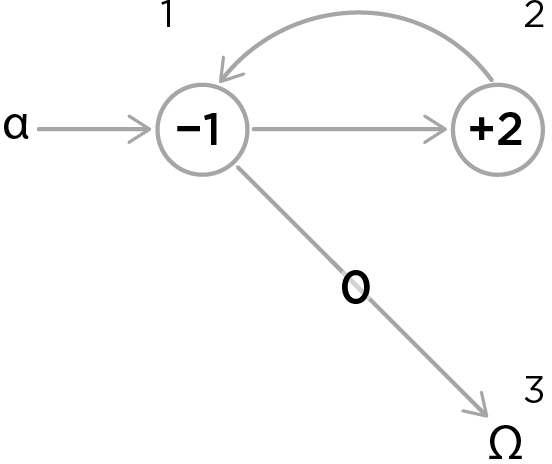
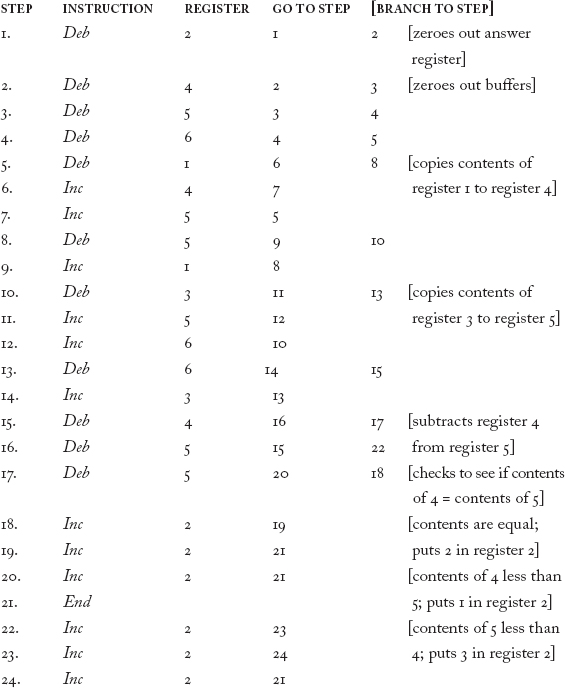
a. How many steps will it take the register machine to add 2 + 5 and get 7, running Program 1 (counting End as a step)?
Answer: Six steps: three decrements, two increments, one End (the last decrement is a branch on zero).
b. How many steps will it take to add 5 + 2?
Answer: Twelve steps: six decrements, five increments, and one End.
(What conclusion do you draw from this?)
Answer: The order of the contents can make a big difference, so you might think it would be good to have a rule of always putting the smaller number in register 1—but if you first had to test the two numbers to see which is smaller, you’d use up more steps than you’d spend doing the addition!
EXERCISE 2
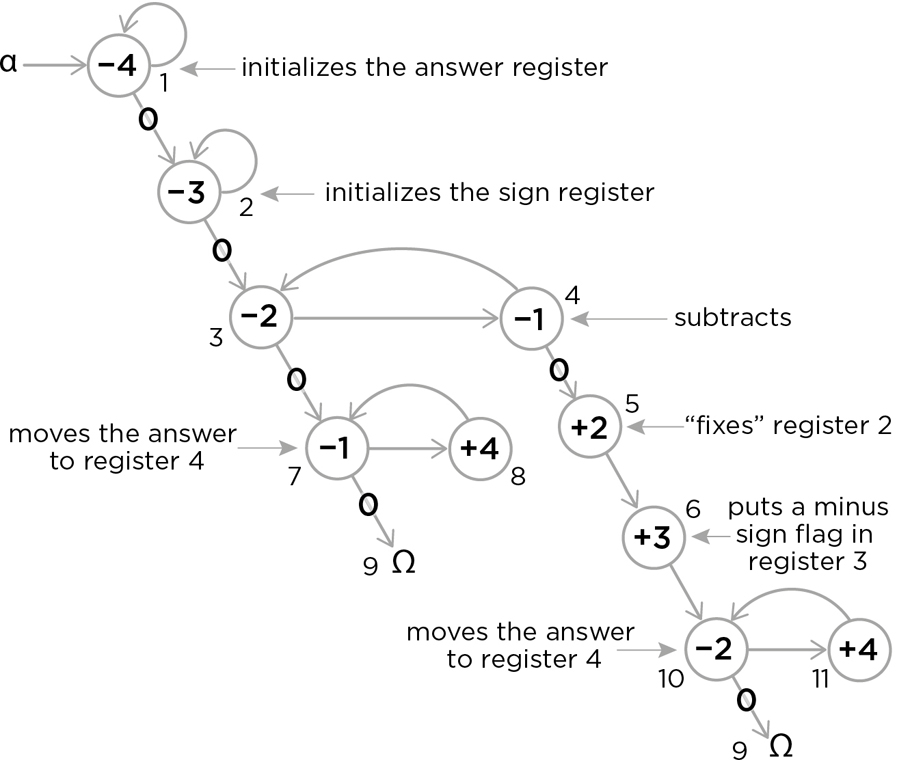
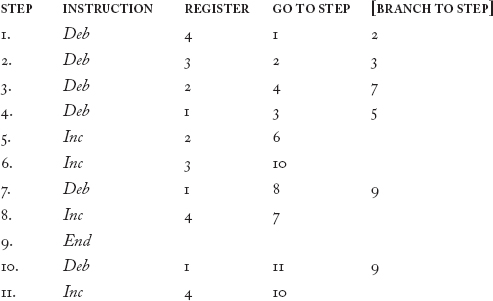
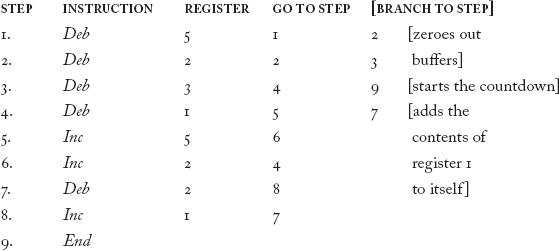
a. Write the RAP program for this flow graph. (Note that since the program branches, you can number the steps in several different ways. It doesn’t matter which way you choose as long as the “go to” commands point to the right steps.)
b. What happens when the program tries to subtract 3 from 3 or 4 from 4?
The program halts with 0 in register 4.
c. What possible error is prevented by zeroing out register 3 before trying the subtraction at step 3 instead of after step 4?
If there was a zero at the start in both registers 1 and 2, the answer when the program ended could be nonsensical (either –0, or some number other than 0 or 1 in the sign register).
EXERCISE 3
a. Draw a flow graph (and write the RAP program) for multiplying the content of register 1 by the content of register 3, putting the answer in register 5.
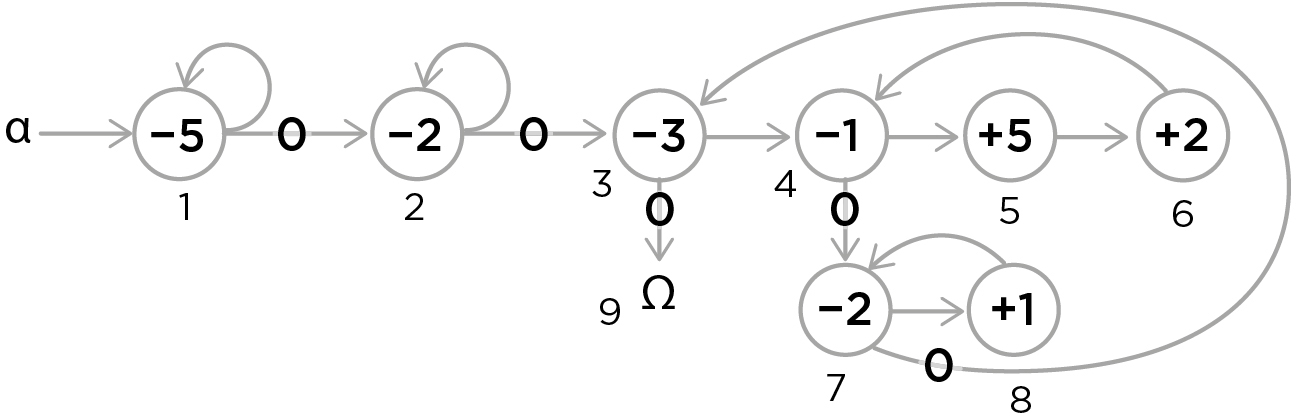
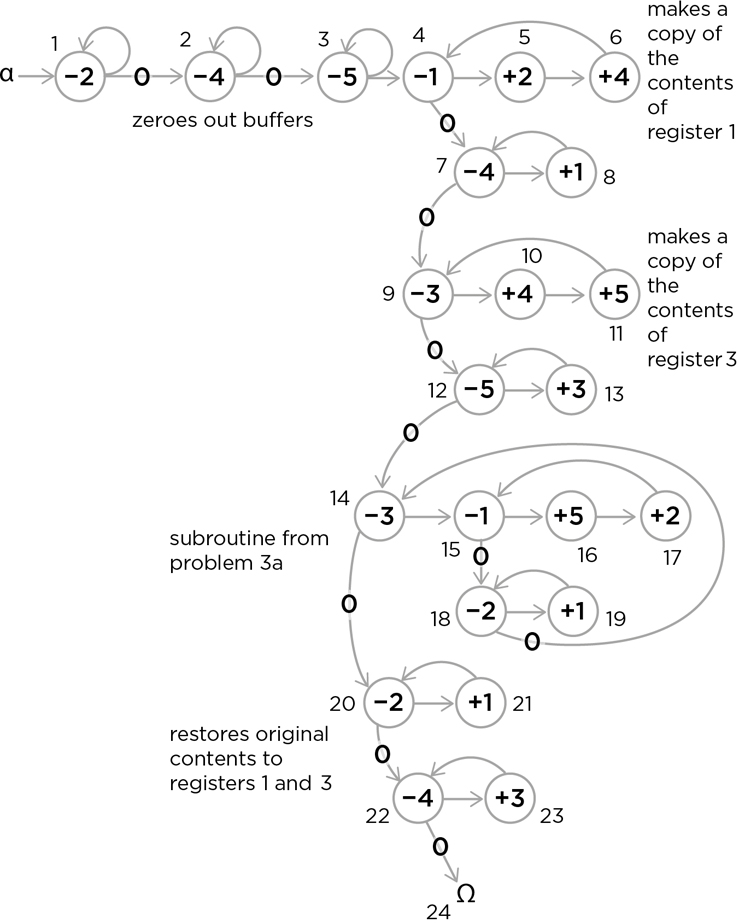
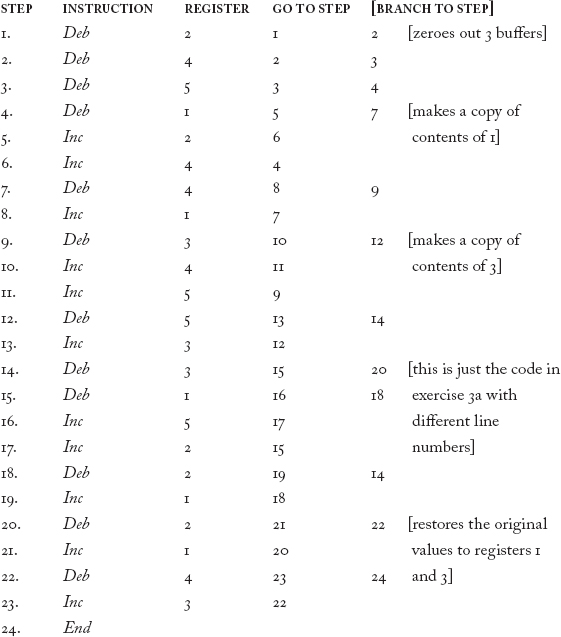
b. (Optional) Using Copy and Move, improve the multiplier you created in problem a: when it stops, the original contents of register 1 and register 3 are restored, so that you can easily check the inputs and output for correctness after a run.
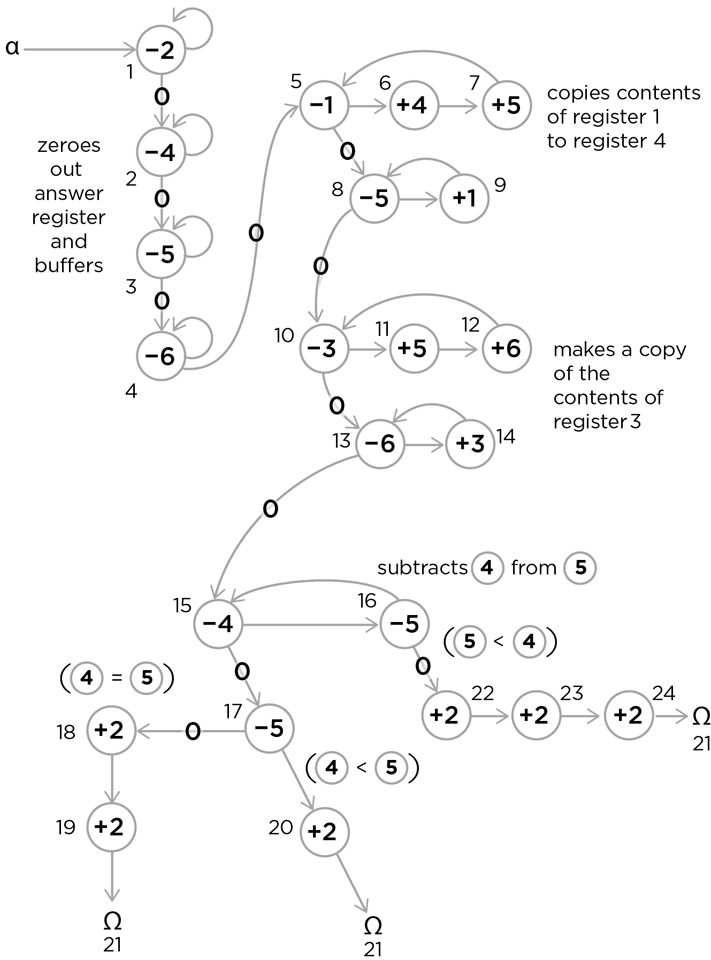
c. (Optional) Draw a flow graph and write a RAP program that examines the contents of register 1 and register 3 (without destroying them!) and writes the address (1 or 3) of the smaller content in register 2, and puts 2 in register 2 if the contents of registers 1 and 3 are equal. (After this program has executed, the contents of register 1 and register 3 should be unchanged, and register 2 should say if their contents are equal, and if not, which of those two registers has the smaller content.)
EXERCISE 4 (OPTIONAL)
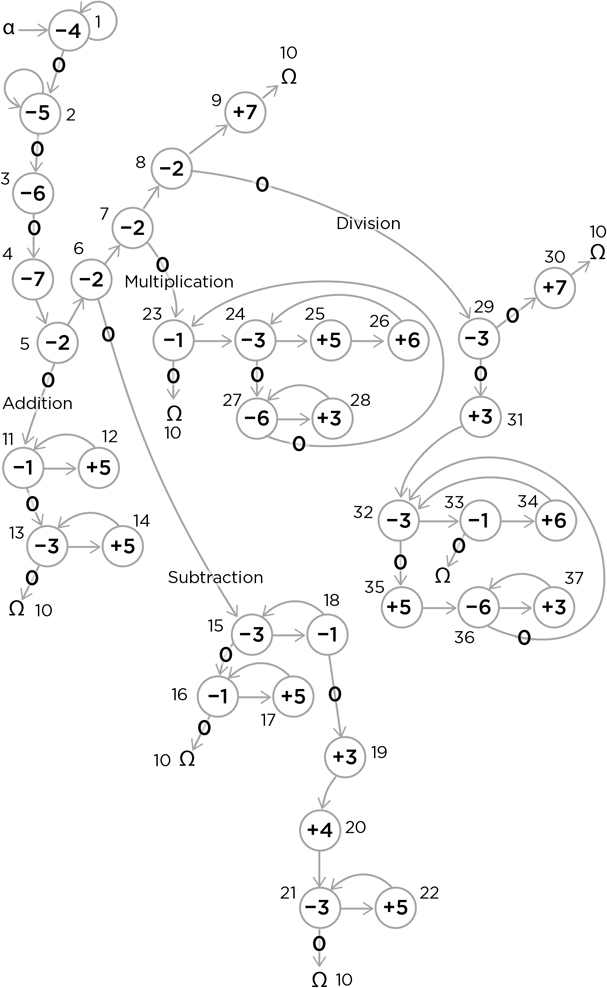
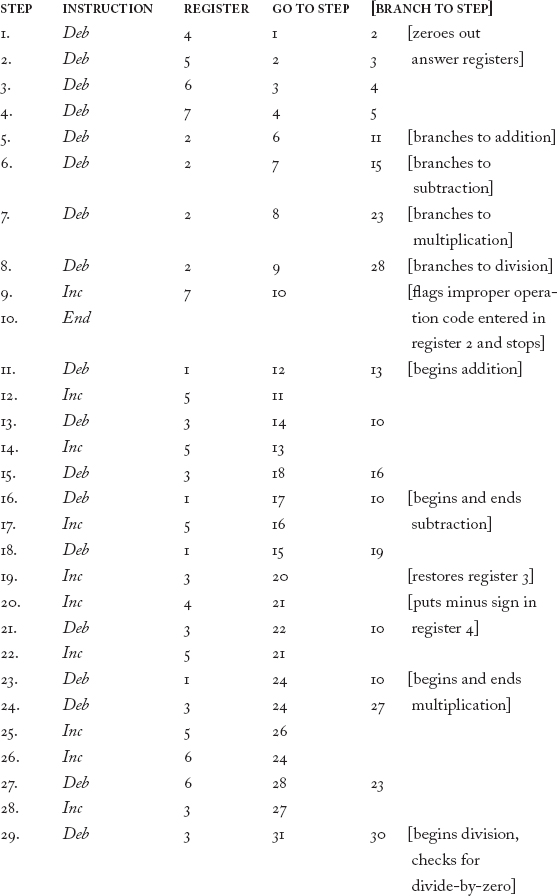
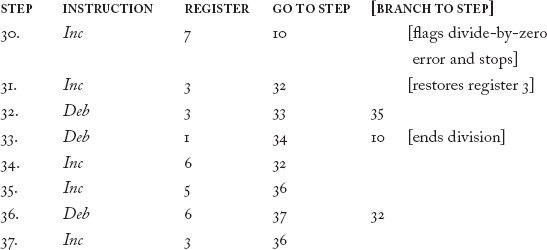
Draw a flow graph, and write a RAP program that turns a register machine into a simple pocket calculator, as follows:
a. Use register 2 for the operation:
0 = add
1 = subtract
2 = multiply
3 = divide
b. Put the values to be acted on in registers 1 and 3.
(Thus 306 would mean 3 + 6, and 513 would mean 5 – 3, and 425 would mean 4 × 5, and 933 would mean 9 ÷ 3). Then put the results of the operation in registers 4 through 7, using register 4 for the sign (using 0 for + and 1 for –) and register 5 for the numerical answer, register 6 for any remainder in a case of division, and register 7 as an alarm, signaling a divide-by-zero mistake.
When to use it
When starting a new subject, deliberately seek out the classics and high-quality secondary sources to build a strong foundation.
When evaluating arguments, treat them as truth claims to be critically assessed, not just as historical artifacts.
To deepen understanding, explore the context of a great work by studying lesser-known contemporaries.
When confronted with a claim that seems inconceivable, consider whether you have the appropriate thinking tools to conceive it.
FROM THEORY TO EVERYDAY LIFE
In practice
The Conspiracy Letter
Imagine you've discovered a plot to destroy the Statue of Liberty. You gather evidence and write a compelling letter. But instead of being taken seriously, critics treat it as an insightful narrative. Philosophy appreciation (treating arguments as literary artifacts) differs from engaging with truth claims.
The Great Library
A good library has all the good books; a great library has all the books. To truly appreciate great philosophers, you need to see the lesser contemporaries and predecessors that highlight their brilliance.
A MOMENT TO REFLECT
Put it to work.
When reading a philosophical work, ask yourself: 'Do I believe this? If not, why not?' to move beyond appreciation to genuine engagement.
Consider a field you are interested in. What is the 10% of work in that field that is truly excellent? How can you identify it?
What ideas do you currently find inconceivable? Could they become conceivable with better thinking tools?
References
- A Theory of Justice — John Rawls (1971)
- Population Thinking and Natural Selection — Peter Godfrey-Smith (2009)
CONTINUE THE CONVERSATION
Source texts
- Intuition Pumps and Other Tools for Thinking