Testing Principles via Analogies
Analogies can test whether a stated principle is being applied consistently. Compare cases that match in the respects the principle treats as relevant, then ask whether a changed judgment reveals a double standard or a relevant difference between the cases.
THE IDEA
TESTING PRINCIPLES
Analogies also enable us to test our principles. We may think that we are doing something because of some fundamental principle of ours, but if that is really true we should be able to move to an analogous situation and apply the same principle. If that doesn’t hold it is a sign that our principle wasn’t a true one, or that we picked the wrong level of abstraction. Unfortunately people often do this wilfully to try and convince themselves or others they are working to strong fundamental principles rather than prejudice.
For example, perhaps a woman is not picked for a job and the hiring panel is accused of sexism. They may claim that it was not sexism, it was simply that the woman did not have enough experience. However, if they then hire a man who has even less experience, it shows that this principle was not a true logical principle at work. It is often more tricky than this as the analogous situation might not be real, and we are then pushed to imagine what would happen in an analogous situation. This question arose in relation to Hillary Clinton and Barack Obama in their respective elections. People who didn’t support Clinton were accused of sexism. They fought back and said they didn’t support her because “she was a liar” (for example). And yet, many (perhaps all) male politicians lie about things, and are still supported. Similarly people who didn’t support Obama were accused of racism. Those who were accused fought back and said they didn’t support him because “he was inexperienced”, for example. And yet white men with far less experience might win their support.
We can clarify this using diagrams. Someone might think they’re applying a principle about inexperienced people in general, regardless of the fact that person A is a woman:
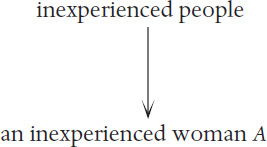
However, if that is really the case we should be able to pivot, using the abstract principle, to an analogous situation with an inexperienced man:
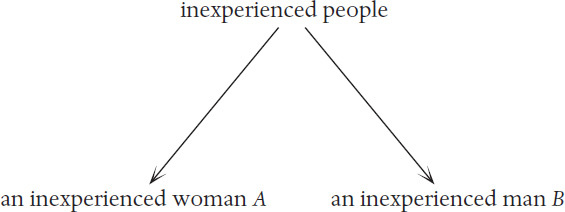
If the inexperienced man gets more credit or more support, then the two are not being treated analogously according to this particular principle, and we should consider whether there is another principle lurking:
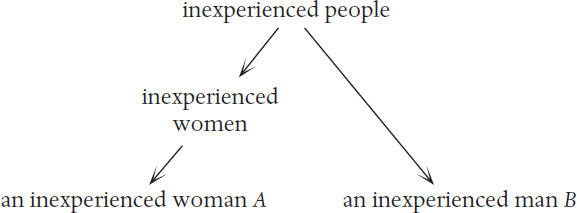
According to the intermediate level of “inexperienced women”, the bottom two items are no longer analogous. The abstract version is this:
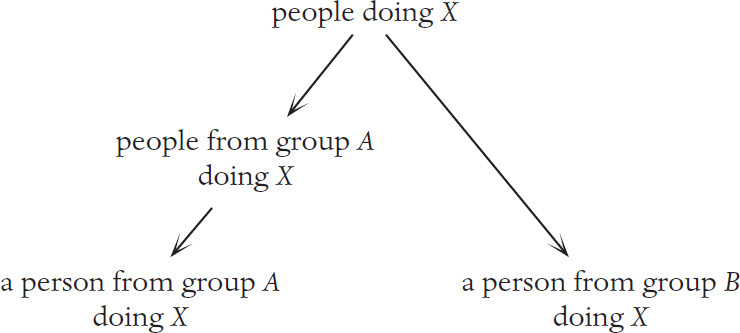
If the person from group A is treated differently from the person in group B, it’s a sign that the intermediate principle is at work, not the general one. As discussed in Chapter 3, this applies every time a black person is shot by police in the US, when the same argument repeats about whether it was racism or not. We can ask ourselves whether a white person in the same situation would be treated the same way. If not, then it’s a sign that the intermediate principle (the person was black) is at play, not the general one of just the fact that they were doing X.
We should use these principles to test our own arguments as well as those of other people. In arguments about science vs religion there is an analogy that I think scientists should feel uncomfortable about. Many scientists are disparaging about religion because it consists of people believing things without scientific evidence, because of something written in a book or told to them by a religious leader. However, science is asking people to believe in it in a somewhat similar way: there may well be evidence to back up scientific findings, but non-scientists are not expected to read all the research data and check all the research for themselves. Scientists seem to be asking non-scientists to believe them, or believe what is written in books and journals, in an analogous way to religious leaders asking people to believe what they preach, or what is written in the Bible or another holy book. There may well be something crucially different about those situations, but if so we should admit that at this level of abstraction the two appear somewhat similar, and thus, the argument that you “shouldn’t just believe what someone says” is not a very convincing argument in favour of science. Using our diagrams again, we have a proposed argument:
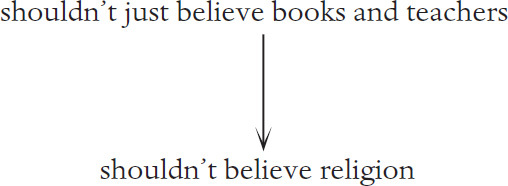
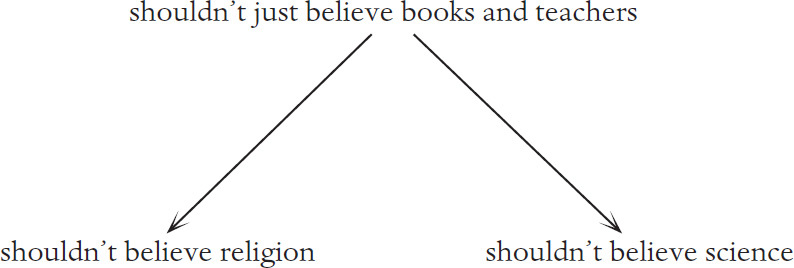
But if this is really a general principle, it is applicable to science as well:
If scientists want to argue that science is more reliable than religion, they need to find a more nuanced intermediate principle that distinguishes the two, and then only go up to the level of that nuanced principle so that science and religion are not analogous:
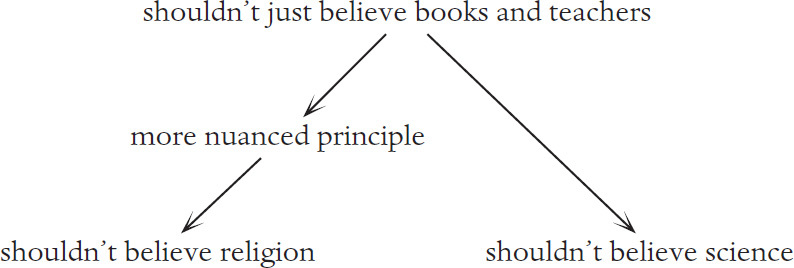
That nuanced principle might be that we shouldn’t just believe books and teachers unless they are backed up by reproducible evidence, but that still leaves the question of how we can tell if the evidence is reproducible. One might say that religious scripture is eyewitness testimony from people we can’t ask, but we might also say that some science is based on eyewitness testimony from people we can’t ask, scientists who ventured into the jungle and observed creatures now extinct, or who landed on the moon and reported what they saw. The situation is more subtle than most arguments about it betray, and I think this is a more productive way to see why so many people believe in religion rather than (as some scientists do) declaring that all those people are stupid.
When to use it
Evaluating hiring or promotion decisions for potential bias.
Analyzing political or moral arguments for hidden double standards.
Reflecting on one’s own beliefs to ensure they are based on genuine principles rather than prejudice.
Improving scientific communication by acknowledging epistemic reliance on authority.
FROM THEORY TO EVERYDAY LIFE
In practice
Hiring and Gender
A panel rejects a woman for insufficient experience, then hires a man with less experience. If the panel claims experience alone decided the result, this comparison challenges that explanation. Other relevant differences need to be examined before concluding why the decisions differed.
Political Support and Double Standards
Cheng asks whether someone who rejects Clinton for lying, or Obama for inexperience, applies the same standard to other politicians. Supporting a comparable politician despite the stated objection can reveal an inconsistent standard and prompt closer examination of the reason given.
Police Shootings and Race
A comparison of police treatment asks whether a white person would be treated the same way as a black person in otherwise comparable circumstances. A difference challenges a claimed race-neutral explanation and gives reason to investigate what determined the response.
Science vs Religion
Scientists criticize religion for believing without evidence, yet science also asks non-scientists to trust expert testimony and written sources. If the principle is 'don't believe just because someone says so,' it applies to science too, prompting a search for a more nuanced distinction.
A MOMENT TO REFLECT
Put it to work.
Think of a principle you strongly hold. Can you find an analogous situation where you would apply it differently? What does that reveal about your actual values?
When someone gives a reason for a decision, try to imagine a counterfactual with a different person in the same circumstances. Would the reason still hold?
In a current public debate, identify a claim that relies on a general principle. Test it by moving to an analogous situation—does the argument stay consistent?
CONTINUE THE CONVERSATION
Source texts
- The Art of Logic How to Make Sense in a World that Doesn’t (Eugenia Cheng)