Take the Best vs. Dawes' Rule in Scarce Information Environments
Under the source’s definition, information is scarce when the number of binary cues is less than log2(N). Its theorem says Take the Best is more accurate than Dawes’ Rule when averaged across the specified possible environments, not necessarily in any particular environment.
THE IDEA
Table 31.6. Illustration of the Fact That 8 Objects Can Be Predicted Perfectly by log8 = 3 Binary Cues
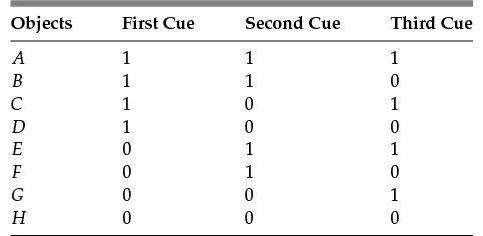
THEOREM If the number of cues is less than log N, the Profile Memorization Method will never achieve 100% correct inferences. Thus, no other strategy will either.
This theorem motivates the following definition:
DEFINITION A set of M cues provides scarce information for a reference class of N objects if M < log N.
We can now formulate a theorem that relates the performance of Take the Best to that of Dawes’ Rule.
THEOREM In the case of scarce information, Take the Best is on average more accurate than Dawes’ Rule.
The proof is in Martignon, Hoffrage, and Kriegeskorte (1997). The phrase “on average” means across all possible environments; that is, all combinations of binary entries for N × M matrices. The logarithms here are to base two. This is an average over the specified matrices, rather than a guarantee for a particular real-world task. The intuition underlying the theorem is the following: In scarce environments, Dawes’ Rule can take little advantage of its strongest property – namely, compensation. If, in a scarce environment, cues are redundant – that is, if a subset of these cues does not add new information – things will be even worse for Dawes’ Rule. Take the Best suffers less from redundancy because decisions are taken at a very early stage.
When to use it
Choosing between job candidates when you only have two or three reliable criteria (e.g., education, experience, interview score) and many applicants.
Comparing prediction rules on a task with few binary cues, checking their performance in the actual setting rather than relying only on the theorem’s average.
Investment decisions in a new market where only a handful of indicators (e.g., GDP growth, political stability) are available for many countries.
Selecting a movie to watch from a large catalog based on only a few features (e.g., genre, rating, length).
FROM THEORY TO EVERYDAY LIFE
In practice
Predicting with 3 cues for 8 objects
Table 31.6 illustrates that 8 objects can be predicted perfectly by log2(8)=3 binary cues. The theorem then shows that if you have fewer than 3 cues (scarce information), no strategy, including Dawes' Rule, can achieve 100% correct inferences, and Take the Best performs better on average.
A MOMENT TO REFLECT
Put it to work.
Can you think of a real-world decision where you have very few cues (less than log2 of the number of alternatives)? How might Take the Best outperform a more complex rule in that case?
Why does cue redundancy hurt Dawes' Rule more than Take the Best? Explain the intuition in your own words.
The theorem states Take the Best is more accurate 'on average.' What does that mean for a specific decision environment?
Often confused with
References
- Martignon, Hoffrage, and Kriegeskorte (1997) — Martignon, L., Hoffrage, U., & Kriegeskorte, M. (1997)
CONTINUE THE CONVERSATION
Source texts
- Heuristics and Biases The Psychology of Intuitive Judgment (Thomas Gilovich, Dale Griffin, Daniel Kahneman)