Systems Thinking – The Value of Stepping Back and Seeing the Bigger Picture
Systems thinking examines how parts of an organisation or situation interact. Solving each part separately can miss feedback loops and shift problems elsewhere, so it helps to consider the effects of a proposed change across the system.
THE IDEA
Systems Thinking
Gotthold Ephraim Lessing wrote, ‘In nature everything is connected, everything is interwoven, everything changes with everything, everything merges from one into another’2 as long ago as 1769. Over the years, biologists recognised again and again that it was hard to explain why the population of one animal species (e.g. lions) was declining without understanding the way it was affected by the presence or absence of other species (e.g. antelopes). And in turn, the population of antelopes depends on the availability of plants to eat, which depends on the terrain, the presence of water, the climate, etc. So, eventually the term ‘the ecosystem’ was coined by Arthur Tansley in the 1930s.
Fundamental to systems thinking is a recognition that some problems are complex rather than complicated. By way of an example:
- Repairing a car is a complicated problem: A car comprises many separate, discrete parts. If you identify something that is not working, parts that are faulty or broken can usually be repaired or replaced separately, in isolation. The parts can then be put back together again, and the car should work.
- Improving transport links in a town or city is a complex problem: Imagine that cyclists are looking for more traffic‐free cycle lanes. If you do everything you can to solve their concerns, they might be happy; but you may create problems for other road users (driving cars and trucks), who might be (rightly or wrongly) unhappy about the impact this has on them.
So, a systems thinking approach recognises that for complex problems you cannot break down each bit of a problem into pieces, solve it separately and then put these solutions together and expect them to work. Indeed, systems thinking tells us that thinking that you can solve a complex problem as if it was complicated (i.e. addressing issues as discrete, separate phenomena, in isolation) will very often create other ‘spin‐off’ problems immediately or in the future.
In business terms, if you take an organisation, you can consider its various activities (e.g. sales and marketing) as ‘systems’ that interact with and depend upon other internal ‘systems’ (e.g. procurement, finance and IT). Seen this way, the success or failure of an organisation can depend upon how well these systems (or elements) work together. And a classic term to describe poor working between parts of an organisation is to say there are ‘silos’.
External factors such as customers, competitors, suppliers, regulators, the environment, etc., can also be regarded as systems, and how the organisation interacts with these can also explain how and why it succeeds or fails. For example, an organisation may struggle if its internal processes make it difficult to serve customers.
Diagram 3.1 provides an example of how you see an organisation as a series of systems that interact with one another internally and are also impacted by external systems.
The diagram can be adapted to each organisation. Its purpose is to help people ‘step back and see the big picture’ and identify factors they might otherwise overlook. For example, we can ask: ‘Do suitable systems and technology support our goals?’, ‘Do we have the right people and capabilities?’ or ‘Do we have suitable suppliers to give us what we need?’, etc.
Jay W Forrester developed an approach to modelling business systems.3 In the late 1950s and early 1960s, he showed General Electric that highs and lows in its production of certain domestic appliances, which were thought to be due to external factors, could arise ‘from entirely internally determined’ elements of the organisation.4 He was able to show that overly simplistic, linear thinking about business (i.e. thinking some problems were complicated rather than complex) could result in unexpected spin‐off problems.5 His concepts were applied across various industries and integrated with data analysis and computing. It enabled him to create models for what might be happening and help decision‐makers tackle even more complex challenges (e.g. urban planning, policy setting, etc.).
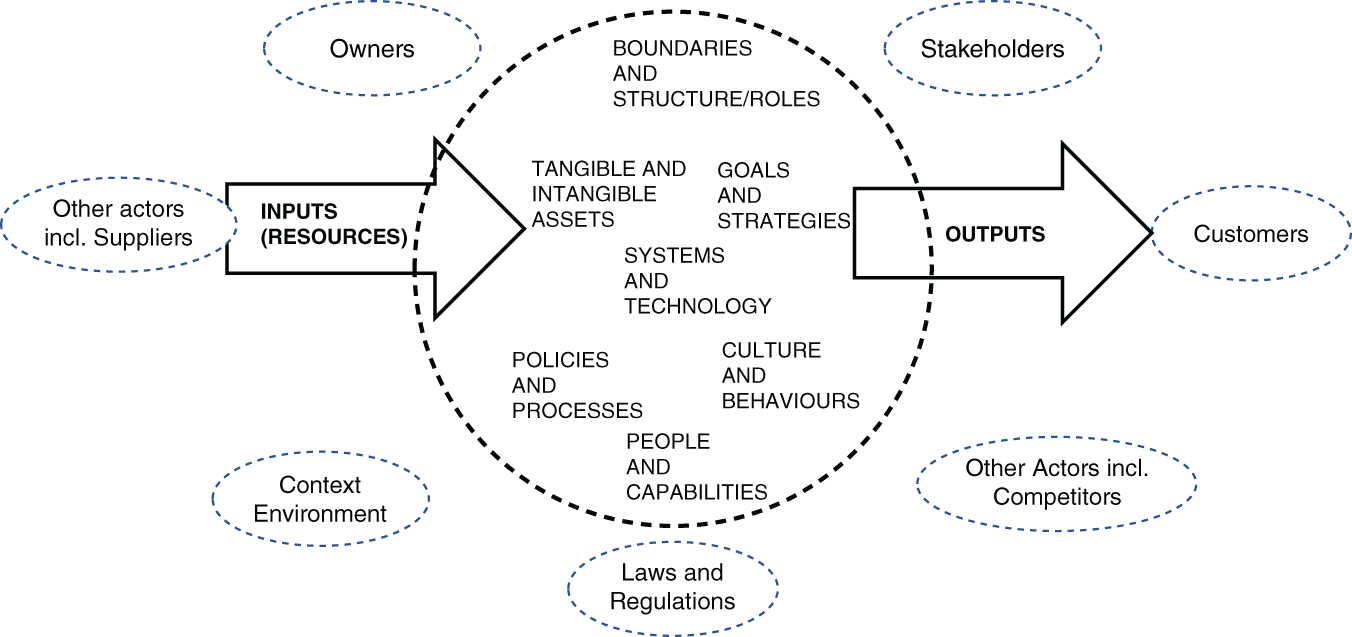
Diagram 3.1 An organisation as an open system (illustration)
Since then, systems thinking has become of interest in certain contexts, but it is still not ‘mainstream’ in many domains.6 However, there have been some popular books on systems thinking, such as
- Peter Senge's ‘The Fifth Discipline’ (1990) which highlights the benefits of looking at the big picture when trying to address challenges and the importance of a learning culture.
- Barry Oshry's ‘Seeing Systems’ (2007) which discusses some of the common interactions you see in organisations, including top/bottom and provider/customer, and the dysfunctional patterns (‘dances') that can arise between different parts of an organisation.
- Donella Meadows' ‘Thinking in Systems’ (2008) (first written in the 1990s and emerging from work with Jay Forrester at MIT) which explains systems analysis and feedback loops in a step‐by‐step way and illustrates how they can be applied to some of the global challenges we face.
- Derek and Laura Cabrera's ‘Systems Thinking Made Simple’ (2015) which provides a very accessible overview of the topic. They highlight, among other things, the importance of understanding different perspectives.
A systems thinking approach includes:
- Analysing systems into their sub‐systems and looking at the interactions between systems to see how causes and effects work (i.e. systems analysis).7
- Recognising that unless you understand causal connections and feedback loops within a system, and between systems, you will find yourself surprised when things don't work and surprised when new problems appear to come from ‘out of the blue’.8
When to use it
Improving organizational efficiency by breaking down silos and enhancing interdepartmental collaboration.
Urban planning: designing a city's transport system while considering impacts on cyclists, drivers, pedestrians, and businesses.
Policy setting: analyzing how a new regulation might affect multiple stakeholders and produce ripple effects.
Business strategy: understanding how changes in marketing affect supply chain, customer service, and finance.
FROM THEORY TO EVERYDAY LIFE
In practice
Complex vs. Complicated: Transport Links
Improving transport links in a town is a complex problem. Responding to cyclists' demands for cycle lanes may create problems for other road users, showing that isolated solutions can lead to unintended consequences.
General Electric Domestic Appliances
Jay Forrester showed General Electric how production highs and lows attributed to external demand could arise from the organisation’s own decisions and feedback loops. His models helped explain how attempts to fix one part of a business could affect others.
A MOMENT TO REFLECT
Put it to work.
Think of a challenge you currently face. Is it complicated or complex? How might treating it as complicated lead to unintended consequences?
Identify a system you interact with daily (e.g., your organization, a community). What are the key subsystems and how do they interact?
Recall a time when solving one problem created another elsewhere. Which connections or feedback loops would have helped you anticipate that effect?
Often confused with
References
- The Fifth Discipline — Peter Senge (1990)
- Seeing Systems — Barry Oshry (2007)
- Thinking in Systems — Donella Meadows (2008)
- Systems Thinking Made Simple — Derek and Laura Cabrera (2015)
CONTINUE THE CONVERSATION
Source texts
- Beyond the Five Whys Root Cause Analysis and Systems Thinking (James C. Paterson)