Support Theory and Extensions
Support theory models probability judgments as responses to descriptions of events. Listing an event’s components can increase its judged probability, while listing alternatives can reduce it. Extensions examine why a combined description may receive less support than its separately assessed parts, including repacking and anchoring as possible mechanisms.
THE IDEA
Prescriptive Implications
Support theory is a descriptive model: different descriptions of the same event can produce different judgments. The discussion of nonmeasurability below concerns the failure to assign a single description-independent probability to an event, rather than an inability to record people’s estimates.
Models of subjective probability or degree of belief serve two functions: descriptive and prescriptive. The literature on nonstandard probability models is primarily prescriptive. These models are offered as formal languages for the evaluation of evidence and the representation of belief. In contrast, support theory attempts to describe the manner in which people make probability judgments, not to prescribe how people should make these judgments. For example, the proposition that judged probability increases by unpacking the focal hypothesis and decreases by unpacking the alternative hypothesis represents a general descriptive principle that is not endorsed by normative theories, additive or nonadditive.
Despite its descriptive nature, support theory has prescriptive implications. It could aid the design of elicitation procedures and the reconciliation of inconsistent assessments (Lindley, Tversky, & Brown, 1979). This role may be illuminated by a perceptual analogy. Suppose a surveyor has to construct a map of a park on the basis of judgments of distance between landmarks made by a fallible observer. A knowledge of the likely biases of the observer could help the surveyor construct a better map. Because observers generally underestimate distances involving hidden areas, for example, the surveyor may discard these assessments and compute the respective distances from other assessments using the laws of plane geometry. Alternatively, the surveyor may wish to reduce the bias by applying a suitable correction factor to the estimates involving hidden areas. The same logic applies to the elicitation of probability. The evidence shows that people tend to underestimate the probability of an implicit disjunction, especially the negation of an elementary hypothesis. This bias may be reduced by asking the judge to contrast hypotheses of comparable level of specificity instead of assessing the probability of a specific hypothesis against its complement.
The major conclusion of the present research is that subjective probability, or degree of belief, is nonextensional and hence nonmeasurable in the sense that alternative partitions of the space can yield different judgments. Like the measured length of a coastline, which increases as a map becomes more detailed, the perceived likelihood of an event increases as its description becomes more specific. This does not imply that judged probability is of no value, but it indicates that this concept is more fragile than suggested by existing formal theories. The failures of extensionality demonstrated in this article highlight what is perhaps the fundamental problem of probability assessment – namely, the need to consider unavailable possibilities. The problem is especially severe in tasks that require the generation of new hypotheses or the construction of novel scenarios. The extensionality principle, we argue, is normatively unassailable but practically unachievable because the judge cannot be expected to fully unpack any implicit disjunction. People can be encouraged to unpack a category into its components, but they cannot be expected to think of all relevant conjunctive unpackings or to generate all relevant future scenarios. In this respect, the assessment of an additive probability distribution may be an impossible task. The judge could, of course, ensure the additivity of any given set of judgments, but this does not ensure that additivity will be preserved by further refinement.
The evidence reported here and elsewhere indicates that both qualitative and quantitative assessments of uncertainty are not carried out in a logically coherent fashion, and one might be tempted to conclude that they should not be carried out at all. However, this is not a viable option because, in general, there are no alternative procedures for assessing uncertainty. Unlike the measurement of distance, in which fallible human judgment can be replaced by proper physical measurement, there are no objective procedures for assessing the probability of events such as the guilt of a defendant, the success of a business venture, or the outbreak of war. Intuitive judgments of uncertainty, therefore, are bound to play an essential role in people’s deliberations and decisions. The question of how to improve their quality through the design of effective elicitation methods and corrective procedures poses a major challenge to theorists and practitioners alike.
26. Unpacking, Repacking, and Anchoring: Advances in Support Theory
Yuval Rottenstreich and Amos Tversky
The study of intuitive probability judgment has shown that people often do not follow the extensional logic of probability theory (see, e.g., Kahneman, Slovic, & Tversky, 1982). In particular, alternative descriptions of the same event can give rise to different probability judgments, and a specific event (e.g., that 1,000 people will die in an earthquake) may appear more likely than a more inclusive event (e.g., that 1,000 people will die in a natural disaster). To accommodate such findings, Tversky and Koehler (1994) have developed a nonextensional theory of belief in which subjective probability is not attached to events, as in other models, but to descriptions of events, called hypotheses. According to this account, called support theory, each hypothesis A has a support value, s(A), corresponding to the strength of the evidence for this hypothesis. The judged probability, P(A, B), that hypothesis A rather than B holds, assuming that one and only one of them obtains, is given by
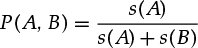
Thus, judged probability is interpreted in terms of the support of the focal hypothesis A relative to the alternative hypothesis B. The key assumption of support theory is that unpacking a description of an event (e.g., a plane crash, C) into disjoint components (e.g., an accidental plane crash, C**a, caused by human error or mechanical failure; or a nonaccidental plane crash, C**n, caused by terrorism or sabotage) generally increases its support. Thus, the support of the explicit disjunction C**a ∨ C**n is equal to or greater than the support of the implicit disjunction C that does not mention any cause; that is, s(C) ≤ s(C**a ∨ C**n). The rationale for this assumption is twofold. First, unpacking an implicit hypothesis may remind people of possibilities they might have overlooked. Second, the explicit mention of a possibility tends to increase its salience and hence its perceived support.
Support theory provides a unified framework for the analysis and the interpretation of a wide range of findings. It predicts that the judged probability of an event increases by unpacking the focal hypothesis and decreases by unpacking the alternative hypothesis. For instance, the judged probability that a given person will die a natural rather than an unnatural death increases by listing various causes of natural death (e.g., heart attack, stroke, cancer) and decreases by listing various causes of unnatural death (e.g., car accident, homicide, fire). Furthermore, support theory implies that the judged probability of a hypothesis plus the judged probability of its complement, evaluated by different groups of participants, adds up to one. For finer partitions, however, the sum of the judged probabilities of a set of mutually exclusive and exhaustive hypotheses generally is greater than one. These predictions have been confirmed in numerous studies; earlier experiments are reviewed by Tversky and Koehler (1994), some later experiments are discussed by Fox and Tversky (1998).
This article presents a significant generalization of support theory that allows subadditivity for explicit disjunctions. To illustrate this extension, consider the possibilities that the winner of the next presidential election in the United States will be a Democrat (Dem), a Republican (Rep), or an Independent (Ind). The original version of support theory assumes that support is additive for explicit disjunctions, such that s(Rep ∨ Ind) = s(Rep) + s(Ind), and consequently, judged probability (P) is also additive for explicit disjunctions, as in the standard theory of probability. As shown next, however, several observations suggest that support is subadditive for explicit disjunctions, such that s(Rep ∨ Ind) ≤ s(Rep) + s(Ind), and hence

That is, the judged probability that the winner of the upcoming election will be a Republican or an Independent rather than a Democrat is less than or equal to the judged probability that the winner will be a Republican rather than a Democrat or an Independent plus the judged probability that the winner will be an Independent rather than a Republican or a Democrat. More generally, we assume that if A and B are mutually exclusive hypotheses, and (A1, A2) is recognized as a partition of A, then s(A) ≤ s(A1 ∨ A2) ≤ s(A1) + s(A2). This assumption regarding the support function s imposes the following constraints on the observed measure P. In particular, the left inequality implies a testable condition, called implicit subadditivity,
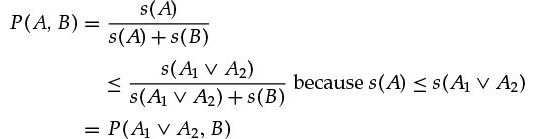
and the right inequality implies a second testable condition, called explicit subadditivity,
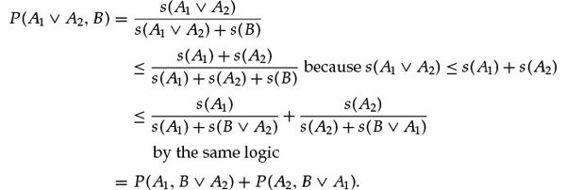
Note that probability theory requires additivity throughout, whereas the theory of belief functions (Shafer, 1976) assumes superadditivity. Thus, support theory and Shafer’s theory depart from the probability calculus in opposite directions. The contrast concerns the direction in which each model departs from additivity.
Before addressing the cognitive processes that give rise to explicit subadditivity, we discuss three issues regarding the interpretation of support theory. First, we wish to emphasize that the predictions of the theory, notably binary complementarity – that is, P(A, B) + P(B, A) = 1 – concern hypotheses, not events. This distinction is particularly important in tasks where the alternative to the focal hypothesis is not explicitly stated. Consider, for example, the outcome of a race between an incumbent and a challenger, and let In denote the hypothesis that the incumbent will win the race and Ch denote the hypothesis that the challenger will win the race. Support theory implies that the judged probability of In plus the judged probability of not-In (i.e., the incumbent will not win the race) equals one, but the theory is not committed to the prediction that the judged probability of In plus the judged probability of Ch will equal one. In this simple example it is immediately obvious that Ch is the same as not-In; therefore, additivity is likely to hold, assuming it is clear that there are no other candidates and that ties are excluded. However, when the hypotheses under discussion are more complicated and the setting is less familiar, additivity need not hold (see Gonzales & Bonini, 1995; Macchi, Osherson, & Legrenzi, 1995).
Second, the unpacking inequality s(A) ≤ s(A1 ∨ A2) is assumed to hold only when the judge knows, or believes, that A1 ∨ A2 has the same extension as A. Thus, the theory predicts that the judged probability that a patient has meningitis (M), for example, is less than or equal to the judged probability that the patient has either viral meningitis or nonviral meningitis because their disjunction is clearly coextensional with M. However, the theory does not require that the judged probability of meningitis will be less than or equal to the judged probability of either viral meningitis (M**v) or bacterial meningitis (M**b), unless the judge happens to know M**v ∨ M**b is coextensional with M. Note that a judge presented with the explicit disjunction M**v ∨ M**b may recognize that it has the same extension as the implicit disjunction M even though, presented with M alone, the judge may not be able to unpack it into M**u and M**b. Thus, the theory permits recognition without recall.
Third, the present theory expresses an observed probability judgment, P(A, B), in terms of the underlying support, s(A) and s(B), of the individual hypotheses. Although it is possible, in some cases, to predict judged probability from independent assessments of support (see Tversky & Koehler, 1994), the present theory treats support as a psychological construct derived from probability judgment. A formal statement of the theory is presented in the Appendix in Rottenstreich and Tversky (1997). It provides necessary and sufficient conditions for the representation of probability judgments in terms of subadditive support; it also provides a simple method for constructing an essentially unique support function from observed judgments of probability.
Let us turn now from the interpretation of support theory to the main topic of this article, namely the psychological processes that can produce explicit subadditivity. More specifically, we investigate two such mechanisms, repacking and anchoring, that are discussed in turn.
As noted in the original version of the theory, a judge presented with an explicit disjunction may, nevertheless, think about it as an implicit disjunction, and vice versa. Consider, for example, the probability that a particular student majors in industrial, mechanical, or electrical engineering. A judge presented with such an explicit disjunction may repack the various disciplines and evaluate the implicit disjunction engineering. Because unpacking increases support, repacking reduces support giving rise to explicit subadditivity. Furthermore, we expect more explicit subadditivity for disjunctions of similar components than for disjunctions of dissimilar components because similar components are more easily repacked.
A second source of explicit subadditivity is the use of anchoring and adjustment. Instead of assessing independently the support of each component of an explicit disjunction and then adding the separate assessments, the judge may assess one of the components (perhaps the larger or the more familiar) and then adjust this value upward to accommodate the other components. Because such adjustments are generally insufficient (Poulton, 1994; Slovic & Lichtenstein, 1968; Tversky & Kahneman, 1974), the use of this heuristic is likely to produce explicit subadditivity. An individual who is asked to assess the combined population of the United States and Canada, for example, may anchor on the U.S. population and then adjust it upward, without making an explicit assessment of the population of Canada. If frequency, probability, or support are evaluated in this manner, we expect subadditivity for explicit disjunctions, even if their components are not repacked.
When to use it
In forecasting, checking whether an estimate changes when an event or its alternative is unpacked into comparable descriptions.
When writing survey questions, matching the specificity of focal and alternative hypotheses and testing whether wording changes responses.
Educating decision-makers about the fragility of intuitive probability judgments, especially in complex domains like legal reasoning, medical diagnosis, or business strategy.
Developing computational models of human judgment that incorporate subadditivity for more accurate predictions of human behavior in uncertain environments.
FROM THEORY TO EVERYDAY LIFE
In practice
Death causes unpacking
Judged probability that a person dies a natural death increases when causes like heart attack, stroke, and cancer are listed, compared to a generic 'natural death'. Conversely, listing unnatural causes (car accident, homicide, fire) decreases the judged probability of natural death.
Election outcome repacking
The extended theory permits the judgment P(Rep or Ind vs. Dem) to be less than or equal to P(Rep vs. Dem or Ind) + P(Ind vs. Rep or Dem). It proposes repacking and anchoring as mechanisms that can produce this explicit subadditivity; the election scenario illustrates a prediction, rather than proving which mechanism operates.
Student majors repacking
A judge presented with an explicit disjunction 'industrial, mechanical, or electrical engineering' may repack it as 'engineering', reducing support and causing explicit subadditivity.
Population anchoring
Using approximately 330 million as an illustrative U.S. population, a judge estimating the combined population of the U.S. and Canada might start with that figure and make too small an upward adjustment. The example concerns anchoring, not a current population estimate.
A MOMENT TO REFLECT
Put it to work.
Think of a recent decision where you estimated the probability of an event. How might unpacking or repacking that event have changed your judgment?
When estimating an outcome, are you listing mutually exclusive ways it could occur or factors that may occur together? How could that distinction affect the estimate?
How can recognizing the subadditivity of explicit disjunctions improve your critical thinking when evaluating statistical claims in news or research?
Often confused with
References
- Support Theory: A Nonextensional Representation of Subjective Probability — Tversky, A. & Koehler, D. J. (1994)
- The Making of a Probability — Fox, C. R. & Tversky, A. (1998)
- Judgment Under Uncertainty: Heuristics and Biases — Kahneman, D., Slovic, P., & Tversky, A. (1982)
- A Mathematical Theory of Evidence — Shafer, G. (1976)
- The Psychology of Choice — Lindley, D. V., Tversky, A., & Brown, R. V. (1979)
- Studies in Subjective Probability — Poulton, E. C. (1994)
- Comparison of Bayesian and Regression Approaches to the Study of Information Processing in Judgment — Slovic, P. & Lichtenstein, S. (1968)
CONTINUE THE CONVERSATION
Source texts
- Heuristics and Biases The Psychology of Intuitive Judgment (Thomas Gilovich, Dale Griffin, Daniel Kahneman)