Supply Networks: The System Seeing Itself
Businesses are linked through supply networks whose costs and consequences extend beyond any one organization. Senge describes the Sustainable Food Lab as an effort to help companies, farmers, governments, and NGOs understand those connections together, then test changes across the food system.
THE IDEA
SUPPLY NETWORKS: THE SYSTEM SEEING ITSELF
The innovations that will have the big impact will be ones that integrate complete value chains around securing long term viability for social and ecological as well as economic systems.
-Darcy Winslow, Nike
Today’s businesses sit within complex supply networks that often span the world. In recent years, leaders have focused on managing supply chains for efficiency improvements, cost reductions, and more rapid response. But these are small steps compared to the changes needed to create truly sustainable supply networks that will remain viable into the future. Creating such networks will require engaging organizations across entire supply chains in seeing the larger system that they are creating and innovating new ways of operating together.
No global supply networks affect more people than those for food. Food production and distribution is the world’s largest industry, employing over a billion people. For most of those living in wealthy northern countries, global food systems seem to be working fine. After all, a consumer in New York or Paris can buy a cantaloupe in the middle of winter for $1.50. But behind affordable prices and high availability for well-off consumers sits a system that is one of the most powerful generators of poverty, political and economic instability, and local environmental destruction in the world.
Over the fifty-year period described in this account, prices of agricultural commodities like soy, maize (corn), wheat, cotton, and potatoes have fallen between 60 and 80 percent, while production for these same products has increased by factors of two to ten. Falling prices may be a boon to rich consumers, but they are a tragedy for rural families worldwide who depend on farm incomes. For example, the average selling price of coffee at the time of this account was roughly half what it cost growers to produce.16 The argument is that this system produces cheap food for the rich and expensive food for the poor, a condition that more global businesses were beginning to recognize.17 Addressing a conference of advertising executives, the VP of marketing for Unilever Europe, Chris Pomfret, said “the security of our global food supply chains [is] absolutely critical to the future of our business. ‘Can sustainability sell?’ is the wrong question. The real question is: ‘Can a business like ours survive in the long term without sustainability?’”18
Seeing the System Together. Still, the number of people and key institutions that truly see the global food system is far too small and far too non-integrated to make much difference. Although Unilever is one of the largest sellers of food products in the world, what it can accomplish acting alone is negligible. “Doing something about sustainable agriculture will require bringing parties together that normally do not cooperate,” says van Heemstra. For systems like global agriculture, this means that not only diverse businesses but also governmental and nongovernmental organizations must learn how to see the system together.
In 2004, Unilever and Oxfam were joined by over thirty multinational food companies, global and local NGOs, major foundations, and government representatives from the Netherlands, the European Commission, and Brazil in a novel experiment called the Sustainable Food Lab. The aim was to bring “sustainable food supply chains into the mainstream,” using a new process to foster collaborative learning across the supply chain.19
As the Sustainable Food Lab project began to develop, it became clear that the participants shared many understandings of the inter-dependencies of the present system and a poignant image of where it is headed. In their words, they were trapped in a “race to the bottom,” going faster and faster toward where no one wanted to go. Three interacting sets of reinforcing forces are continuing to drive this race:20
- Reinforcing growth in supply driven by rising production and rising profits, leading to capital investment and further increases in capacity (food producers)
- Reinforcing growth in demand driven by supply increases that lower prices and raise availability, leading to further increase in supply as producers see more market opportunities (food companies, retailers, and consumers)
- Further increases in capacity driven by falling prices, spurring investments in increased efficiency and land use in order to maintain farm incomes (local and larger food producers)
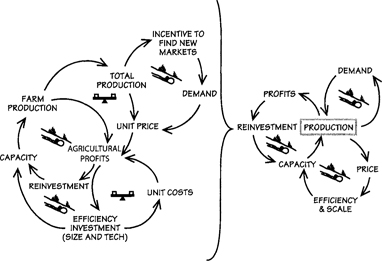
The first and second sets of forces drive growth in capacity, production, and demand in many industries, not just food. They grow stronger as large multinational corporations with access to financial capital and advanced technology enter and come to dominate industries. But there are at least two novel features of food production that make these basic economic forces problematic. In general, as rising production and falling prices turn products into commodities, producers search for lower-cost ways to produce, until profits are so low that there is little incentive for businesses to expand further. But the farmers and small farming companies in poorer countries who face falling prices often continue increasing production even when there is zero profit or even loss. Farmers do so because their only other option is to abandon their farms and traditional life, and pursue an even more uncertain future by migrating to cities. Instead, they attempt to maintain their incomes by boosting production through efficiency increases like use of fertilizers and pesticides, or by farming more marginal land (the third set of reinforcing forces). In short, the reality of our food systems is that production continues to rise and prices to fall even when economic conditions are adverse. Or, as the members of the Sustainable Food Lab put it, “When incomes are up, production rises, and when incomes are down, production rises.”
This leads to the second distinctive reality of food systems: production cannot be driven up indefinitely without exceeding environmentally sustainable yields. Forced into relentless increases in production, farmers find themselves in a vicious cycle of pursuing short-term production increases that reduce the longer-term fertility of their land and lead to still more desperate measures to keep up production and incomes. Worldwide trends of overproduction have resulted in the loss of more than a billion hectares (an area the size of China and India combined) of topsoil in the last fifty years.
Driving the system are different and conflicting mental models. “Global food production is a classic case of a system out of control,” says Hal Hamilton, director of the Sustainability Institute and co-director of the Sustainable Food Lab project. “No one intends their decisions to result in a system that is unsustainable. Individuals make the best decisions possible, but they are doing so in a system that is critically fragmented. Most companies think the answer is to use technology to increase productivity. On the other side of the street, many activists are dedicated to fighting big corporations [that] they see as destroying local farming communities and ecologies. Governments get caught in the middle between corporate pressures to boost production and the political instability of farmers displaced from their lands by falling prices. Rich country governments respond by spending $500 billion a year for farm subsidies, but poor governments don’t have this option. What is lacking is any way for all of these groups to think together on behalf of the long term and their common interests.”
The Sustainable Food Lab’s approach was to address this gap through collaborative “sensing,” “presencing,” and “realizing”—a particular way to link together the different learning disciplines for complex problems involving diverse stakeholders. (See Appendix 3.)
Collaborative sensing (“co-sensing”) requires looking outward and looking inward. For the Sustainable Food Lab team, looking outward started with systems maps and other conceptual tools, but also included “learning journeys” in rural Brazil to experience parts of the system firsthand that most had never seen. Facing the reality of a system which we have all played a part in creating can generate powerful forces for change—if there is time to allow the meaning of this reality to penetrate our habitual ways of thinking and feeling, thus catalyzing deeper visions, individually and collectively. Between understanding the system forces conceptually and seeing the system more viscerally through the learning journeys, the Sustainable Food Lab members knew the “race to the bottom” was a tragic competition with no winners.21 “It is so obvious that the whole agricultural system is sick,” comments one business member.
In a six-day retreat, two months after the learning journeys, each person spent two days and nights on a “solo” in a wilderness setting, one of the oldest methods of gently lifting us out of our normal mindsets and incubating new visions. Rather than forcing very different personal visions into a single shared vision, team members then formulated different “prototype” initiatives reflecting their unique perspectives and areas of influence. These ranged from focusing on specific supply chains, to researching how to communicate the realities of the whole system to consumers, to building a broad-based business coalition of food businesses that could potentially shift the rules of the game affecting all agricultural commodities.22
Building Shared Visions That Can Shift Larger Systems. At the time of writing, it was too early to gauge the impact of these specific initiatives. Even so, I believe the efforts provide four lessons for others attempting to understand and change larger systems.
First, because the most intractable systemic issues cross geographic and institutional boundaries, the strategic microcosm needed to address the system must likewise be a cross-sector group representing business, government, and civil society. Forming groups of people from these different worlds who are willing to work together rather than just throw bricks at one another can itself be a major task. It took more than two years to assemble the initial group for the Sustainable Food Lab, starting with the commitment of Unilever and Oxfam to work together.
Second, seeing systems collectively entails a multifaceted journey of thinking and feeling. You will know you are starting to see the system when people begin to move beyond blame to recognize that we are all part of the problem. The global food system is driven by (1) companies pursuing “business-as-usual” models with little regard for the effects on farming families, farming communities, and environmental systems; (2) farmers being unable to moderate pressures for continual production growth; and (3) all of us as consumers when we buy food at the cheapest price with little thought as to where the food comes from.
The third lesson is that the quality of collective seeing and the shared commitment that it can engender are shaped by the quality of relationships people develop. The transformation of larger systems will not arise from the transactional relationships that characterize most business, government, and NGO activities. “The relationships among leaders across normal boundaries might be the most crucial ingredient to major change,” says Hamilton. The Food Lab participants found themselves developing deep connections, trust, and respect for each other—and recognizing that their strength as a team lay as much in their differences as in their similarities.
Finally, enacting new systems is not about getting “the answer,” it is about developing networks of engaged and trusting people who are guided by a common understanding of the current system and a commitment to create new systems. “If I learned anything … it is the notion that we need to be working on all different parts of the system in order to successfully change the whole system,” comments one Lab team member. Echoing Les Omotani’s comment on bringing change to large school systems, another adds, “[To get started,] you don’t have to have the answers for everything that needs to be done to solve the problem. In fact, if you did have all the answers, you might not have the best answer.”
As we develop our capacity to see large global systems, deeper patterns will become clearer. When I attended a daylong session on international manufacturing at MIT, I listened to a representative of a leading labor rights NGO talking about the problems with multinational apparel manufacturers, and heard a tale remarkably similar to that of global food production—a tale of falling prices, relentless expansion, and lower-than-living-wage conditions for workers. Then, to my amazement, not once but several times, the labor advocate talked of a “race to the bottom” in global apparel manufacturing. I left wondering whether the Sustainable Food Lab might not be just about food, but about learning how to shift the forces driving many global supply chains toward where nobody wants to go.
When to use it
Applying the concept to a global food supply chain to transition from unsustainable production to long-term viability.
Using cross-sector collaboration (business, government, NGOs) to address environmental degradation in a manufacturing supply chain.
Changing organizational focus from efficiency and cost-cutting to a systems view that includes social and ecological health.
Identifying and disrupting reinforcing feedback loops that trap an industry in a 'race to the bottom'.
FROM THEORY TO EVERYDAY LIFE
In practice
Sustainable Food Lab
In 2004, Unilever, Oxfam, multinational food companies, NGOs, foundations, and government representatives formed the Sustainable Food Lab. Participants mapped how supply, demand, and pressure to maintain farm income could reinforce overproduction and falling prices. Visits to rural Brazil and a retreat helped them develop prototype projects across different parts of the system. Senge draws lessons from that process while noting that its wider impact was still too early to assess.
A MOMENT TO REFLECT
Put it to work.
How might your organization be contributing to a 'race to the bottom' in its supply chains?
What would it take to bring together a cross-sector group to address a systemic issue you face?
How can you foster collaborative sensing to see the larger system and move beyond blame?
What 'mental models' are driving unsustainable practices in your industry, and how could they be shifted?
CONTINUE THE CONVERSATION
Source texts
- The Fifth Discipline The Art Practice of the Learning Organization (Peter M. Senge)