Supply and Demand in the Sexual Market Place
Supply and demand can offer an analogy for dating: preferences, available partners, and perceived scarcity can influence choices. This account extends that analogy into claims about age, gender, and the history of marriage. Those claims depend on untested assumptions about a common scale of partner value and should be distinguished from established economic relationships.
THE IDEA
Supply and Demand in the Sexual Market Place
This account uses supply and demand as an analogy for dating and marriage. Its proposed age curves and historical explanations are speculative; the figures and references below are retained as claims of the account, not verified measurements of a person’s worth.
In economics, prices can help coordinate supply and demand. Equilibrium means that quantity supplied equals quantity demanded at a given price. It does not by itself establish efficient allocation or the absence of wasted resources.
The law of supply states that, all else equal, a higher price generally increases the quantity producers are willing to supply. This is movement along a supply curve; changes in costs or other conditions can shift the curve itself.
The law of demand states that, all else equal, a higher price generally reduces the quantity demanded, while a lower price increases it. Related goods and changing preferences can also affect demand.
Substitute products
The demand for a product can be heavily affected by substitutes to that product. If say, the price of bread goes up, but the price of pasta or rice goes down, then people are likely to switch over to an alternative source of carbohydrates. This is a consequence of utility maximizing consumers that elect to switch to an alternate product.
Giffen Goods
A Giffen good is an inferior good for which the loss of purchasing power caused by a price increase outweighs the incentive to substitute away from it. Quantity demanded can therefore rise with price. Expensive watches, cars, whiskey, and suits do not qualify merely because they are luxuries.
Veblen Goods
For a Veblen good, a high price can itself enhance appeal by signaling status or exclusivity. This is a different explanation from the income effect behind a Giffen good; neither label applies automatically to every luxury product.
The account starts from an approximately balanced global sex ratio. (2) It then argues that women can appear scarce as potential partners even when total population counts are similar. Global totals alone cannot establish the options available to people of a particular age, location, or set of preferences. It cites the following OKCupid graphs:
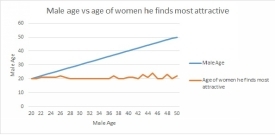
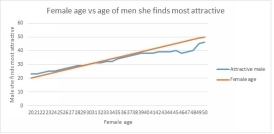
Graph 2 Male age vs age of women he finds most attractive Graph 3 Female Age vs age of men she finds most attractive
The account cites a global ratio of 101 men for every 100 women (2) and suggests that confirmation bias, framing, or base-rate neglect can intensify perceived scarcity. (3) The proposed behavioral link is that someone who fears remaining alone may commit before assessing compatibility.
The proposed sexual market value curve assumes that women’s attractiveness rises early and then declines, while men’s follows a later trajectory. The account further assumes that people extrapolate their recent experience into the future. These assumptions may describe some expectations, but the curve does not establish a common value scale or a predictable path for every person.
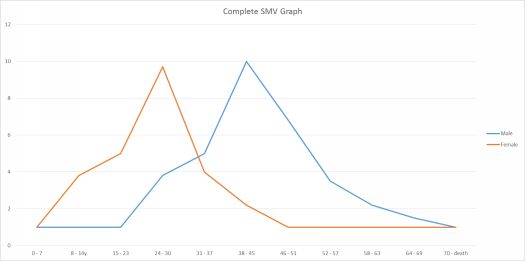
Graph 4 Sexual Market Value Curve
Using those curves, the account proposes that men may underestimate their future options and women may seek commitment as their perceived options narrow. It calls this pattern "AF/BB" in Red Pill terminology. It cites average marriage ages of 29 for men and 27 for women. (4) Those averages do not establish the proposed motives. The model assumes that a man’s attractiveness will increase after thirty while a woman’s will decline (11), and places an average 29-year-old man where it places a woman aged 15 - 17 on its curve. That comparison is an assumption of the model, not evidence about individual partners or an appropriate basis for comparing adult relationships with adolescents.
The account assumes that marriage, pregnancy, and caring for children reduce women’s attractiveness, while men gain status and wealth as they age. (12) It also warns men against the "dad bod". These are broad expectations about gender and life courses; the account supplies no evidence here that they predict a particular couple’s attraction, health, resources, or satisfaction.
The account links women’s fertility and appearance to a decline in dating options after the early thirties. (13) It illustrates its proposed value scale by assigning a woman a decline of 3 points and a man an increase of 3 points, producing a 6-point gap. No measurement method is supplied for those scores. It then compares a woman’s expectations after 15 - 20 years of attention with a trader entering the market in 2008 after leaving during the boom of early 2000. The analogy describes a possible expectation mismatch; it does not validate the curve.
The next assumption is that men’s preferences concentrate on a narrow age group of women, while women’s preferred male age varies with their own age. The account attributes this to reproductive pressures (14) and cites another OKCupid graph. Attraction ratings in a dating-app sample would not by themselves establish the distribution of actual partnerships.
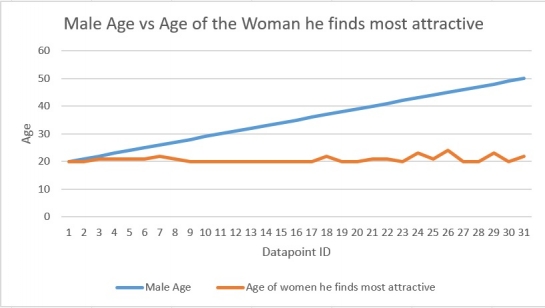
Graph 3 Male age vs the age of the women he finds most attractive
The account extrapolates that 90% of men would prefer the same 10% of women when age alone determines attractiveness. It then claims that hypergamy—preferring a higher-status partner—would produce a corresponding pattern in which 90% of women prefer 10% of men. Historical differences in reproductive success (15) do not by themselves establish either distribution of present-day preferences.
A population with similar numbers of men and women need not form mutually acceptable pairs. Preferences, location, age, and relationship goals matter. Dividing the analysis into relevant groups may help, but an aggregate count alone establishes neither market equilibrium nor an allocation everyone would choose.
The determinants of supply are production costs, expectations of future prices and number of suppliers. The determinants of demand are income, tastes and preferences, prices of related goods and services, consumer expectations about future prices and incomes, number of potential consumers.
If one assumes a controlled form of reproduction where one male and one female were assigned to one another, one would still not achieve 100% reproductive rates due to infertility, death in childbirth claiming both mother and child, and various other factors within the population. However, one would expect similar rates of reproduction between the two sexes.
The account next offers a historical conjecture: rulers and noblemen could maintain harems, while other men had fewer opportunities to reproduce. It suggests that marriage alliances and the prospect of material security could help sustain such arrangements. This is a proposed explanation, rather than a conclusion that follows from aggregate sex ratios.
It compares powerful men’s concentration of partners with an oligopoly. In an economic market, barriers to entry can allow a small number of suppliers to maintain above-average returns. Applying that analogy to marriage requires evidence about the institutions and choices involved.
An oligopoly is a market with a small number of major suppliers. They may compete or collude; concentration alone does not establish collusion. For example, telecom operators might sustain high prices through coordinated conduct or barriers to entry. A monopoly similarly allows a single supplier to restrict competition, though its effects depend on costs, regulation, and alternatives.
From the perspective of the average male, this was hardly a good agreement to enter into; one would live under the rule of a king, toil for what was a short and brutal life, or perhaps die in a war defending the nation for virtually no reward. He is able to produce a good (sperm) yet he is not able to do so in a manner, which is wanted by the market. In a market where one is not able to produce goods wanted by the market, one goes bankrupt, which in evolutionary terms would mean that the genetics of those men would be evolutionary dead ends.
In the analogy, people with few prospects of having children might seek strategies that improve those prospects. The account presents reproducing or not reproducing as a binary outcome. That distinction does not make risk-taking inevitable, or make a person’s own life and death equivalent to reproductive success.
The account conjectures that exclusion from reproductive opportunities could contribute to warfare or revolt. (12) It mentions raids, abduction, and replacing rulers as possible responses, then proposes that monogamous marriage developed to stabilize male participation in society. This is a speculative origin story; the analogy alone cannot establish the causes of war or marriage institutions.
Market regulation becomes necessary and regulations are normally justified with one out of two arguments. The first being market failure, where the market itself fails to regulate the industry in question in some fashion, for instance accounting for externalities or ensuring efficient allocation of resources. The second being when a monopoly or similar, would yield a great tangible benefit. The latter would be the case where extreme economies of scale results in much more efficient operations that benefit the nation.
In this conjecture, limiting rulers’ harems and extending marriage opportunities would give more men a stake in the social order. Calling this reproductive communism expresses the account’s allocation analogy. It assumes that authorities could assign partners and that such arrangements would secure allegiance, without establishing either assumption.
The proposed shift would change competition from the number of partners to the qualities sought in a partner. The account assumes that powerful men would retain preferred partners while other men accepted the remaining opportunities. This describes its hierarchy of preferences, not a demonstrated rule of partner choice.
The historical narrative then assigns similar stabilizing roles to caste in India and religion in Europe. It treats the "state" as the king’s estate and proposes that transferring family support to individual men would release royal resources for investment or war. These broad comparisons would require evidence specific to the societies and periods concerned.
The account calls its simplified resource total Gross Tribal Product (GTP), defined as consumption, investment, and saving. That is an invented accounting frame, with possible overlap between categories. It proposes that fewer royal dependents would free resources for productive investment and expansion, but supplies no calculation showing the size or direction of the effect.
The narrative imagines a growing kingdom in which men support the ruler because they have families and livelihoods, while women seek greater independence. This sequence organizes the account’s argument; it does not demonstrate a general historical progression.
The account then claims that women’s freedom would restore a destabilizing concentration of partners: twenty percent of men attract women while the other 80% turn against those 20%. No evidence is supplied here for those proportions or for the asserted causal link between women’s suffrage and social breakdown.
Its concluding hypothesis is that men without a path to fatherhood will contribute less to society and become hostile to it. That claim needs evidence about the people and institutions involved. Reproductive opportunities alone cannot explain everyone’s motives for work, cooperation, or defending a community.
When to use it
When considering commitment, examine compatibility and shared plans alongside any expectations about future dating options.
Study how a dating app’s user population and matching rules affect the opportunities people actually see.
Examine the proposed economic explanation of marriage institutions against historical evidence and competing explanations.
Test whether preferences for status predict relationship outcomes in a specified population.
FROM THEORY TO EVERYDAY LIFE
In practice
Man settling in late 20s
The account imagines a man marrying at age 29 and assumes his attractiveness will increase after 30 while his wife’s declines. The example illustrates its proposed value curves; it does not establish how either partner will change or whether they will be satisfied with the marriage.
Stock market trader analogy
The account compares a woman dating again in her mid-30s with a trader who left during the early 2000s boom and returned during the 2008 crash. The analogy conveys a possible mismatch between expectations and circumstances, but does not establish a uniform decline in women’s dating prospects.
A MOMENT TO REFLECT
Put it to work.
When have you felt pressure to commit because potential partners seemed scarce? What did you know about your actual options?
What assumptions would you need to justify a single scale of partner value across people with different preferences?
What evidence would distinguish the proposed dating-market explanation of marriage patterns from cultural, legal, or economic alternatives?
CONTINUE THE CONVERSATION
Source texts
- Rolf Dobelli - The Art of Thinking Clearly-Harper Paperbacks (2014)