Sexual Harassment (Boundary Drawing)
The difficulty of defining acceptable behavior in harassment situations is addressed by setting a safe boundary early to create a buffer zone, protecting oneself from gradual escalation and manipulation.
THE IDEA
SEXUAL HARASSMENT
It can be especially hard to draw lines when dealing with people who do not respect boundaries. This can happen if you are the kind of person who likes being generous and being able to help people. Unfortunately people are liable to ask more and more of you. More seriously, it arises in situations of micro-aggressions and sexual harassment: how serious does someone’s misconduct need to be before you should take action and report them?
Some forms of physical contact are generally accepted, such as a handshake. Others are clearly not, such as groping. But where do we draw the line in between? Is touching someone’s shoulder appropriate? Their back? Their waist? Their hip? Do we have to draw a literal line on our bodies to indicate where can count as friendly and where counts as harassment? This is a difficult dilemma for those who have been made uncomfortable by someone’s behaviour, especially if they’re in a position of vulnerability or on the lower side of a power differential. You may worry that reporting someone touching your shoulder will be dismissed as overreacting. So at what point is it worth taking action? If you accept one action then you can feel like the next small escalation isn’t that much worse. But all those small escalations add up.
Manipulative people can actually exploit this to take advantage of people who are prone to being kind, generous or accepting. As soon as you give in once, even a little bit, they know that the boundary can move by a little bit, and so by applying that logic repeatedly, they can think that the boundary is totally movable. If you put your foot down and stop them at some point, they might accuse you of being mean, unreasonable, overreacting.
It can be difficult to identify the exact point at which an interaction will become hurtful or unsafe. We only know where it will definitely hurt us a lot, like if inappropriate physical contact becomes rape.
It took me a while to learn that the best way to be safe is to draw the line somewhere where you definitely feel safe, before things start being at all questionable. This creates a buffer zone encompassing the grey area, protecting us from the area that is definitely dangerous, but without definitely declaring where the buffer zone ends and the unsafe zone starts:
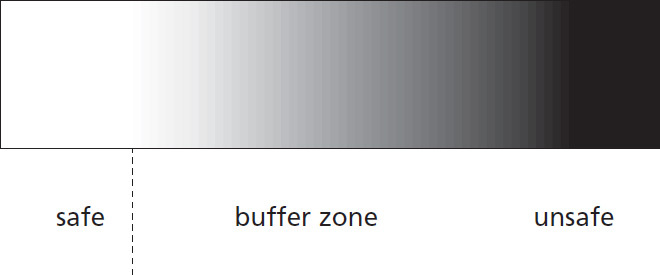
I used to think this was ungenerous, because it means that wherever I draw the line there might have been a little bit more I could allow without getting hurt. But having been hurt too many times I now know I need that buffer zone to protect myself. And I also know that protecting yourself is important, and not necessarily ungenerous. As we saw in Chapter 5, if protecting yourself means denying someone something, or even hurting them, I don’t think it’s your fault if the other person then gets hurt by it. It’s the fault of the system, of the toxic relationship that has created such a zero-sum game.
When to use it
Deciding what physical contact is acceptable in a professional setting.
Setting early boundaries in a new relationship to prevent manipulation.
Establishing a personal policy on microaggressions in social groups.
Defining acceptable behavior for subordinates when you are in a position of power.
FROM THEORY TO EVERYDAY LIFE
In practice
Physical Contact Line-Drawing
A handshake may be welcome while another form of contact is not. Consent, context and the person’s preferences matter, rather than a fixed map of acceptable body parts. Someone may choose an early boundary, including no physical contact, without having to determine exactly where a dangerous interaction would begin.
Workplace Microaggressions
A colleague makes inappropriate jokes and later escalates the behavior. An early boundary may help communicate what is unwelcome, but laughing initially or not objecting does not make someone responsible for later misconduct. Support from colleagues or the organization may be needed.
A MOMENT TO REFLECT
Put it to work.
Where in your life do you have a grey area where you're unsure where to draw the line? How could you create a buffer zone there?
When a boundary has been ignored, what response or support could help you feel safer now?
How can you distinguish between being 'ungenerous' and protecting yourself when setting boundaries?
CONTINUE THE CONVERSATION
Source texts
- The Art of Logic How to Make Sense in a World that Doesn’t (Eugenia Cheng)