Sequence of Arrival of Information
The order in which information is received influences how it is structured into patterns, often resulting in suboptimal arrangements that require creative restructuring to enable further progress.
THE IDEA
Sequence of arrival of information
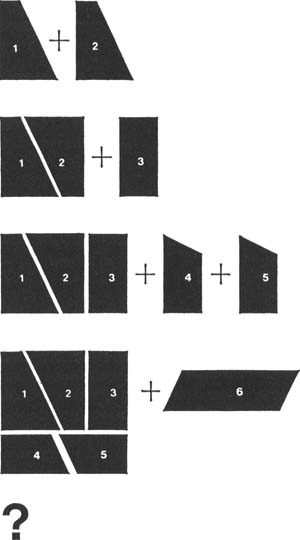
Opposite are shown the outlines of two pieces of thin plastic which are given to someone who is then instructed to arrange them together to give a shape that would be easy to describe. The two pieces are usually arranged to give a square as shown. Then another piece of plastic is added with the same instructions as before. This is simply added to the square to give a rectangle. Two more pieces are now added together. They are put together to give a slab which is added to the rectangle to give a square again. Finally another piece is added. But this new piece will not fit. Although one has been correct at each stage one is unable to proceed further. The new piece cannot be fitted into the existing pattern.
A different way of arranging the plastic pieces is shown below. With this new way of arranging them one can fit in all the pieces including the final one. Yet this other method is less likely to be tried than the first method since a square is so much more obvious than a parallelogram.
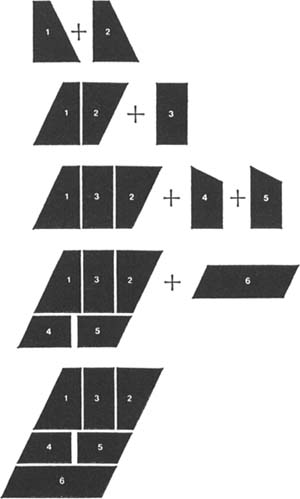
If one started off with the square then one would have to go back and rearrange the pieces at some stage to give a parallelogram before one could proceed. Thus even though one had been correct at each stage one would still have to restructure the situation before being able to proceed.
The plastic pieces indicate what happens in a self-maximizing system. In such a system information available at any moment is always arranged in the best way (most stable in physiological terms). As more information comes in it is added to the existing arrangement as the plastic pieces were added. But being able to make sense of the information at several stages does not mean that one can go on. There comes a time when one cannot proceed further without restructuring the pattern — without breaking up the old pattern which has been so useful and arranging the old information in a new way.
The trouble with a self-maximizing system that must make sense at each moment is that the sequence of arrival of information determines the way it is to be arranged. For this reason the arrangement of information is always less than the best possible arrangement for the best possible arrangement would be quite independent of the sequence of arrival of the pieces of information.
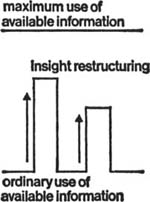
In the mind which is a cumulative memory system the arrangement of information as concepts and ideas tends to make less than the maximum use of the information available. This is shown diagrammatically where the usual level of information use is shown well below the theoretical maximum level. It is by insight restructuring that one can move towards the maximal level.
When to use it
Troubleshooting a technical issue where early assumptions lead to a dead end, requiring a fresh perspective.
Designing a curriculum: the order of topics can either build a coherent framework or create conceptual dead ends.
In business strategy, initial data points can lock a team into a suboptimal approach; periodic restructuring helps avoid this.
Creative problem-solving sessions often use lateral thinking techniques to break free from sequence-induced patterns.
FROM THEORY TO EVERYDAY LIFE
In practice
The Plastic Pieces Puzzle
A person is given plastic pieces step by step and instructed to arrange them into a shape that is easy to describe. Initially, they form a square, then extend to a rectangle, then add more pieces to form a larger square. When the final piece is added, it does not fit. However, if the initial arrangement had been a parallelogram instead of a square, all pieces including the final one would fit. The sequence in which information arrives can produce a pattern that later becomes a dead end and requires restructuring.
A MOMENT TO REFLECT
Put it to work.
Recall a problem where you followed a logical sequence but reached an impasse. How might restructuring the initial assumptions have helped?
In what ways does the order in which you learn new information affect your understanding? Could a different sequence lead to deeper insights?
How can you deliberately break out of an established pattern when the current arrangement of information stops being productive?
CONTINUE THE CONVERSATION
Source texts
- Lateral Thinking A Textbook of Creativity (Edward de Bono)