Self-Anchoring While Understanding Intention
In the reported experiments, listeners sometimes first considered what they could see or were privately thinking about, then adjusted to what the speaker could know. This egocentric interference occurred even when participants knew that their perspectives differed.
THE IDEA
SELF-ANCHORING WHILE UNDERSTANDING INTENTION
Consider the following situation as an illustration. Suppose you are taking a tour of the University of Chicago campus, and the guide stops next to Frank Lloyd Wright’s Robie House. As the tour guide is talking about the Robie House, another building catches your attention because it is particularly unattractive, an unusual sight on that campus. At that point, you hear the guide say, “This building used to be a dormitory.” In order to understand this phrase you must successfully identify the intended referent of “this building.” The referent is most likely the Robie House because it is the topic of conversation and the focus of the group’s attention. Indeed, when the Robie House was operated by the Chicago Theological Seminary between 1926 and 1963, it was used as a dormitory and dining hall. Assume also that you know that the guide is not looking at the other, unattractive building you just saw. One possibility is that you interpret “This building used to be a dormitory,” by considering your knowledge of what the guide is focused on, the topic, and so on. In other words, you would assume that the phrase has been optimally designed with respect to mutual knowledge. This information would immediately lead you to the conclusion that the guide is referring to the Robie House. However, the perspective adjustment theory makes a different prediction.
Instead of restricting your interpretation to what you know about the perspective of the speaker, your initial interpretation is anchored egocentrically – that is, in information available to you. This would lead you to identify quickly the unattractive building you were looking at as the intended referent of the guide’s utterance, “This building used to be a dormitory.” However, given that you know the perspective of the guide, you attempt to adjust to the guide’s perspective. In general, then, the theory suggests a systematically egocentric error pattern, although the error might sometimes only be momentary. Such an interpretation error would occur whenever available, egocentric information suggests a different interpretation than the shared perspective.
To test between these two alternatives, Keysar, Barr, Balin, and Paek (1998) created a situation analogous to the Robie House case, except the participants in the experiment conversed about pictures of objects such as buildings, not the objects themselves. Unknown to the participants, we controlled critical moments during the experiment when we diverted the attention of the addressee to a picture that was not part of mutual focus. Immediately following this diversion, addressees heard an utterance from a confederate director that referred to the picture in mutual focus. Each critical moment was analogous to the example of looking at the unattractive building, which was not the topic of conversation, and then hearing, “This building used to be a dormitory.”
We reasoned that if addressees interpret this utterance egocentrically, then the picture of the unattractive building should be identified as the referent. This temporary error should delay the identification of the picture of the Robie House as the actual referent. Indeed, participants in our experiment took longer to identify the Robie House as the referent when their attention was diverted to the unattractive building (which also could be a referent of “this building”), compared to a control condition when they were looking at a picture of a truck (which could not be a referent of “this building.”) The interference is consistent with an egocentric anchor: the listener temporarily considers the building that has caught their own attention.
If understanding is guided by the principle of optimal design, then differences in perspectives should not matter. Instead, we found that differences in perspective lead to a systematic pattern of errors, even when the differences are well known. In the case of the Robie House, the unattractive building was not the topic of the conversation, but it was physically present. The perspective of the tour guide was different to the extent that the guide was not focused on that building. In one sense, perspectives always diverge as individuals have private thoughts about things that are not present. We also explored the possibility that addressees search even their private thoughts for potential referents.
Consider the use of pronouns: Pronouns can be used to make definite reference to specific entities in the world, just as the demonstrative reference in “this building.” When a speaker says, “He is courageous,” the speaker is using the pronoun “he” to refer to a specific individual. The use of pronouns, like other definite descriptions, presupposes that the referent is readily identifiable by the listener (Chafe, 1976). Therefore, when a speaker is using a pronoun appropriately, the referent of that pronoun should be selected from among entities that are mutually known. Because the perspective adjustment theory suggests differently, we investigated how people understand pronouns.
The experiments were modeled after the following situation: Suppose that a history professor and a student are discussing topics for a term paper. After considering several options, the student proposes to write about Niccolo Machiavelli. The mention of Machiavelli reminds the professor of John Smith, a colleague whose political intrigues had recently been revealed. As the thought of John Smith crosses the professor’s mind, the student comments: “I think he has been greatly misunderstood.” Who would the professor take the pronoun “he” to refer to? Our experiments show that the professor indeed interprets the utterance egocentrically, and in some cases identifies the referent of “he” to be John Smith instead of Machiavelli. The participants in our experiment made incorrect interpretations three times as often when the professor was reminded of an intrigue-related colleague whose name was John compared to a colleague whose name was Mary. In addition, when the participants correctly identified the referent of “he” to be Machiavelli, there was evidence that they had to adjust their perspective: They took longer to identify Machiavelli as the referent of “he” when they were thinking of a colleague named John rather than a colleague named Mary. So when the private thought was about a person whose gender fit the pronoun, that person was considered as the referent. The fact that the thought is private and not shared by the other person is not sufficient to preempt anchoring in an egocentric interpretation.
A further test used an eyetracking system (Keysar, Barr, Balin, & Brauner, 2000). One participant sat in front of an array of objects as shown in Fig. 8.1. Another participant, who was actually a confederate, sat on the other side of the array. They played a simple game: The confederate (the “director”) received a picture that included objects from the array but in different locations. The director then instructed the participant, the addressee, to rearrange objects to match the picture. Although most objects were mutually visible, some objects were occluded so that only the addressee could see them. They did not appear in the director’s photograph and were therefore not part of the game.
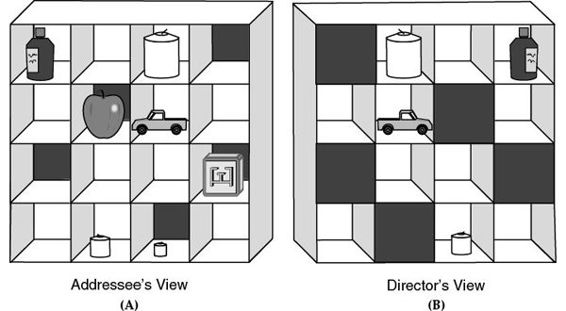
Figure 8.1. The array of objects from (A) the addressee’s and (B) the director’s perspectives. The two views are distinct because of the occluded slots. The critical instruction (“Put the small candle next to the truck”) picks out a different candle from the director’s perspective (the shared candle) than from the addressee’s perspective (the occluded candle).
Using an eyetracking device, we tracked the addressee’s eye movements as they followed the director’s instructions. It has been demonstrated that as soon as people identify an object as a referent, their eye fixates on that object as a precursor to the reach of the hand (Tanenhaus, Spivey-Knowlton, Eberhard, & Sedivy, 1995). Therefore, the eye movement information in our experiment indicated which objects addressees were considering as referents at any given moment.
Figure 8.1 illustrates how we tested the theory. At a critical point, the director told the addressee, “Put the small candle next to the truck.” The only candles that are relevant here are those that are visible from the director’s perspective: a large candle on the top row and a smaller one on the bottom row. Clearly, the director is talking about the mutually visible candle on the bottom row. The addressee, however, can also see a third candle that is obviously invisible to the director. Would the addressees consider the occluded candle as the intended candle?
The observed looking and reaching patterns suggest that they do. Addressees take the occluded candle to be the referent before correcting themselves and adjusting to the director’s perspective. In 25% of the cases, the addressee actually reached for the occluded candle, sometimes correcting in midair, sometimes lifting it briefly, returning it, then picking up the correct candle. This demonstrates strikingly how addressees egocentrically identify a referent and then adjust to the speaker’s perspective.
However, even when the addressee did not reach for the occluded candle, there was evidence for an egocentric anchor and adjustment. As soon as the addressees heard the expression “the small candle,” their eye was fastest to fixate on the occluded candle – suggesting that they initially identified it as the intended candle. In most cases, one could see the adjustment as the eye moved from the occluded candle and eventually fixated on the candle next to it, the one intended by the director. Such adjustment delayed the identification of the intended candle: The addressees fixated on the intended object much later when the occluded slot contained a small candle than in a control condition, when the occluded slot contained an entirely different object that could not be a referent (e.g., a small toy monkey).
The robustness of the effects, along with the fact that participants reached for objects that the director could not see at all, made us somewhat concerned. We suspected that participants might not have paid attention to the difference between visible and occluded objects. It seemed possible that participants simply did not notice which objects were actually occluded from the director’s perspective. To test this possibility, we asked participants to hide the occluded objects themselves. In spite of this, the experiment demonstrated the same interference effects and the same tendency to reach for those objects that could only be referents from the participant’s egocentric perspective.
In these experiments, knowing that the director could not see an object did not always prevent the listener from considering it. The findings support an account in which a listener’s own perspective can interfere with initial interpretation, followed by adjustment toward the speaker’s perspective. They do not show that every utterance must be understood through that sequence.
When to use it
Understanding instructions in a busy workplace when your attention is momentarily distracted.
Interpreting ambiguous pronouns in a conversation where you have private information about a possible referent.
Deciphering directions given by a tour guide when different landmarks are visible to you but not to the guide.
Collaborating on a task where each person has different access to information (e.g., in a command-and-control center).
FROM THEORY TO EVERYDAY LIFE
In practice
Robie House tour guide
In the tour illustration, a guide says 'This building used to be a dormitory' about the Robie House while a listener is looking at another building. The theory predicts that the listener may briefly consider the building in their own focus before adjusting to the shared topic.
Professor and student discussing Machiavelli
In the illustration, a student mentions Machiavelli, reminding a professor of a colleague named John Smith. The student’s 'I think he has been greatly misunderstood' may briefly bring John to the professor’s mind as the referent, even though the student has not mentioned him.
Eyetracking experiment with candles
Participants rearranged objects based on a director's instructions. When told 'Put the small candle next to the truck,' they often initially fixated on or even reached for a candle visible only to them, even though the director could not see it, before adjusting to the mutually visible candle.
A MOMENT TO REFLECT
Put it to work.
Can you recall a situation where you misinterpreted someone’s statement because your attention was focused elsewhere? How did you realize the error?
In a multicultural team, how might differences in background knowledge amplify self-anchoring effects during communication?
What strategies could you use to consciously adjust from your own perspective to the speaker’s perspective in real-time conversation?
Often confused with
References
- Study on egocentric interpretation of referring expressions — Keysar, B., Barr, D. J., Balin, J. A., & Paek, T. S. (1998)
- Eyetracking study on perspective adjustment in referential communication — Keysar, B., Barr, D. J., Balin, J. A., & Brauner, J. S. (2000)
- Givenness, contrastiveness, definiteness, subjects, topics, and point of view — Chafe, W. (1976)
- Integration of visual and linguistic information in spoken language comprehension — Tanenhaus, M. K., Spivey-Knowlton, M. J., Eberhard, K. M., & Sedivy, J. C. (1995)
CONTINUE THE CONVERSATION
Source texts
- Heuristics and Biases The Psychology of Intuitive Judgment (Thomas Gilovich, Dale Griffin, Daniel Kahneman)