Seeing Circles of Causality
Systems thinking looks for feedback: actions change conditions, which in turn influence later actions. Senge uses filling a glass of water to show how a seemingly simple action involves a continuing loop of observation and adjustment.
THE IDEA
SEEING CIRCLES OF CAUSALITY
Reality is made up of circles but we see straight lines. Herein lie the beginnings of our limitation as systems thinkers. One of the reasons for this fragmentation in our thinking stems from our language. Language shapes perception. What we see depends on what we are prepared to see. Western languages, with their subject-verb-object structure, are biased toward a linear view. If we want to see systemwide interrelationships, we need a language of interrelationships, a language made up of circles. Without such a language, our habitual ways of seeing the world produce fragmented views and counterproductive actions—as it has done for decision makers in the war on terrorism. Such a language is important in facing dynamically complex issues and strategic choices, especially when individuals, teams, and organizations need to see beyond events and into the forces that shape change.
To illustrate the rudiments of the new language, consider a very simple system—filling a glass of water. You might think, “That’s not a system—it’s too simple.” But think again.
From the linear viewpoint, we say, “I am filling a glass of water.” What most of us have in mind looks pretty much like the following picture:
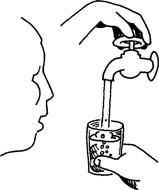
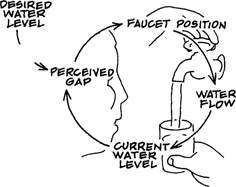
But, in fact, as we fill the glass, we are watching the water level rise. We monitor the “gap” between the level and our goal, the desired water level. As the water approaches the desired level, we adjust the faucet position to slow the flow of water, until it is turned off when the glass is full. In fact, when we fill a glass of water we operate in a water-regulation system involving five variables: our desired water level, the glass’s current water level, the gap between the two, the faucet position, and the water flow. These variables are organized in a circle or loop of cause-effect relationships which is called a “feedback process.” The process operates continuously to bring the water level to its desired level.
People get confused about feedback because we often use the word in a somewhat different way—to gather opinions about an act we have undertaken. “Give me some feedback on the brewery decision,” you might say. “What did you think of the way I handled it?” In that context, “positive feedback” means encouraging remarks and “negative feedback” means bad news. But in systems thinking, feedback is a broader concept. It means any reciprocal flow of influence. In systems thinking it is an axiom that every influence is both cause and effect. Nothing is ever influenced in just one direction.
When to use it
Analyzing why a business process isn't improving despite individual changes—uncovering reinforcing or balancing feedback loops.
Understanding traffic congestion as a system where driver behavior, road capacity, and traffic signals form feedback loops.
Mapping how team morale affects performance and how performance then affects morale. Whether the loop reinforces or counteracts a change depends on those relationships, rather than on whether a comment sounds positive or negative.
Evaluating the war on terrorism as a system where actions and reactions create unintended feedback cycles—highlighted in the text.
FROM THEORY TO EVERYDAY LIFE
In practice
Filling a Glass of Water
From a linear view, we say 'I am filling a glass of water.' But in reality, we monitor the gap between the current water level and the desired level, adjusting the faucet position to slow the flow until the glass is full. This is a feedback process involving five variables (desired level, current level, gap, faucet position, water flow) organized in a cause-effect loop.
A MOMENT TO REFLECT
Put it to work.
Think of a recent problem you tried to solve. Did you assume a linear cause-effect chain? How might viewing it as a feedback loop with multiple variables change your approach?
What aspects of your daily life are influenced by feedback loops that you currently see as linear? Identify one and map the variables involved.
How does the structure of your language (subject-verb-object) influence the way you perceive causality? Can you rephrase a statement to reflect circular interrelationships?
Often confused with
CONTINUE THE CONVERSATION
Source texts
- The Fifth Discipline The Art Practice of the Learning Organization (Peter M. Senge)