Risk Aversion and Loss Aversion
People are risk-averse when facing potential gains and risk-seeking when facing potential losses, a pattern explained by a psychological value function that is concave for gains, convex for losses, and steeper for losses (loss aversion). This challenges classical expected utility theory and forms the basis of prospect theory.
THE IDEA
RISKY CHOICE
Risky choices, such as whether or not to take an umbrella and whether or not to go to war, are made without advance knowledge of their consequences. Because the consequences of such actions depend on uncertain events such as the weather or the opponent’s resolve, the choice of an act may be construed as the acceptance of a gamble that can yield various outcomes with different probabilities. It is therefore natural that the study of decision making under risk has focused on choices between simple gambles with monetary outcomes and specified probabilities, in the hope that these simple problems will reveal basic attitudes toward risk and value.
We shall sketch an approach to risky choice that derives many of its hypotheses from a psychophysical analysis of responses to money and to probability. The psychophysical approach to decision making can be traced to a remarkable essay that Daniel Bernoulli published in 1738 (Bernoulli 1954) in which he attempted to explain why people are generally averse to risk and why risk aversion decreases with increasing wealth. To illustrate risk aversion and Bernoulli’s analysis, consider the choice between a prospect that offers an 85% chance to win $1,000 (with a 15% chance to win nothing) and the alternative of receiving $800 for sure. A large majority of people prefer the sure thing over the gamble, although the gamble has higher (mathematical) expectation. The expectation of a monetary gamble is a weighted average, where each possible outcome is weighted by its probability of occurrence. The expectation of the gamble in this example is .85 × $1,000 + .15 × $0 = $850, which exceeds the expectation of $800 associated with the sure thing. The preference for the sure gain is an instance of risk aversion. In general, a preference for a sure outcome over a gamble that has higher or equal expectation is called risk averse, and the rejection of a sure thing in favor of a gamble of lower or equal expectation is called risk seeking.
Bernoulli suggested that people do not evaluate prospects by the expectation of their monetary outcomes, but rather by the expectation of the subjective value of these outcomes. The subjective value of a gamble is again a weighted average, but now it is the subjective value of each outcome that is weighted by its probability. To explain risk aversion within this framework, Bernoulli proposed that subjective value, or utility, is a concave function of money. In such a function, the difference between the utilities of $200 and $100, for example, is greater than the utility difference between $1,200 and $1,100. It follows from concavity that the subjective value attached to a gain of $800 is more than 80% of the value of a gain of $1,000. Consequently, the concavity of the utility function entails a risk averse preference for a sure gain of $800 over an 80% chance to win $1,000, although the two prospects have the same monetary expectation.
It is customary in decision analysis to describe the outcomes of decisions in terms of total wealth. For example, an offer to bet $20 on the toss of a fair coin is represented as a choice between an individual’s current wealth W and an even chance to move to W + $20 or to W – $20. This representation appears psychologically unrealistic: People do not normally think of relatively small outcomes in terms of states of wealth but rather in terms of gains, losses, and neutral outcomes (such as the maintenance of the status quo). If the effective carriers of subjective value are changes of wealth rather than ultimate states of wealth, as we propose, the psychophysical analysis of outcomes should be applied to gains and losses rather than to total assets. This assumption plays a central role in a treatment of risky choice that we called prospect theory (Kahneman and Tversky 1979). Introspection as well as psychophysical measurements suggest that subjective value is a concave function of the size of a gain. The same generalization applies to losses as well. The difference in subjective value between a loss of $200 and a loss of $100 appears greater than the difference in subjective value between a loss of $1,200 and a loss of $1,100. When the value functions for gains and for losses are pieced together, we obtain an S-shaped function of the type displayed in Figure 1.
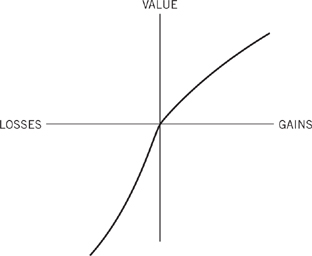
Figure 1. A Hypothetical Value Function
The value function shown in Figure 1 is (a) defined on gains and losses rather than on total wealth, (b) concave in the domain of gains and convex in the domain of losses, and (c) considerably steeper for losses than for gains. The last property, which we label loss aversion, expresses the intuition that a loss of $X is more aversive than a gain of $X is attractive. Loss aversion explains people’s reluctance to bet on a fair coin for equal stakes: The attractiveness of the possible gain is not nearly sufficient to compensate for the aversiveness of the possible loss. For example, most respondents in a sample of undergraduates refused to stake $10 on the toss of a coin if they stood to win less than $30.
The assumption of risk aversion has played a central role in economic theory. However, just as the concavity of the value of gains entails risk aversion, the convexity of the value of losses entails risk seeking. Indeed, risk seeking in losses is a robust effect, particularly when the probabilities of loss are substantial. Consider, for example, a situation in which an individual is forced to choose between an 85% chance to lose $1,000 (with a 15% chance to lose nothing) and a sure loss of $800. A large majority of people express a preference for the gamble over the sure loss. This is a risk seeking choice because the expectation of the gamble (–$850) is inferior to the expectation of the sure loss (–$800). Risk seeking in the domain of losses has been confirmed by several investigators (Fishburn and Kochenberger 1979; Hershey and Schoemaker 1980; Payne, Laughhunn, and Crum 1980; Slovic, Fischhoff, and Lichtenstein 1982). It has also been observed with nonmonetary outcomes, such as hours of pain (Eraker and Sox 1981) and loss of human lives (Fischhoff 1983; Tversky 1977; Tversky and Kahneman 1981). Is it wrong to be risk averse in the domain of gains and risk seeking in the domain of losses? These preferences conform to compelling intuitions about the subjective value of gains and losses, and the presumption is that people should be entitled to their own values. However, we shall see that an S-shaped value function has implications that are normatively unacceptable.
To address the normative issue we turn from psychology to decision theory. Modern decision theory can be said to begin with the pioneering work of von Neumann and Morgenstern (1947), who laid down several qualitative principles, or axioms, that should govern the preferences of a rational decision maker. Their axioms included transitivity (if A is preferred to B and B is preferred to C, then A is preferred to C), and substitution (if A is preferred to B, then an even chance to get A or C is preferred to an even chance to get B or C), along with other conditions of a more technical nature. The normative and the descriptive status of the axioms of rational choice have been the subject of extensive discussions. In particular, there is convincing evidence that people do not always obey the substitution axiom, and considerable disagreement exists about the normative merit of this axiom (e.g., Allais and Hagen 1979). However, all analyses of rational choice incorporate two principles: dominance and invariance. Dominance demands that if prospect A is at least as good as prospect B in every respect and better than B in at least one respect, then A should be preferred to B. Invariance requires that the preference order between prospects should not depend on the manner in which they are described. In particular, two versions of a choice problem that are recognized to be equivalent when shown together should elicit the same preference even when shown separately. We now show that the requirement of invariance, however elementary and innocuous it may seem, cannot generally be satisfied.
When to use it
Investment decisions: Investors may hold losing stocks too long (risk seeking to avoid realizing a loss) and sell winning stocks too early (risk aversion to lock in gains).
Insurance: People buy insurance to avoid a sure loss (risk averse), but may not insure against small probable losses due to high premiums, influenced by loss aversion.
Negotiations: Framing offers in terms of gains or losses affects the opponent's willingness to accept; a concession framed as a loss is more painful than a gain is attractive.
Public policy: Framing a policy as preventing a loss (e.g., lives saved) vs. allowing a loss (e.g., lives lost) can significantly influence public support and decisions.
FROM THEORY TO EVERYDAY LIFE
In practice
Risk Aversion for Gains
A choice between an 85% chance to win $1,000 (with a 15% chance to win nothing) and a sure $800. Most people prefer the sure $800 despite the gamble having higher expected value ($850). People are risk-averse in the domain of gains.
Risk Seeking for Losses
A choice between an 85% chance to lose $1,000 (with a 15% chance to lose nothing) and a sure loss of $800. Most people prefer the gamble, even though it has a worse expected value (–$850 vs –$800). This shows risk seeking in the domain of losses.
A MOMENT TO REFLECT
Put it to work.
Think of a recent financial decision you made. Were you more risk-averse for potential gains and risk-seeking for potential losses? How does the S-shaped value function apply?
Consider a situation where you had to choose between a sure loss and a gamble. Which did you choose and why? How does loss aversion influence your choice?
How might the framing of a problem as a gain or a loss affect your decision in everyday life, such as choosing between a discount or a surcharge?
Often confused with
References
- Exposition of a New Theory on the Measurement of Risk — Daniel Bernoulli (1954)
- Prospect Theory: An Analysis of Decision under Risk — Daniel Kahneman and Amos Tversky (1979)
- Theory of Games and Economic Behavior — John von Neumann and Oskar Morgenstern (1947)
- Fishburn and Kochenberger — Peter C. Fishburn and Gary A. Kochenberger (1979)
- Hershey and Schoemaker — John C. Hershey and Paul J.H. Schoemaker (1980)
- Payne, Laughhunn, and Crum — John W. Payne, Dan J. Laughhunn, and Roy Crum (1980)
- Slovic, Fischhoff, and Lichtenstein — Paul Slovic, Baruch Fischhoff, and Sarah Lichtenstein (1982)
- Eraker and Sox — Stephen A. Eraker and Harold C. Sox (1981)
- Fischhoff — Baruch Fischhoff (1983)
- Tversky — Amos Tversky (1977)
- Tversky and Kahneman — Amos Tversky and Daniel Kahneman (1981)
- Allais and Hagen — Maurice Allais and Ole Hagen (1979)
CONTINUE THE CONVERSATION
Source texts
- Thinking, Fast and Slow (Daniel Kahneman)