Reinforcing Feedback
Reinforcing feedback is a process where a small change amplifies itself, leading to growth or decline. It can result in virtuous cycles (good outcomes) or vicious cycles (bad outcomes).
THE IDEA
REINFORCING FEEDBACK: DISCOVERING HOW SMALL CHANGES CAN GROW
If you are in a reinforcing feedback system, you may be blind to how small actions can grow into large consequences—for better or for worse. Seeing the system often allows you to influence how it works.
For example, managers frequently fail to appreciate the extent to which their own expectations influence subordinates’ performance. If I see a person as having high potential, I give him special attention to develop that potential. When he flowers, I feel that my original assessment was correct and I help him still further. Conversely, those I regard as having lower potential languish in disregard and inattention, perform in a disinterested manner, and further justify, in my mind, the lack of attention I give them.
Robert Merton identified this phenomenon as the “self-fulfilling prophecy.”8 It is also known as the “Pygmalion effect,” after the famous George Bernard Shaw play (later to become My Fair Lady). Shaw in turn had taken his title from Pygmalion, a character in Greek and Roman mythology, who believed so strongly in the beauty of the statue he had carved that it came to life.
Pygmalion effects have been shown to operate in countless situations.9 An example occurs in schools, where a teacher’s opinion of a student influences the behavior of that student. Jane is shy and does particularly poorly in her first semester at a new school (because her parents are fighting constantly). This leads her teacher to form an opinion that she is unmotivated. Next semester, the teacher pays less attention to Jane and she does poorly again, withdrawing further. Over time, Jane gets caught in an ever-worsening spiral of withdrawal, poor performance, labeling by her teachers, inattention, and further withdrawing. Thus, students are unintentionally “tracked” into a high self-image of their abilities, where they get personal attention, or a low self-image, where their poor classwork is reinforced in an ever-worsening spiral.
In reinforcing processes such as the Pygmalion effect, a small change builds on itself. Whatever movement occurs is amplified, producing more movement in the same direction. A small action snowballs, with more and more and still more of the same, resembling compounding interest. Some reinforcing (amplifying) processes are “vicious cycles,” in which things start off badly and grow worse. A “gas crisis” is a classic example. Once word that gasoline is becoming scarce gets out it sets off a spate of trips to local service stations, to fill up. Once people start seeing lines of cars, they are convinced that the crisis is here. Panic and hoarding then set in. Before long, everyone is “topping off” their tanks when they are only one-quarter empty, lest they be caught when the pumps go dry. The same thing happens when there is a run on food or water before a major storm and people expect power to be out and normal supplies to disappear. A run on a bank is another example, as is a panic to sell off a type of stock when the word gets out that values are falling. All are escalation structures where small moves in an undesirable direction set off a reinforcing spiral.
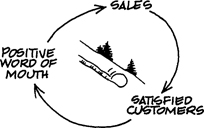
But there’s nothing inherently bad about reinforcing loops. There are also virtuous cycles—processes that reinforce in desired directions. For instance, physical exercise can lead to a reinforcing spiral; you feel better, thus you exercise more, thus you’re rewarded by feeling better and exercise still more. Reinforcing spirals can also contribute to the growth of a new product. For example, many products grow from “word of mouth.” Word of mouth about a product can reinforce a snowballing demand (as occurred with the Volkswagen Beetle and the iPod) as satisfied customers tell others who then become satisfied customers, who tell still others. Networked devices can add another reinforcing dynamic when sharing works best among people using compatible devices or services.
Here is how you might diagram the positive word-of-mouth process that drives growth in sales and satisfaction:
When to use it
A manager wants to improve team performance by setting high expectations and providing support, creating a virtuous cycle of motivation and achievement.
A community facing a potential panic (e.g., before a storm) can understand reinforcing dynamics to implement calming measures and prevent hoarding.
A company launching a new product can leverage word-of-mouth marketing to create a reinforcing growth loop, encouraging early adopters to share their experiences.
An individual wanting to start a new habit (like exercise) can design a system that rewards small successes, turning initial effort into a self-reinforcing spiral of improvement.
FROM THEORY TO EVERYDAY LIFE
In practice
Pygmalion Effect in Management
A manager forms expectations about a subordinate's potential. If perceived as high potential, the manager provides more attention and development opportunities. The subordinate then performs better, confirming the manager's original assessment and reinforcing the cycle of increased attention and performance.
Gas Crisis Panic
When rumors of a gas shortage spread, drivers rush to fill their tanks. Seeing long lines at stations convinces others that a shortage is real, leading to more panic buying and hoarding. The initial small actions of a few escalate into a full-blown crisis as the reinforcing loop amplifies the behavior.
Word-of-Mouth Product Growth
Satisfied customers may tell others about a product, leading to new buyers who may recommend it in turn. This can reinforce demand. It does not require every customer to become a promoter or guarantee exponential growth.
A MOMENT TO REFLECT
Put it to work.
Can you identify a reinforcing feedback loop in your personal life or work? How might a small change become amplified over time?
Think of a time when a self-fulfilling prophecy affected your performance. How could awareness of reinforcing feedback have changed the outcome?
What virtuous cycles can you initiate to improve a situation, and what small actions could trigger them?
References
- Self-Fulfilling Prophecy — Robert Merton
CONTINUE THE CONVERSATION
Source texts
- The Fifth Discipline The Art Practice of the Learning Organization (Peter M. Senge)