Redefining Your Scope of Influence in the Beer Game
In the Beer Game supply-chain simulation, orders change other players’ inventories and delivery delays. Players can reduce costly swings by tracking orders already in transit and considering how their reactions affect the whole chain. Repeatedly ordering more in response to delays can amplify the shortage they are trying to fix.
THE IDEA
REDEFINING YOUR SCOPE OF INFLUENCE: HOW TO IMPROVE PERFORMANCE IN THE BEER GAME
To begin to see the possibilities for improvement, consider the outcomes if each player did nothing to correct his or her inventory or backlog. Following the “no strategy” strategy, each player would simply place new orders equal to orders he or she received. This is about the simplest ordering policy possible. If you receive new incoming orders for four cases of beer, you place orders for four. If you receive incoming orders for eight, you place orders for eight. Given the pattern of consumer demand in this game, that means ordering four cases or truckloads every week—until you receive your first order of eight. Thereafter you order eight.
When this strategy is followed unswervingly by all three players, all three positions settle into a form of stability by Week 11. The retailer and wholesaler never quite catch up with their backlogs. Backlogs develop, as in the basic game, due to the delays in getting orders filled. Backlogs persist because the players make no effort to correct them—because the “no strategy” strategy precludes placing the orders in excess of orders received needed to correct backlogs.
Is the “no strategy” strategy successful? Probably, most players would say no. After all, the strategy generates persistent backlogs. Everyone throughout the system is kept waiting longer than necessary for his orders to be filled. In real life, such a situation would, undoubtedly, invite competitors to enter a market and provide better delivery service. Only producers/distributors with monopolies on markets would be likely to stick to such a strategy.15
But the strategy eliminates the buildup and collapse in ordering, and the associated wild swings in inventories. Moreover, total cost generated by all positions in the “no strategy” strategy is lower than what is achieved by 75 percent of the teams that play the game16 — Figure unavailable in the source files. In other words, the majority of players in the game, many of them experienced managers, do much worse than if they simply placed orders equal to the orders they receive. In trying to correct the imbalances that result from “doing nothing,” most players make matters worse—in many cases dramatically worse.
On the other hand, about 25 percent of the players score better than the “no strategy” strategy, and about 10 percent score very much better. In other words, success is possible. But it requires a shift of view for most players. It means getting to the heart of fundamental mismatches between common ways of thinking about the game—what we will later call our “mental model” of it—and the actual reality of how the game works. Most players see their job as “managing their position” in isolation from the rest of the system. What is required is to see how their position interacts with the larger system.
Consider how you feel if you are a typical player at any position. You pay close attention to your own inventory, costs, backlog, orders, and shipments. Incoming orders come from “outside”—most wholesalers and brewers, for instance, are shocked by the implacable mystery of those latter-half orders, which should be high numbers, but instead appear week after week as “zero, zero, zero, zero.” You respond to new orders by shipping out beer, but you have little sense of how those shipments will influence the next round of orders. Likewise, you have only a fuzzy concept of what happens to the orders you place; you simply expect them to show up as new shipments after a reasonable delay. Your perspective of the system looks something like the following figure.
Given this picture of the situation, if you need beer it makes sense to place more orders. If your beer doesn’t arrive when expected, you place still more orders. Given this picture of the situation, your job is to manage your position, reacting to changes in the external inputs of incoming orders, beer arrivals, and your supplier’s delivery delay.
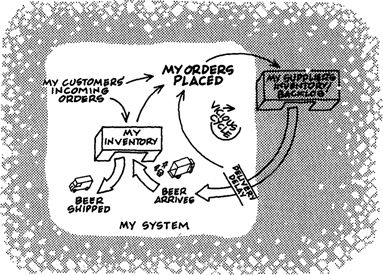
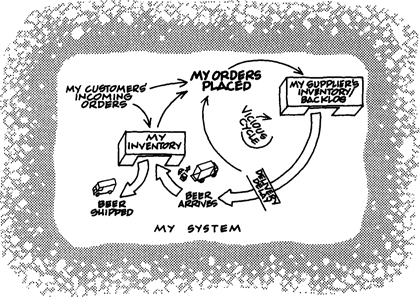
What the typical “manage your position” view misses is the ways that your orders interact with others’ orders to influence the variables you perceive as “external.” The players are part of a larger system that most perceive only dimly. For example, if they place a large number of orders, they can wipe out their supplier’s inventory, thereby causing their supplier’s delivery delay to increase. If they, then, respond (as many do) by placing still more orders, they create a “vicious cycle” that increases problems throughout the system.
This vicious cycle can be set off by any player who panics, anywhere within the system—whether retailer, or wholesaler. Even factories can create the same effect, simply by failing to produce enough beer. Eventually, as one vicious cycle influences other vicious cycles, the resulting panic spreads up and down the entire production-distribution system. Once the panic builds momentum, I have seen players generate orders that are twenty to fifty times what is actually needed to correct real inventory imbalances.
To improve performance in the beer game players must redefine their scope of influence. As a player in any position, your influence is broader than the limits of your own position. You don’t simply place orders which go off into the ether and return as beer supplies; those orders influence your supplier’s behavior. Which in turn might influence yet another supplier’s behavior. In turn, your success is not just influenced by your orders; it is influenced by the actions of everyone else in the system. For example, if the brewery runs out of beer, then pretty soon, everyone else will run out of beer. Either the larger system works, or your position will not work. Interestingly, in the beer game and in many other systems, in order for you to succeed others must succeed as well. Moreover, each player must share this systems viewpoint—for, if any single player panics and places a large order, panics tend to reinforce throughout the system.
There are two key guidelines for players in the game.
First, keep in mind the beer you ordered but that, because of the delay, has not yet arrived. I call this the “take two aspirin and wait” rule. If you have a headache and need to take aspirin, you don’t keep taking aspirin every five minutes until your headache goes away. You wait patiently for the aspirin to take effect because you know that aspirin operates with a delay. Many players keep ordering beer every week until their inventory discrepancy goes away.
Second, don’t panic. When your supplier can’t get you the beer you want as quickly as normal, the worst thing you can do is order more beer. Yet, that is exactly what many players do. It takes discipline to contain the overwhelming urge to order more when backlogs are building and your customers are screaming. But, without that discipline, you and everyone else will suffer.
These guidelines are consistently missed by most players because they are evident only if you understand the interactions that cross the boundaries between different positions. The “take two aspirin and wait” guideline comes from understanding the delay embedded in the response of your supplier’s shipments to changes in your orders placed. The “don’t panic” guideline comes from understanding the vicious cycle created when the orders you place exacerbate your supplier’s delivery delay.
How well can players do if they follow these guidelines?
It is not possible to totally eliminate all overshoots in orders and all inventory/backlog cycles. It is possible to hold these instabilities to a very modest level, a small fraction of what occurred in Lover’s Beer. It is possible to achieve total costs that are one-fifth of the “do nothing” strategy, or about one-tenth the typical costs achieved by teams. In other words, substantial improvements are possible.
When to use it
Supply chain management to avoid bullwhip effect
Cross-functional project teams to align actions and reduce finger-pointing
Crisis management where coordinated calm response prevents escalation
Any multi-stakeholder environment where actions have delayed feedback effects
FROM THEORY TO EVERYDAY LIFE
In practice
The Beer Game Simulation
In the Beer Game described here, retailers, wholesalers, and brewers often amplify inventory swings while trying to fix their own shortages. A baseline policy that matches new orders to incoming orders costs less than the results of 75% of teams, although it leaves persistent backlogs. Players who account for goods already ordered and avoid panic ordering can do much better: Senge reports costs as low as one-tenth of typical teams’ costs.
Real-World Supply Chain Panic
During demand spikes or supply disruptions, companies may increase orders to their suppliers, causing suppliers to increase production or allocate inventory, leading to longer lead times and further panic ordering. This vicious cycle mirrors the Beer Game and illustrates the need to understand system-wide delays and avoid overreacting.
A MOMENT TO REFLECT
Put it to work.
How might your current view of your role in an organization limit your effectiveness in achieving system-wide goals?
Think of a situation where you or your team 'panicked' and took actions that made things worse. What would the 'take two aspirin and wait' rule have suggested?
In what areas of your life or work do delays exist that you often fail to account for in your decision-making?
Often confused with
CONTINUE THE CONVERSATION
Source texts
- The Fifth Discipline The Art Practice of the Learning Organization (Peter M. Senge)