Rationality as Survival
Nassim Nicholas Taleb proposes judging rationality by whether actions help people and communities survive and avoid ruin. He argues that some customs or apparently mistaken beliefs can support useful behavior even when people cannot explain why. This is a functional account of belief; the survival of a practice alone does not prove that it caused a group to survive.
THE IDEA
How to Be Rational About Rationality
In this passage from Skin in the Game, Nassim Nicholas Taleb argues for survival and avoidance of ruin as criteria of rational action. His claims about the functions of religion and custom form part of that argument.
Restaurants without kitchens—Science from the grave—Do not shoot to the left of piano players—Merchants of rationality
My friend Rory Sutherland claims that the real function of swimming pools is to allow the middle class to sit around in bathing suits without looking ridiculous. Same with New York restaurants: you think their mission is to feed people, but that’s not what they are about. They are in the business of overcharging you for liquor or Great Tuscan wines by the glass, yet get you in the door by serving you your low-carb (or low-something) dishes at break-even cost. (This business model, of course, fails to work in Saudi Arabia.)
So when we look at religion, and, to some extent, ancestral superstitions, we should consider what purpose they serve, rather than focusing on the notion of “belief,” epistemic belief in its strict scientific definition. In science, belief is literal belief; it is right or wrong, never metaphorical. In real life, belief is an instrument to do things, not the end product. This is similar to vision: the purpose of your eyes is to orient you in the best possible way, and get you out of trouble when needed, or help you find prey at a distance. Your eyes are not sensors designed to capture the electromagnetic spectrum. Their job description is not to produce the most accurate scientific representation of reality; rather the most useful one for survival.
OCULAR DECEPTION
Our perceptional apparatus makes mistakes—distortions—in order to lead us to more precise actions: ocular deception, it turns out, is a necessary thing. Greek and Roman architects misrepresented the columns of their temples, by tilting them inward, in order to give us the impression that the columns are straight. As Vitruvius explains, the aim is to “counteract the visual reception by a change of proportions.” A distortion is meant to bring about an enhancement for your aesthetic experience. The floor of the Parthenon is curved in reality so we can see it as straight. The columns are in truth unevenly spaced, so we can see them lined up like a marching Russian division in a parade.
Should one go lodge a complaint with the Greek Ministry of Tourism claiming that the columns are not vertical and that someone is taking advantage of our visual mechanisms?
ERGODICITY FIRST
The same applies to distortions of beliefs. Are visual deceits any different from leading someone to believe in Santa Claus, if it enhances his or her holiday aesthetic experience? No, unless it causes harm.
In that sense harboring superstitions is not irrational by any metric: nobody has managed to build a criterion for rationality based on actions that bear no cost. But actions that harm you are detectable, if not observable.
Some tail risks deserve a deliberately cautious response: a single event can cause an irreversible exit from the Social Security system. Is selective paranoia “irrational” if those individuals and populations who don’t have it end up dying or extinct?
The principle is:
Survival comes first, truth, understanding, and science later.
In other words, you do not need science to survive (we’ve survived for several hundred million years or more, depending on how you define the “we”), but you must survive to do science. As your grandmother would have said, better safe than sorry. Or as per the expression attributed to Hobbes: Primum vivere, deinde philosophari (First, live; then philosophize). This logical precedence is well understood by traders and people in the real world, as per the Warren Buffett truism “to make money you must first survive”—skin in the game again; those of us who take risks have their priorities firmer than vague textbook pseudo-rationalism. An absorbing barrier, such as ruin, matters because a person who reaches it cannot keep playing. This is the practical concern behind my discussion of whether the world is “ergodic,” though absence of an absorbing barrier alone does not establish ergodicity.
And what do we mean by “survival”? Survival of whom? Of you? Your family? Your tribe? Humanity? Note for now that I have a finite shelf life; my survival is not as important as the survival of things that do not have a limited life expectancy, such as mankind or planet earth. Hence the more “systemic” things are, the more important survival becomes.
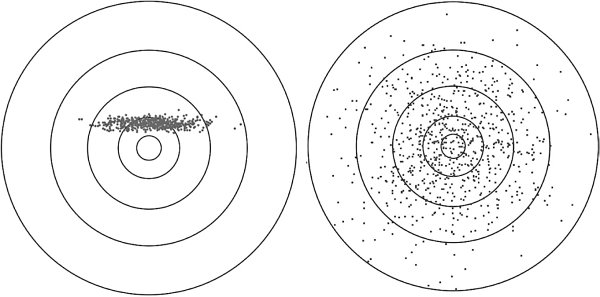
FIGURE 3. An illustration of the bias-variance tradeoff. Assume two people (sober) shooting at a target in, say, Texas. The left shooter has a bias, a systematic “error,” but on balance gets closer to the target than the right shooter, who has no systematic bias but a high variance. Typically, you cannot reduce one without increasing the other. When fragile, the strategy at the left is the best: maintain a distance from ruin, that is, from hitting a point in the periphery should it be dangerous. This schema explains why if you want to minimize the probability of the plane crashing, you may make mistakes with impunity provided you lower your dispersion.
Rationality does not superficially look like rationality—just as science doesn’t look like science as we’ve seen. Three rigorous thinkers (and their schools) orient my thinking on the matter: the cognitive scientist and polymath Herb Simon, who pioneered artificial intelligence; the psychologist Gerd Gigerenzer; and the mathematician, logician, and decision theorist Ken Binmore, who spent his life formulating the logical foundations of rationality.
FROM SIMON TO GIGERENZER
Simon formulated the notion now known as bounded rationality: we cannot possibly measure and assess everything as if we were a computer; we therefore produce, under evolutionary pressures, some shortcuts and distortions. Our knowledge of the world is fundamentally incomplete, so we need to avoid getting into unanticipated trouble. And even if our knowledge of the world were complete, it would still be computationally near-impossible to produce a precise, unbiased understanding of reality. A fertile research program on ecological rationality came out of the effort to cure Simon’s problem; it is mostly organized and led by Gerd Gigerenzer (the one who critiqued Dawkins in Chapter 9), mapping how many things we do that appear, on the surface, illogical, but have deeper reasons.
REVELATION OF PREFERENCES
As for Ken Binmore, he showed that the concept casually dubbed “rational” is ill-defined, in fact so ill-defined that many uses of the term are just gibberish. There is nothing particularly irrational in beliefs per se (given that they can be shortcuts and instrumental to something else): to him everything lies in the notion of “revealed preferences.”
Before explaining the concept, consider the following three maxims:
Judging people by their beliefs is not scientific.
There is no such thing as the “rationality” of a belief, there is rationality of action.
The rationality of an action can be judged only in terms of evolutionary considerations.
The axiom of revelation of preferences (originating with Paul Samuelson, or possibly the Semitic gods), as you recall, states the following: you will not have an idea about what people really think, what predicts people’s actions, merely by asking them—they themselves don’t necessarily know. What matters, in the end, is what they pay for goods, not what they say they “think” about them, or the various possible reasons they give you or themselves for that. If you think about it, you will see that this is a reformulation of skin in the game. Even psychologists get it; in their experiments, their procedures require that actual dollars be spent for a test to be “scientific.” The subjects are given a monetary amount, and they watch how the subject formulates choices by examining how they spend the money. However, a large share of psychologists fughedabout revealed preferences when they start bloviating about rationality. They revert to judging beliefs rather than action.
Beliefs are … cheap talk. There may be some type of a translation mechanism too hard for us to understand, with distortions at the level of the thought process that are actually necessary for things to work.
Actually, by a mechanism (more technically called the bias-variance tradeoff), you often get better results making “errors,” as when you aim slightly away from the target when shooting. (See Figure 3.) I have shown in Antifragile that making some types of errors is the most rational thing to do, when the errors are of little cost, as they lead to discoveries. For instance, most medical “discoveries” are accidental to something else. An error-free world would have no penicillin, no chemotherapy … almost no drugs, and most probably no humans.
This is why I have been against the state dictating to us what we “should” be doing: only evolution knows if the “wrong” thing is really wrong, provided there is skin in the game to allow for selection.
WHAT IS RELIGION ABOUT?
It is therefore my opinion that religion exists to enforce tail risk management across generations, as its binary and unconditional rules are easy to teach and enforce. We have survived in spite of tail risks; our survival cannot be that random.
Recall that skin in the game means that you do not pay attention to what people say, only to what they do, and to how much of their necks they are putting on the line. Let survival work its wonders.
Superstitions can be vectors for risk management rules. We have as potent information that people who have them have survived; to repeat, never discount anything that allows you to survive. For instance, Jared Diamond discusses the “constructive paranoia” of residents of Papua New Guinea, whose superstitions prevent them from sleeping under dead trees. Whether it is superstition or something else, some deep scientific understanding of probability that is stopping you, it doesn’t matter, so long as you don’t sleep under dead trees. And if you dream of making people use probability in order to make decisions, I have some news: more than ninety percent of psychologists dealing with decision making (which includes such regulators and researchers as Cass Sunstein and Richard Thaler) have no clue about probability, and try to disrupt our efficient organic paranoias.
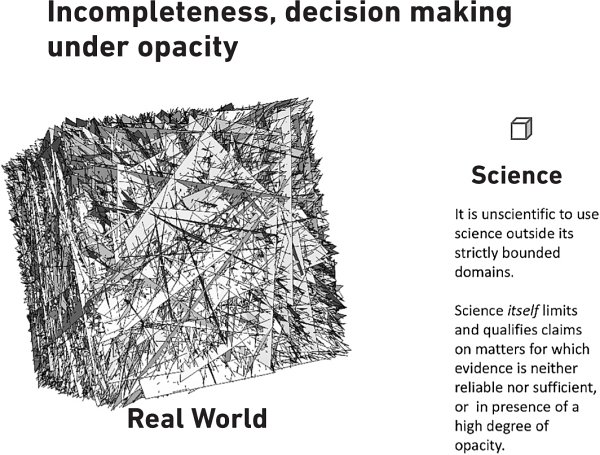
FIGURE 4. The classical “large world vs small world” problem. Science is currently too incomplete to provide all answers—and says it itself. We have been so much under assault by vendors using “science” to sell products that many people, in their mind, confuse science and scientism. Science is mainly rigor in the process.
Further, I find it incoherent to criticize someone’s superstitions if these are meant to bring some benefits, while at the same time having no problemo with the optical illusions in Greek temples.
The notion of “rational” bandied about by all manner of promoters of scientism isn’t defined well enough to be used for beliefs. To repeat, we do not have enough grounds to discuss “irrational beliefs.” We do with irrational actions.
Extending such logic, we can show that much of what we call “belief” is some kind of background furniture for the human mind, more metaphorical than real. It may work as therapy.
Also recall from Chapter 3 that collective rationality might require some individual biases.
“TAWK” AND CHEAP “TAWK”
The first principle we draw:
There is a difference between beliefs that are decorative and different sorts of beliefs, those that map to action.
There is no difference between them in words, except that the true difference reveals itself in risk taking, having something at stake, something one could lose in case one is wrong.
And the lesson, by rephrasing the principle:
How much you truly “believe” in something can be manifested only through what you are willing to risk for it.
But this merits continuation. The fact that there is this decorative component to belief, life, these strange rules followed outside the Gemelli clinics of the world, merits a discussion. What are these for? Can we truly understand their function? Are we confused about their function? Do we mistake their rationality? Can we use them instead to define rationality?
WHAT DOES LINDY SAY?
Let us see what Lindy has to say about “rationality.” While the notions of “reason” and “reasonable” were present in ancient thought, mostly embedded in the notion of precaution, or sophrosyne, this modern idea of “rationality” and “rational decision making” was born in the aftermath of Max Weber, with the works of psychologists, philosophasters, and psychosophasters. The classical sophrosyne means precaution, self-control, and temperance all in one. It was replaced with something a bit different. “Rationality” was forged during the post-enlightenment period, at a time when we thought that understanding the world was around the corner. It assumes absence of randomness, or a simplified random structure of our world. Also, of course, no interactions with the world.
The only definition of rationality that I’ve found that is practically, empirically, and mathematically rigorous is the following: what is rational is that which allows for survival. Unlike modern theories by psychosophasters, it maps to the classical way of thinking. Anything that hinders one’s survival at an individual, collective, tribal, or general level is, to me, irrational.
Hence the precautionary principle and sound risk understanding.
THE NONDECORATIVE IN THE DECORATIVE
Now what I’ve called decorative is not necessarily superfluous, often to the contrary. The decorative may just have a function we do not know much about. We could consult for that the grandmaster statistician, time, through a very technical tool called the survival function, known by both old people and very complex statistics. We will resort here to the old-people version.
The fact to consider is not that beliefs have survived a long time—the Catholic church as an administration is close to twenty-four centuries old (it is largely the continuation of the Roman Republic). The point is that people who have religion—a certain religion—have survived.
Another principle:
When you consider beliefs in evolutionary terms, do not look at how they compete with each other, but consider the survival of the populations that have them.
Consider a competitor to the Pope’s religion, Judaism. Jews have close to five hundred different dietary interdicts. These may seem irrational to an outsider who defines rationality in terms of what he can explain. Actually they will most certainly seem so. The Jewish kashrut prescribes keeping four sets of dishes, two sinks, the avoidance of mixing meat with dairy products or merely letting the two be in contact with each other, in addition to interdicts on some animals: shrimp, pork, etc. The good stuff.
These laws might have had an ex ante purpose. One can blame insalubrious behavior of pigs, exacerbated by the heat in the Levant (though heat in the Levant was not markedly different from that in pig-eating areas farther West). Or perhaps an ecological reason: pigs compete with humans in eating the same vegetables, while cows eat what we don’t eat.
But it remains the case that whatever their purpose, kashrut laws survived several millennia not because of their “rationality” but because the populations that followed them survived. It most certainly brought cohesion: people who eat together hang together. (To be technical, it is a convex heuristic.) Such group cohesion might be also responsible for trust in commercial transactions with remote members of the community, thus creating a vibrant network. Or some other benefit—but it remains that Jews have survived in spite of a very hard history.
This allows us to summarize:
Rationality does not depend on explicit verbalistic explanatory factors; it is only what aids survival, what avoids ruin.
Why? Clearly as we saw in the Lindy discussion:
Not everything that happens happens for a reason, but everything that survives survives for a reason.
Rationality is risk management, period.
When to use it
Evaluating financial risk management strategies: prioritizing survival and avoiding ruin over maximizing expected returns.
When studying a persistent cultural practice, examine possible effects on cooperation and risk alongside other explanations for its survival.
When designing a public health intervention, investigate the concern behind a behavior and whether the behavior reduces or increases the relevant risk.
Decision-making under uncertainty: using simple heuristics (like 'sleep under no dead tree') rather than complex probabilistic models, especially when the cost of error is catastrophic.
FROM THEORY TO EVERYDAY LIFE
In practice
Optical Illusions in Greek Temples
Taleb uses the Parthenon’s optical refinements to illustrate the difference between literal measurement and a useful perceptual effect. He extends the analogy to beliefs that may support useful actions. The architectural example does not itself establish which beliefs have that effect.
Jewish Dietary Laws (Kashrut)
Taleb suggests that kashrut may support group cohesion and trust through shared practices. The persistence of a community and its dietary laws is consistent with that possibility, but does not isolate the laws’ contribution to survival.
Constructive Paranoia in Papua New Guinea
Jared Diamond’s account of avoiding dead trees illustrates a simple precaution against falling branches. Whether someone explains it through custom or probability, the practical question is whether the action reduces the hazard.
A MOMENT TO REFLECT
Put it to work.
Does a custom you follow reduce a specific risk? What evidence distinguishes that benefit from a reassuring story about it?
How does the concept of revealed preferences challenge the way we judge the rationality of others? Think of a situation where someone's actions differ from their stated beliefs.
What costs or harms would you need to examine before treating a long-lived practice as a useful precaution?
Often confused with
CONTINUE THE CONVERSATION
Source texts
- Skin In The Game Hidden Asymmetries In Daily Life (Nassim Nicholas Taleb)