Radical Translation and a Quinian Crossword Puzzle
Quine's principle of indeterminacy of radical translation argues that two equally good translation manuals for an unknown language can assign different meanings with no fact of the matter. The crossword puzzle analogy demonstrates how multiple solutions can fit the same clues, making the claim plausible.
THE IDEA
30. RADICAL TRANSLATION AND A QUINIAN CROSSWORD PUZZLE
The claim that when two equally good functional interpretations clash there are no deeper facts that could settle the matter has been most memorably and ably defended by philosopher W. V. O. Quine (1960), in his principle of the indeterminacy of radical translation, which he defended with the help of a famous intuition pump. Imagine discovering an isolated island in the middle of the Pacific Ocean, let’s say, inhabited by people from who knows where, speaking a language that nobody else speaks. With no bilingual interpreters available to help, the anthropologists or linguists must figure out this language from observation and trial-and-error interaction with the natives, a task Quine called “radical translation.” In principle, Quine argued, two such investigators, given the task of deriving a translation manual for this exotic tongue, could arrive at substantially different but equally good translation manuals, which assigned different meanings to utterances made by the natives, and where there could be no fact of the matter about which translation was correct! To many philosophers, this idea has seemed too radical to take seriously—and so they simply ignore it and persist in their traditional ways. Here is a thinking tool designed to make the idea seem at least plausible, if not downright obvious. Two things need to be explained: (1) how Quine’s claim could be true (“in principle”), and (2) how it could nevertheless be all but impossible to give an actual instance of it.
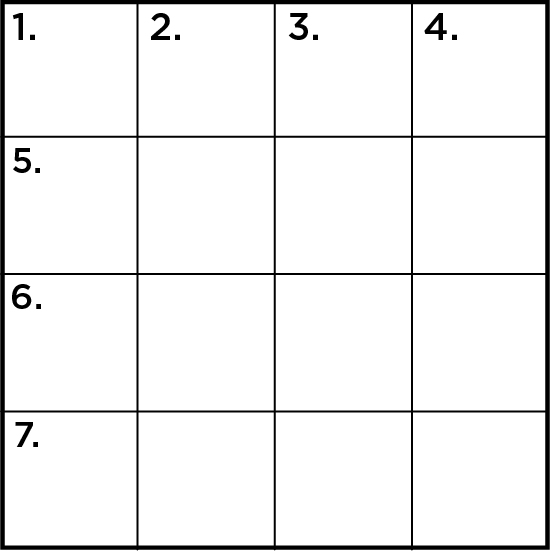
I regularly give this crossword puzzle to my students and ask them to solve it. In a few minutes, most of them announce success. Try it for yourself before reading on.
When to use it
Field linguists encountering an unknown language with no bilingual speakers, leading to multiple possible translation manuals.
Legal interpretation of ambiguous statutes where two different readings both fit the text and context.
Machine translation systems that produce multiple plausible translations, forcing choices without a gold standard.
Anthropologists interpreting cultural rituals where outsiders must infer meaning from behavior alone.
FROM THEORY TO EVERYDAY LIFE
In practice
The Crossword Puzzle Analogy
Dennett offers a crossword puzzle as an analogy for Quine’s proposal: different completions might fit the same constraints. He asks readers to consider whether different translation manuals could likewise account equally well for behavior while assigning different meanings. The puzzle is intended to make that possibility easier to imagine.
A MOMENT TO REFLECT
Put it to work.
How does the crossword puzzle analogy illustrate the indeterminacy of radical translation?
Can you think of a real-world scenario where two competing interpretations of a text or language are both equally valid?
What does Quine's argument imply about the objectivity of meaning and translation?
References
- Word and Object — W. V. O. Quine (1960)
CONTINUE THE CONVERSATION
Source texts
- Intuition Pumps and Other Tools for Thinking