Questioning Our Egocentrism
Elder and Paul argue that self-serving assumptions can feel objective from the inside. They recommend questioning your motives, considering other people’s needs, and checking the limits of your own perspective.
THE IDEA
Questioning Our Egocentrism
One of the primary barriers to the development of insightful thinking is the natural human tendency toward egocentric thought. Humans naturally see the world in self-serving terms. In other words, we do not naturally consider the rights and needs of others, nor do we naturally appreciate the point of view of others or the limitations in our own point of view. As humans we become explicitly aware of our egocentric thinking only if specially trained to do so. We do not naturally recognize our egocentric assumptions, the egocentric way we use information, the egocentric way we interpret data, the source of our egocentric concepts and ideas, the implications of our egocentric thought. We do not naturally recognize our self-serving perspective.2
One of the great barriers to detecting egocentric thought comes from the self-deceptive nature of the human mind. Through self-deception, humans live with the unrealistic but confident sense that we have fundamentally figured out the way things actually are, and that we have done this objectively. We naturally believe in our intuitive perceptions — however inaccurate. In other words, though human thinking is often flawed, it nevertheless sees itself as right, correct, in possession of “the truth.” To take command of our egocentric tendencies, we need to actively target these tendencies through questions. In other words, we need to routinely question our motivations and study our own “selfishness” and narrowmindedness.
There are two basic motives of egocentric thinking:
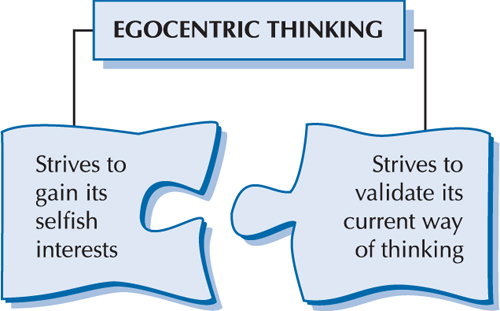
Now contrast the two basic motives of rational thinking:
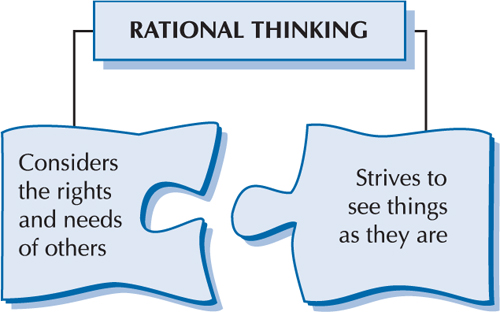
The two sets of motives are referenced through these images but are not listed in the supplied text.
When to use it
Debating or argumentation to avoid bias and consider opposing views.
Group decision-making processes to ensure all perspectives are heard.
Personal growth and self-awareness exercises to identify egocentric tendencies.
Teaching critical thinking skills in educational settings.
FROM THEORY TO EVERYDAY LIFE
In practice
Student's Assumption of Complete Understanding
A student believes their interpretation of a complex theory is correct and dismisses alternative viewpoints from classmates or sources, assuming their own perspective is objective and complete.
Manager's Overconfidence in Objectivity
A manager makes a decision without consulting the team, convinced that their analysis is unbiased and the best course of action, while ignoring potential blind spots and the team's input.
A MOMENT TO REFLECT
Put it to work.
In what situations do I assume my perspective is the only correct one?
How might I be deceiving myself about my objectivity in this decision?
What would a truly rational perspective look like in this situation, considering others' viewpoints?
Often confused with
CONTINUE THE CONVERSATION
Source texts
- The Art of Asking Essential Questions Based on Critical Thinking Concepts and Socratic Principles (Linda Elder, Richard Paul)