Questioning Clarity and Precision
Clear questions guide thinking effectively. Vague or imprecise questions lead to scattered thinking; clarifying a question by breaking it down and adding details helps settle it.
THE IDEA
Questioning Clarity and Precision
One of the most common problems in addressing complex questions arises when the question at issue is unclear. When the question is unclear or vague, thinking has no clear guide. It wanders without a clear sense of relevance. Thoughts are scattered. But when we take time to clarify a question, we are better able to settle it. We make clear to ourselves the intellectual task at hand and what that task requires of us.
One of the most effective strategies is to add details to the question, to break it down, and to be more exact. We disentangle questions best treated separately. We notice relations and overlap between distinguishable sub-questions.
Consider the following, and the multiple meanings the question might have, depending on the context and situation within which we are asking it. By making the question more precise, we are better able to answer it:
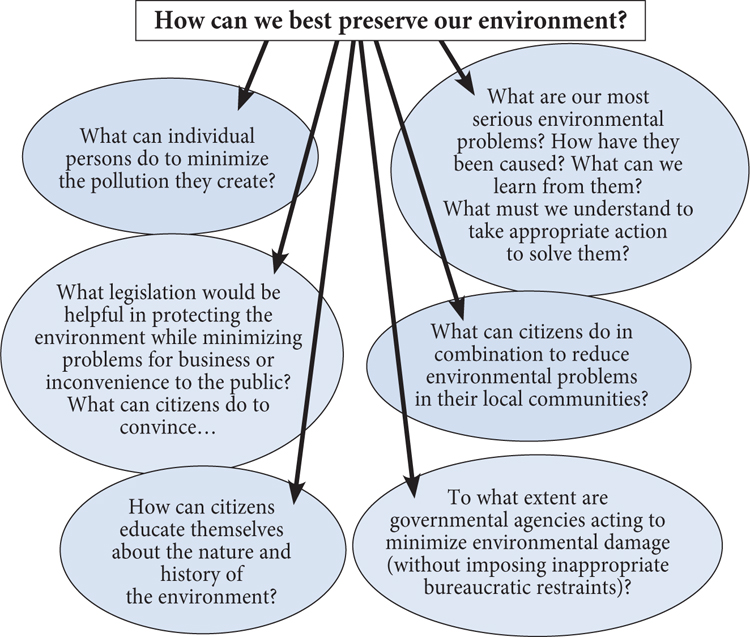
Essential Idea: A question is clear when we know precisely what we need to do to settle it. A vague interrogative sentence is not a clear question. Don’t try to answer a question until you know precisely what it is asking.
When to use it
Academic research: Narrowing down a broad topic into a specific, researchable question.
Business problem-solving: Formulating a precise problem statement before brainstorming solutions.
Personal decision-making: Transforming a vague life goal (e.g., 'be happier') into a concrete, measurable question (e.g., 'What specific daily habit can I add to increase my sense of accomplishment?').
Teaching: Helping students learn to refine their questions for better critical thinking.
FROM THEORY TO EVERYDAY LIFE
In practice
Clarifying a Career Decision
Instead of asking 'What should I do with my life?', a more precise question would be 'Given my skills in programming and strong interest in healthcare, which career path—such as health informatics or medical software development—offers the best growth and alignment with my values?'
Improving a Research Question
A vague research question like 'How does social media affect people?' can be clarified to 'How does daily Instagram use among teenagers correlate with self-reported anxiety levels over a six-month period?'
A MOMENT TO REFLECT
Put it to work.
Think of a recent problem you tried to solve. Was the question you started with well-defined? How could you make it more precise?
Identify a vague question you often ask yourself. Break it down into sub-questions that are more specific and actionable.
When faced with a complex issue, what strategies can you use to separate the core question from related but distinct questions?
CONTINUE THE CONVERSATION
Source texts
- The Art of Asking Essential Questions Based on Critical Thinking Concepts and Socratic Principles (Linda Elder, Richard Paul)