Power Model of Probability Judgment
The power model predicts judged probability from assessments of evidence strength, as demonstrated in a study where NBA fans estimated win probabilities based on team strength ratings. The model shows a close correspondence between strength-based predictions and actual probability judgments.
THE IDEA
Study 3: Basketball Games
Subjects (N = 88) were NBA fans who subscribe to a computer news group. We posted a questionnaire to this news group and asked readers to complete and return it by electronic mail within 1 week. In the questionnaire, subjects assessed the probability that the home team would win in each of 20 upcoming games. These 20 outcomes constituted all possible matches among five teams (Phoenix, Portland, Los Angeles Lakers, Golden State, and Sacramento) from the Pacific Division of the NBA, constructed such that, for each pair of teams, two games were evaluated (one for each possible game location). Use of this “expert” population yielded highly reliable judgments, as shown, among other things, by the fact that the median value of the correlation between an individual subject’s ratings and the set of mean judgments was .93.
After making their probability judgments, subjects rated the strength of each of the five teams. The participants were instructed:
First, choose the team you believe is the strongest of the five, and set that team’s strength to 100. Assign the remaining teams ratings in proportion to the strength of the strongest team. For example, if you believe that a given team is half as strong as the strongest team (the team you gave a 100), give that team a strength rating of 50.
We interpreted these ratings as a direct assessment of support.
Because the strength ratings did not take into account the home court effect, we collapsed the probability judgments across the two possible locations of the match. The slope of the regression line predicting log R(A, B) from log [ŝ(A)*/*ŝ(B)] provided an estimate of k for each subject. The median estimate of k was 1.8, and the mean was 2.2; the median R2 for this analysis was .87. For the aggregate data, k was 1.9 and the resulting R2 was .97. The scatterplot in Fig. 25.4 exhibits excellent correspondence between mean prediction based on team strength and mean judged probability. This result suggests that the power model can be used to predict judged probability from assessments of strength that make no reference to chance or uncertainty. It also reinforces the psychological interpretation of s as a measure of evidence strength.
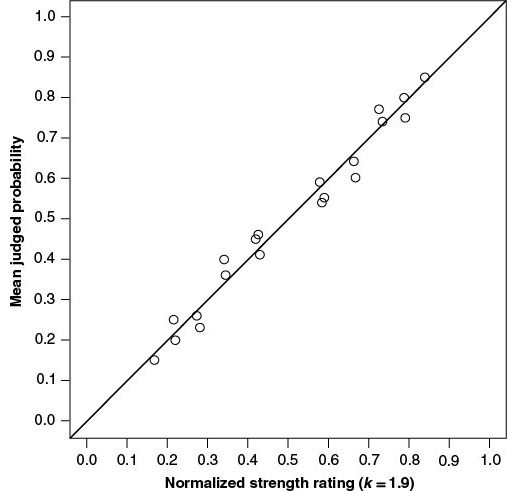
Figure 25.4. Judged probability for basketball games as a function of normalized strength ratings.
When to use it
Modeling how people’s perceptions of candidate strength influence their election-probability judgments.
Studying how perceived competitive advantages influence judgments of a product’s chances of success.
Modeling expert judgments in risk assessment scenarios where evidence strength is quantifiable.
FROM THEORY TO EVERYDAY LIFE
In practice
NBA Win Probability Estimation
NBA fans first estimated home-team win probabilities for matchups among Phoenix, Portland, the Los Angeles Lakers, Golden State, and Sacramento. They then rated the teams’ strength. After combining judgments across game locations, the researchers found that the power model closely matched the fans’ probability judgments. The comparison concerned those judgments, rather than actual game results.
General Application of the Power Model
If a person assesses that Team A is twice as strong as Team B, the power model predicts the judged probability that A beats B as (2^k) / (1 + 2^k), using an illustrative k of 2. For k=2, the probability would be 4/5 = 0.8.
A MOMENT TO REFLECT
Put it to work.
Think of a real-world situation where you assess probabilities (e.g., election outcomes, sports predictions). How might your judgments be influenced by your perception of strength?
If you had to estimate the probability that your favorite sports team wins their next game, how would you convert your belief about their strength into a number? Does the power model seem plausible?
In what ways might the power model fail to capture actual probability judgments? Consider cases where people use base rates or other factors.
CONTINUE THE CONVERSATION
Source texts
- Heuristics and Biases The Psychology of Intuitive Judgment (Thomas Gilovich, Dale Griffin, Daniel Kahneman)