Positive Is Preferable
The source reports slower verification of negative statements and describes Clark’s proposed explanation: people first try to match a statement to the facts, then revise their assumption if it fails. Truth value and grammatical negation are distinct.
THE IDEA
Positive Is Preferable
In The Universe Within, Morton Hunt describes an experiment conducted at Stanford University by Herbert Clark and a colleague that demonstrates that we humans take longer to process a negative thought than a positive one. The subjects of the experiment were shown cards like those in Figure 3-1 and were asked to say as quickly as they could whether the statement on each card was true or false. Try it yourself. It took them two-tenths of a second longer to reply to the false statement than to the true one. The explanation offered by Clark and his colleague was that, when we seek to verify a statement, we instinctively assume it is true and try to match it against the facts. If they match, we do no further mental work. If they don’t, we take the extra step of revising our assumption, thus answering a trifle more slowly. It thus takes half a second or more longer to verify denials than affirmations. We seem programmed to think more readily about what is rather than what is not.
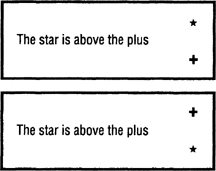
FIGURE 3-1
This phenomenon is easily demonstrated. Read the following sentences, pausing briefly between them.
Is the ball in the bottle red?
Is the ball not in the bottle red?
Did you feel your mind scramble for a fleeting moment at the end of the second sentence to make sense of it? Negatives can do that to our minds so easily.
If negatives give us pause, look what a double negative can do:
Is the ball that is not in the bottle not red?
Huh?
When to use it
In communication, avoid using double negatives or complex negations to ensure clarity.
In user interface design, phrase instructions and feedback in positive terms (e.g., 'Click to continue' instead of 'Don't click cancel').
In education, frame questions positively to reduce cognitive load on students.
In marketing, emphasize what a product does rather than what it doesn't do.
FROM THEORY TO EVERYDAY LIFE
In practice
True vs. False Statement Verification
The account reports that participants took about two-tenths of a second longer to reject a false statement than to accept a true one. This comparison concerns truth value; a negative sentence can be true, and an affirmative sentence can be false.
Everyday Negative Questions
Consider the questions: 'Is the ball in the bottle red?' and 'Is the ball not in the bottle red?' The second one causes a brief mental scramble as the brain processes the negation, making it harder to answer quickly.
A MOMENT TO REFLECT
Put it to work.
Think of a time you misunderstood a question because it was phrased negatively. How could you rephrase it to avoid confusion?
How might this bias affect decision-making in high-pressure situations, such as emergency rooms or air traffic control?
What are the implications of this bias for how we design surveys or legal instructions?
References
- The Universe Within — Morton Hunt
CONTINUE THE CONVERSATION
Source texts
- The Thinkers Toolkit by Morgan D Jones