Plato's Cave (Allegory of the Cave)
Plato's Allegory of the Cave depicts prisoners who mistake shadows for reality, illustrating the journey from ignorance to philosophical enlightenment through the difficult ascent to the intelligible world.
THE IDEA
On the walls of the cave, only the shadows are the truth.
—Plato
Plato presents the Allegory of the Cave in Book VII of The Republic to explore knowledge, education, and the philosopher’s responsibilities.
In the dialogue, Socrates speaks with Glaucon, Plato’s brother, about how philosophical education affects individuals and society.
In this dialogue, Socrates asks Glaucon to imagine a group of prisoners who have been chained to a wall inside a cave from childhood. A fire burns behind the prisoners. Between them and the fire, people carry objects along a raised path behind a low wall. The prisoners see the objects’ shadows on the cave wall in front of them.
Socrates tells Glaucon that the prisoners believe what they observe is the real world, without realizing that they are looking at shadows rather than the objects casting them.
Socrates then asks what would happen if a prisoner were released and made to look around. He observes the light of the fire beyond the wall, whose glow blinds him and almost brings him back to darkness.
As the released man adjusts to the firelight, Socrates imagines him being led farther. Socrates proposes that this is a first step in the acquisition of knowledge. Then, as the man goes outside the cave, he first observes the reflections and shadows of things and people, and eventually sees the things and people themselves.
Finally, the man observes the stars, the moon, and the sun. In Plato’s interpretation, the ascent represents movement toward intellectual understanding, with the sun representing the Good. The man then returns to share this with the prisoners in the cave, since he feels he must help them ascend to the real world.
When he returns into the cave for the other prisoners, the man is unable to see well, as he has become accustomed to the outside light. The prisoners think that this trip has damaged him, and they do not want to accompany him outside. Plato, through Socrates, states that these prisoners would do their best to avoid such a journey, even killing anyone who dared try to free them.
This is Plato’s text:
Socrates is speaking with Glaucon:
Socrates: And now, I said, let me show in a figure how far our nature is enlightened or unenlightened: —Behold! Human beings are living in an underground den, which has a mouth opened towards the light and reaching all along the den. Here, they have been from their childhood, and have their legs and necks chained so that they cannot move, and can only see before them, being prevented by the chains from turning around their heads. Above and behind them, a fire is blazing at a distance, and between the fire and the prisoners, there is a raised way, and you will see if you look, a low wall built along the way, like the screen which marionette players have in front of them, over which they show the puppets.
Glaucon: I see.
S: And do you see, I said, men passing along the wall carrying all sorts of vessels, and statues and figures of animals made of wood and stone and various materials, which appear over the wall? Some of them are talking, others silent.
G: You have shown me a strange image, and they are strange prisoners.
S: Like ourselves, I replied; and they see only their own shadows, or the shadows of one another, which the fire throws on the opposite wall of the cave?
G: True, he said; how could they see anything but the shadows if they were never allowed to move their heads?
S: And of the objects which are being carried in like manner, they would only see the shadows?
G: Yes, he said.
S: And if they were able to converse with one another, would they not suppose that they were naming what was actually before them?
G: Very true.
S: And suppose further that the prison had an echo which came from the other side, would they not be sure to fancy when one of the passersby spoke that the voice which they heard came from the passing shadow?
G: No question, he replied.
S: To them, I said, the truth would be literally nothing but the shadows of the images.
G: That is certain.
S: And now look again, and see what will naturally follow if the prisoners are released and disabused of their error. At first, when any of them is liberated and compelled suddenly to stand up and turn his neck round and walk, and look towards the light, he will suffer sharp pains; the glare will distress him, and he will be unable to see the realities of which in his former state he had seen the shadows; and then conceive someone saying to him, that what he saw before was an illusion, but that now, when he is approaching nearer to being and his eye is turned towards more real existence, he has a clearer vision, what will be his reply? And you may further imagine that his instructor is pointing to the objects as they pass and requiring him to name them, will he not be perplexed? Will he not fancy that the shadows which he formerly saw are truer than the objects which are now shown to him?
G: Far truer.
S: And if he is compelled to look straight at the light, will he not have a pain in his eyes which will make him turn away to take and take in the objects of vision which he can see, and which he will conceive to be in reality clearer than the things which are now being shown to him?
G: True, he said.
S: And suppose once more, that he is reluctantly dragged up a steep and rugged ascent, and held fast until he’s forced into the presence of the sun himself, is he not likely to be pained and irritated? When he approaches the light, his eyes will be dazzled, and he will not be able to see anything at all of what are now called realities.
G: Not all in a moment, he said.
S: He will require to grow accustomed to the sight of the upper world. And first, he will see the shadows best, next to the reflections of men and other objects in the water, and then the objects themselves; then he will gaze upon the light of the moon and the stars and the spangled heaven, and he will see the sky and the stars by night better than the sun or the light of the sun by day?
G: Certainly.
S: Last of him will be able to see the sun, and not mere reflections of him in the water, but he will see him in his own proper place, and not in another, and he will contemplate him as he is.
G: Certainly.
S: He will then proceed to argue that this is he who gives the season and the years, and is the guardian of all that is in the visible world, and in a certain way the cause of all things which he and his fellows have been accustomed to behold?
G: Clearly, he said, he would first see the sun and then reason about him.
S: And when he remembered his old habitation and the wisdom of the den and his fellow-prisoners, do you not suppose that he would felicitate himself on the change, and pity them?
G: Certainly, he would.
S: And if they were in the habit of conferring honors among themselves on those who were quickest to observe the passing shadows and to remark which of them went before, and which followed after, and which were together; and who were, therefore, best able to draw conclusions as to the future, do you think that he would care for such honors and glories, or envy the possessors of them? Would he not say with Homer?
S: Better to be the poor servant of a poor master, and to endure anything, rather than think as they do and live after their manner?
G: “Yes,” he said, I think that he would rather suffer anything than entertain these false notions and live in this miserable manner.
S: Imagine once more, I said, “such anyone coming suddenly out of the sun to be replaced in his old situation; would he not be certain to have his eyes full of darkness?”
G: “To be sure,” he said.
S: And if there were a contest, and he had to compete in measuring the shadows with the prisoners who had never moved out of the den, while his sight was still weak, and before his eyes had become steady (and the time which would be needed to acquire this new habit of sight might be very considerable) would he not be ridiculous? Men would say of him that up he went, and down he came without his eyes; and that it was better not even to think of ascending; and if anyone tried to loose another and lead him up to the light, let them only catch the offender, and they would put him to death.
G: “No question,” he said.
S: This entire allegory, I said, you may now append, dear Glaucon, to the previous argument; the prison-house is the world of sight, the light of the fire is the sun, and you will not misapprehend me if you interpret the journey upwards to be the ascent of the soul into the intellectual world according to my poor belief, which, at your desire, I have expressed whether rightly or wrongly God knows. But, whether true or false, my opinion is that in the world of knowledge the idea of good appears last of all, and is seen only with an effort; and, when seen, is also inferred to be the universal author of all things beautiful and right, parent of light and the lord of light in this visible world, and the immediate source of reason and truth in the intellectual; and that this is the power upon which he who would act rationally, either in public or private life must have his eye fixed.
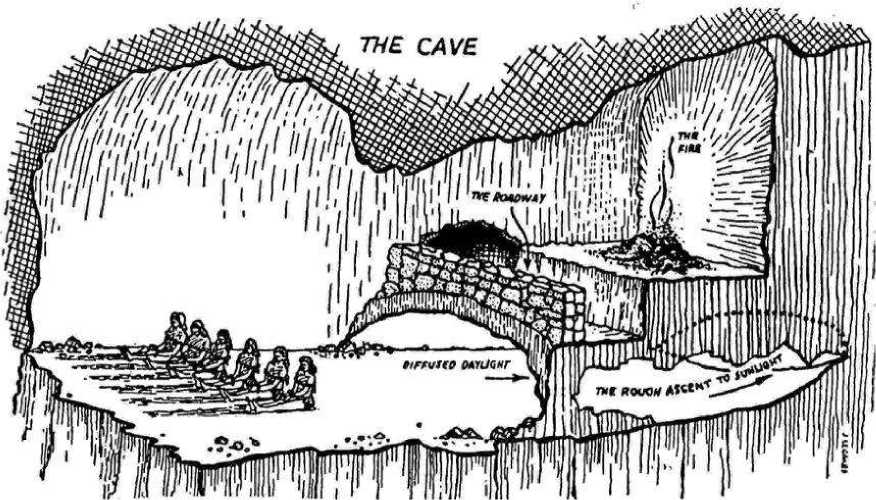
The ascent represents education as a difficult reorientation, rather than the simple addition of facts. Familiar shadows initially seem more credible to the prisoner than the unfamiliar objects that cast them. Seeing more requires time and adjustment.
Those who are able to see beyond the shadows and lies of their culture will never be understood, let alone believed, by the masses.
—Plato
That line expresses a sweeping interpretation of the prisoners’ resistance. The dialogue itself depicts a more specific problem: on returning to the cave, the freed prisoner struggles to see in the darkness, and the others mistake his difficulty for evidence that the ascent harmed him. Their confidence in familiar appearances makes them hostile to an unfamiliar account.
The contrast between the cave and the world outside illustrates Plato’s distinction between sensory appearances and intelligible reality. The sun symbolizes the Good, which makes knowledge and right action possible. The prisoner’s return also raises a political question: what responsibility does someone who has gained understanding have toward the community left behind? This connects the allegory to the philosopher-ruler in The Republic.
The image can help us question what we take for granted, including representations supplied by our culture or the media. It does not establish that every unconventional belief is an escape from illusion, or that resistance proves a new idea true. Those claims still need reasons and evidence.
When to use it
Teaching students to examine the assumptions behind what they take to be knowledge.
Examining how representations in news and social media shape an understanding of events.
Personal development: recognizing self-deceptions and the discomfort of confronting new perspectives.
Discussing resistance to unfamiliar ideas while still asking what evidence supports them.
FROM THEORY TO EVERYDAY LIFE
In practice
The Allegory in Action
In the allegory, prisoners chained since childhood see only shadows on a cave wall and believe them to be reality. One prisoner escapes, painfully adjusts to the light outside, and realizes the shadows were illusions. He returns to enlighten others but is ridiculed and threatened.
A MOMENT TO REFLECT
Put it to work.
What 'shadows' in your own life might you be mistaking for reality?
How do media and cultural narratives shape your perception of truth?
When have you experienced resistance to changing your beliefs when confronted with new evidence?
References
- The Republic (Book VII) — Plato
CONTINUE THE CONVERSATION
Source texts
- Wisdom Theory 100 Mental Models (2020) (Wisdom Theory)