Overconfidence and Expertise
Overconfidence is not solely a function of difficulty; it also depends on the predictability of the domain and the level of expertise. Experts are better calibrated in high-predictability contexts but more overconfident than novices in low-predictability contexts.
THE IDEA
Table 13.4. Confidence and Accuracy for Study 6

The observed pattern of confidence and accuracy is consistent with our hypothesis, as can be seen in Fig. 13.8. This figure plots average accuracy against average confidence, across all subjects and items, for each of the three attributes. For Population, people exhibited considerable accuracy and moderate overconfidence. For Voting, accuracy was at chance level, but overconfidence was again moderate. For Education, too, accuracy was at chance level, but overconfidence was massive.
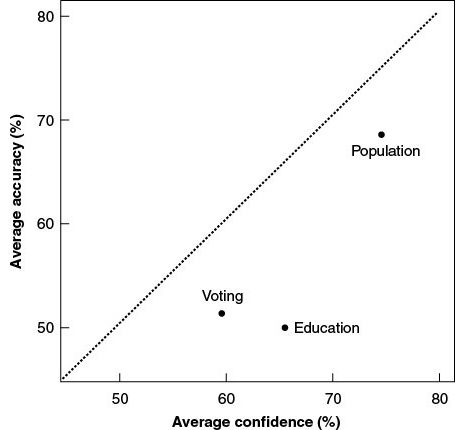
Figure 13.8. Confidence and accuracy for three attributes.
The present results indicate that overconfidence cannot be fully explained by the effect of difficulty. Population and Voting produced comparable levels of overconfidence (6.5 versus 8.5, t < 1, ns) despite a large difference in accuracy (68.2 versus 51.2, p *< .*001). However, there is much greater overconfidence in judgments about Education than about Voting (15.8 versus 8.5, p *< .*01), even though their level of accuracy was nearly identical (49.8 versus 51.2, t < 1, ns).
This analysis may shed light on the relation between overconfidence and expertise. When predictability is reasonably high, experts are generally better calibrated than lay people. Studies of race oddsmakers (Griffith, 1949; Hausch, Ziemba, & Rubinstein, 1981; McGlothlin, 1956) and expert bridge players (Keren, 1987) are consistent with this conclusion. When predictability is very low, however, experts may be more prone to overconfidence than novices. If the future state of a mental patient, the Russian economy, or the stock market cannot be predicted from present data, then experts who have rich models of the system in question are more likely to exhibit overconfidence than lay people who have a very limited understanding of these systems. Studies of clinical psychologists (e.g., Oskamp, 1965) and stock market analysts (e.g., Yates, 1990) are consistent with this hypothesis.
When to use it
A financial analyst uses a complex model to predict stock prices; being aware of overconfidence, they deliberately seek contradictory evidence.
A clinician diagnosing rare diseases considers base rates and seeks second opinions to avoid overconfidence in low-predictability conditions.
A project manager calibrates confidence estimates for task completion deadlines using historical accuracy data, especially when tasks involve high uncertainty.
A sports bettor evaluates their own confidence levels against actual outcome rates to refine betting strategies.
FROM THEORY TO EVERYDAY LIFE
In practice
Population, Voting, and Education Judgment Task
In a study, participants judged attributes of cities (population, voting patterns, education levels) and provided confidence ratings. For population, accuracy was high (68.2%) with moderate overconfidence. For voting and education, accuracy was near chance (51.2% and 49.8% respectively), but overconfidence was moderate for voting and massive for education. Difficulty does not fully explain overconfidence; the same accuracy level can yield different overconfidence depending on the attribute.
Expert Overconfidence in Low-Predictability Domains
Clinical psychologists and stock market analysts, who possess rich mental models, tend to exhibit greater overconfidence than laypeople when making predictions in inherently unpredictable domains (e.g., a patient's future state, market movements). This contrasts with high-predictability settings (e.g., race odds, bridge) where experts are better calibrated.
A MOMENT TO REFLECT
Put it to work.
In which domains of your life are you most prone to overconfidence, and how does your level of expertise relate to that confidence?
How can you adjust your confidence calibration when moving from a high-predictability context (e.g., solving a familiar math problem) to a low-predictability one (e.g., forecasting a friend's behavior)?
Think of a time when an expert gave a very confident prediction that turned out wrong. What factors might have contributed to their overconfidence?
References
- Study of race oddsmakers — Griffith (1949)
- Calibration of expert bridge players — Keren (1987)
- Study of clinical psychologists' overconfidence — Oskamp (1965)
- Judgment and decision making — Yates (1990)
CONTINUE THE CONVERSATION
Source texts
- Heuristics and Biases The Psychology of Intuitive Judgment (Thomas Gilovich, Dale Griffin, Daniel Kahneman)