Outrage Heuristic
The outrage heuristic proposes that feelings of outrage help shape punitive-damages judgments. In the study described here, harm affected dollar awards more than explicit ratings of outrageousness, prompting the authors to distinguish an emotional response from a deliberate evaluation of conduct.
THE IDEA
Exploring the Outrage Heuristic
The source contrasts the representativeness results in Fig. 2.1 with a study that used the same design but produced a less direct match between a proposed heuristic and the judgment it was meant to explain. Kahneman, Schkade, and Sunstein (1998) tested whether feelings of outrage help shape punitive-damages awards, comparing those awards with explicit ratings of outrageousness.
Participants drawn from a jury roll in Texas were shown vignettes of legal cases in which a plaintiff had suffered a personal injury while using a product. Respondents were told that the plaintiff had already been awarded compensatory damages, and that their next task as mock jurors was to determine whether punitive damages were also appropriate, and if so in what amount.
The study involved 28 variants of 10 basic scenarios. One of these scenarios concerned a child who had been burned when his pajamas caught fire as he was playing with matches. The pajamas were made of fabric that was not adequately fire-resistant, and the defendant firm had been aware of the problem. Each participant rated one version of each of the 10 scenarios. Two variables were manipulated experimentally as follows: For 4 of the 10 scenarios, 2 versions were constructed that differed in the severity of harm. In the high-harm version of the pajamas case, for example, the child was 'severely burned over a significant portion of his body and required several weeks in the hospital and months of physical therapy.' In the low-harm version, 'the child's hands and arms were badly burned, and required professional medical treatment for several weeks.' In addition, each of the 14 resulting vignettes was presented in two versions: one in which the defendant firm was large (annual profits in the range of $100–$200 million), and one in which it was of medium size ($10–$20 million). Each individual read vignettes involving firms of both sizes.
Respondents in a dollar punishment group were asked to indicate whether punitive damages were appropriate, and if so in what amount (the target attribute in this study). Respondents in the outrage group rated the outrageousness of the defendant's behavior (the hypothesized heuristic attribute). The mean outrageousness ratings and the median dollar awards were computed for each vignette. For the purpose of the present analysis, we also obtained (from 16 Princeton students) mean ratings of the severity of the harm suffered in each of the 14 vignettes. Lawsuits were not mentioned in these descriptions of harm.
Because the 'pain' that a given financial penalty inflicts on a firm obviously varies with its annual profits, the relation between outrage and dollar awards was evaluated separately for large and small firms. Because dollar responses are known to be a very noisy measure, there was reason to expect that the fit of dollar awards to rated outrageousness would not be as impressive as the relationship between probability ranks and similarity ranks in Figs. 2.1A and 2.1B. Even with this allowance for noisy data, the correlations between the median punitive damages in dollars and the means of outrageousness ratings were disappointingly low: .77 for large firms and .87 for small firms. The main reason for the low correlations was an unanticipated discrepancy between the two measures in their sensitivity to the harm suffered by the plaintiff. Harm had no effect on outrageousness ratings, but did strongly affect dollar awards. When we reconsidered these data for this chapter, we concluded that the instructions to 'judge the outrageousness of the defendant's actions' (italics ours) may have led many respondents to discount the harm resulting from these actions (Kahneman, Schkade, & Sunstein, 1998, offered a slightly different view). To test this interpretation, we defined a new variable for each case: the product of the average ratings of outrageousness and of harm. The data shown in Fig. 2.2 plot dollar punishments against this new variable. The correlations are still not as high as in Fig. 2.1, but they are now respectable: .90 for large firms and .94 for medium-sized firms.
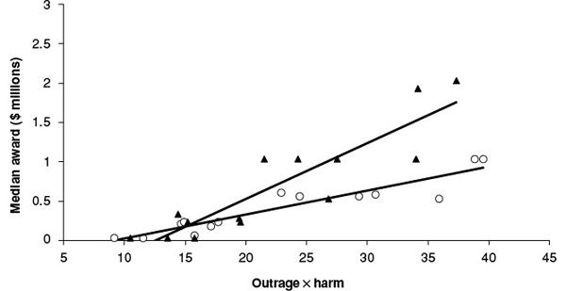
Figure 2.2. Median punitive awards (in dollars) for 14 cases, plotted against the product of average ratings of outrageousness and of severity of harm for each case, for large firms (filled triangles) and for medium-size firms (circles).
We do not intend to suggest that respondents separately assessed outrageousness and harm and then computed their product; rather, we propose that the feeling of outrage is ordinarily sensitive to both the recklessness of the culprit and the suffering of the victim, but that the instructions to judge the outrageousness of the defendant's actions encouraged respondents to report something other than their immediate emotional response. In our view, the judgment of outrageousness is psychologically more complex than the emotion of outrage. This interpretation is post hoc, but testable in at least two ways: (1) The heuristic elicitation procedure could be repeated, with instructions that simply require a report of the respondent's anger or indignation rather than an evaluation of the defendant's behavior, or (2) the original heuristic elicitation procedure could be replicated under time pressure or cognitive load – manipulations that would interfere with discounting and thereby make outrageousness sensitive to harm.
Even when the heuristic elicitation procedure does demonstrate perfect correspondence (as it did for representativeness), the naming of a heuristic remains a judgment call. The analogy of naming factors in factor analysis is instructive: in both cases the appropriate label is rarely unique, although competing candidates are bound to have much in common. The outrage heuristic could just as well have been named the indignation heuristic, or perhaps just the anger heuristic. As is also the case in factor analysis, the label that is chosen for a heuristic may take on a life of its own in subsequent theorizing. We speculate that the course of research on heuristics could have been somewhat different if the representativeness heuristic had been named more simply the similarity heuristic.
When to use it
When examining punitive-damages judgments, distinguish feelings of outrage, deliberate ratings of conduct, and assessments of the harm suffered.
When studying reactions to a company’s misconduct, examine how descriptions of its actions and the resulting harm affect judgments.
Policy makers designing tort reform could consider how anger-driven judgments may lead to inconsistent or excessive penalties.
Everyday moral reasoning: when deciding fairness of a punishment, people may unconsciously substitute an outrage heuristic for a more systematic analysis.
FROM THEORY TO EVERYDAY LIFE
In practice
Pajamas Case Study
A child was burned while playing with matches in pajamas that were not adequately fire-resistant; the defendant firm was aware of the defect. Participants rated outrageousness and awarded punitive damages. Different versions varied harm severity (high vs. low) and firm size (large vs. medium). Results showed that harm severity strongly affected dollar awards but not outrageousness ratings, leading researchers to propose that explicit instructions to judge outrageousness may lead respondents to discount harm.
A MOMENT TO REFLECT
Put it to work.
How might the outrage heuristic influence your own judgments in legal or moral contexts? Can you recall a situation where your outrage overshadowed the actual harm done?
What is the psychological difference between feeling outrage and deliberately judging 'outrageousness'? How does this distinction affect decision-making?
If you were designing a study to test the outrage heuristic, how would you measure the emotion versus the judgment to avoid the discounting effect proposed here?
Often confused with
References
- Kahneman, Schkade, & Sunstein (1998) on outrage heuristic and punitive damages — Kahneman, D., Schkade, D., & Sunstein, C. (1998)
CONTINUE THE CONVERSATION
Source texts
- Heuristics and Biases The Psychology of Intuitive Judgment (Thomas Gilovich, Dale Griffin, Daniel Kahneman)