Organisational Politics
Organisational politics refers to the strategies and tactics involving influence and power that people use to achieve favourable outcomes for the organisation and themselves. It is inevitable and can be used for both personal gain and organisational good.
THE IDEA
Organisational Politics
Organisational politics helps explain how human factors contribute to things going wrong or right. By organisational politics, I mean the strategies and tactics (involving influence, power, etc.) that people in an organisation use to
- achieve favourable outcomes for the organisation and themselves, and
- avoid unfavourable consequences for the organisation and themselves.
We can see how organisational outcomes (e.g. a new zero‐carbon strategy or launching a new product) can be closely linked to personal outcomes (e.g. where you personally might play a vital role in the new strategy or in launching the new product). Note also how politics is not just about getting things done, it's also about being able to stop things from being done; so, if you think drilling a new oil well will conflict with a zero‐carbon goal, you might try, and perhaps succeed, in stopping it.
Consequently, there are two fundamental points that I regard as a ‘base camp’ in some of the training courses I run and when coaching clients about organisational politics:
- Organisational politics will take place around you, whether you choose to engage with it or not;[34]
- Although many people associate organisational politics with Machiavellian plotting for personal gain, it is also quite possible to use politics for an organisation's good.[35]
A useful model for thinking about organisational politics was developed by Simon Baddeley and Kim James.[36] It uses an animal analogy to illustrate the types of characters in an organisation. They posit two animals who don't think much about organisational politics: the ‘innocent’ lamb and the ‘stubborn’ donkey; and two animals who operate politically: the ‘wise’ owl and the ‘cunning’ fox.
The difference between the two types (lamb and owl, and donkey and fox) is that the former are primarily oriented towards what is good for the organisation. In contrast, the latter are primarily oriented towards self‐interest. The different types are summarised in [Illustration 10.4].
In an ideal world, you would hope there weren't too many foxes (or Machiavellian managers) in senior roles; however, you do find foxes in senior positions in most organisations. Based on my experience and work with clients, this can happen because many have learned to hide their self‐centred behaviour from others. As Machiavelli says: ‘Everyone sees what you appear to be, few really know what you are’. Indeed, some managers may hide their self‐serving behaviour from themselves, thinking they aren't Machiavellian, just ‘mature’, ‘flexible’, they ‘know how to play the game’ or they ‘naturally know the pragmatic thing to do’.
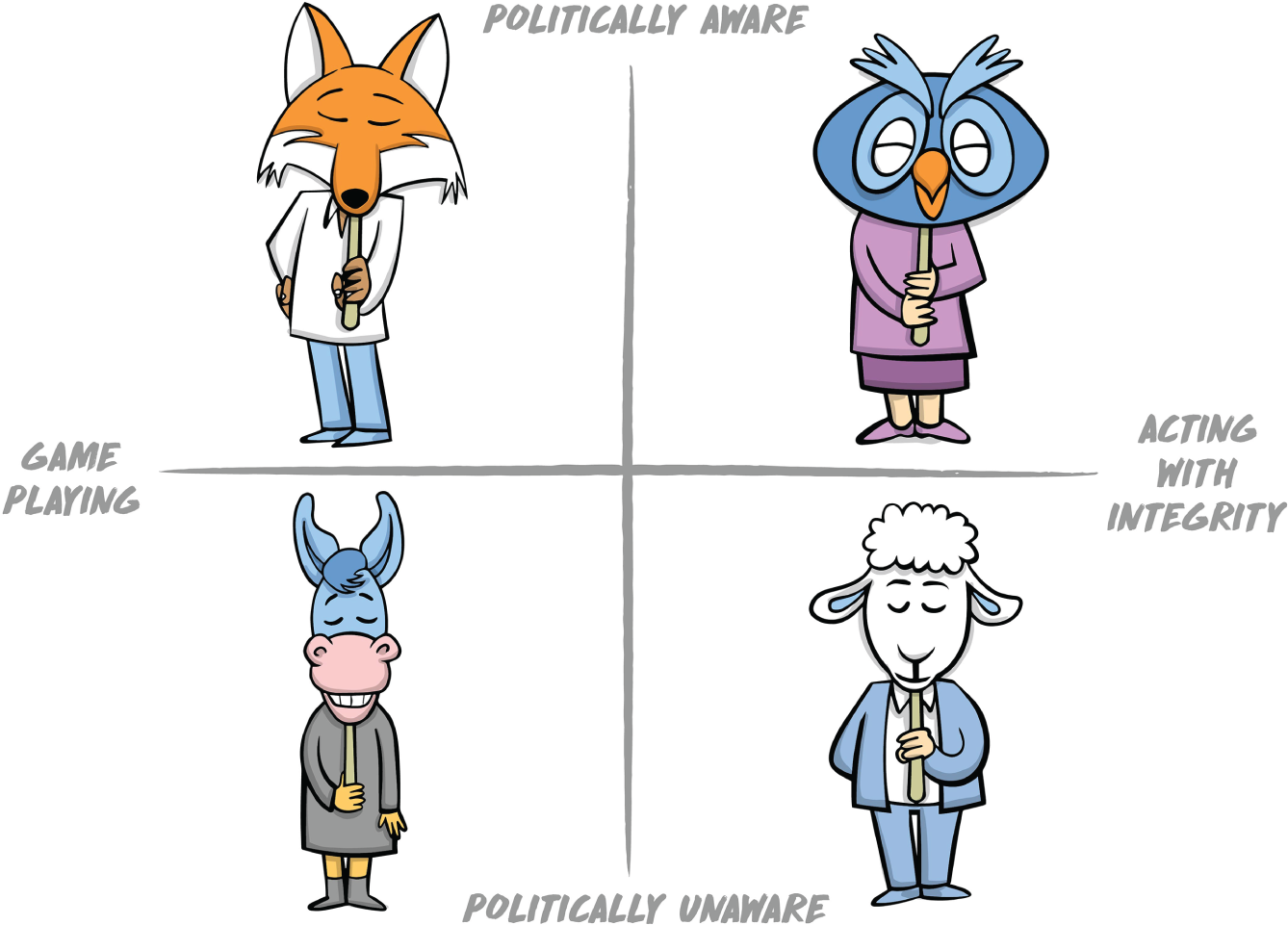
[Illustration 10.4] Political animals (after Kim James & Simon Baddeley)
On the receiving end of Machiavellian behaviour, managers report how some foxes won't reply to emails unless their boss is copied in or how they change their views depending on the way the wind is blowing in a meeting. They also cite examples of ‘silo behaviour’ and ‘empire building’ and good people ‘being thrown under the bus’ if things go wrong. As the saying goes: ‘Having a scapegoat in mind is almost as good a real solution to a problem’.[37]
When to use it
Implementing a new corporate strategy that requires buy-in from different departments, where understanding political alliances can help build coalitions.
Navigating a promotion process where personal relationships with decision-makers may influence outcomes.
Managing a cross-functional project where different teams have competing interests.
Preventing a scapegoat dynamic when a project fails by fostering a culture of accountability.
FROM THEORY TO EVERYDAY LIFE
In practice
Email Ccing Boss
A manager notices that a colleague only replies to emails when their boss is copied in, using the boss's presence to gain leverage or avoid accountability.
Scapegoating
When a project fails, a senior manager quickly blames a junior team member to protect themselves, exemplifying the 'throw under the bus' tactic.
A MOMENT TO REFLECT
Put it to work.
How can you use political awareness to drive positive organizational change?
In your current role, what political dynamics are at play and how do they affect decision-making?
Reflect on a situation where you observed organizational politics being used for good or ill.
CONTINUE THE CONVERSATION
Source texts
- Beyond the Five Whys Root Cause Analysis and Systems Thinking (James C. Paterson)