Open and Closed Systems
This management account contrasts relatively closed systems, whose boundaries support control, with open systems that exchange influences with a wider environment. It also emphasizes overlap between systems approaches and complexity theory.
THE IDEA
Open and Closed Systems
The contrast between tame and wicked problems can also be applied to open and closed systems. Closed systems operate within prespecified boundaries, open systems do not. “The relatively closed system has rigid, impenetrable boundaries; whereas the open system has permeable boundaries between itself and a broader supra-system.” (5) In this contrast, relatively closed systems are treated as having predictable relationships between inputs and outcomes. Open systems are treated as more exposed to outside influences and multiple paths to similar outcomes.
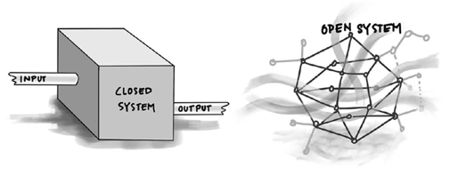
Figure 2. Closed and Open systems
Closed systems are typically bound to protect the system and provide a level of control over the system. Open systems have permeable boundaries and are influenced by internal and external forces that limit control. (6) Using the Cynefin Framework as a guide, we contrasted the differences between system-theoretical approaches and complexity theory. Figure 3 shows this contrast.
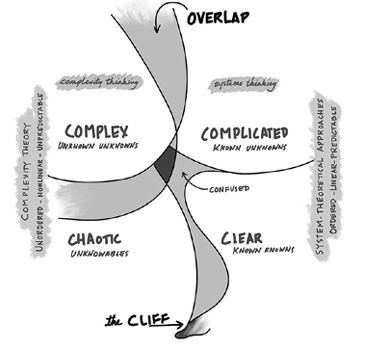
Figure 3. The Cynefin Framework with Systems and Complexity Theory
This contrast, between closed and open systems and system-theoretical approaches and approaches using complexity theory, represents two paradigms that have evolved in parallel over the years, using different perspectives, theories, and methods. The authors acknowledge that there is some overlap between system-theoretical approaches and complexity theory. This overlap, the liminal area in the Cynefin Framework, is identified by the word OVERLAP in Figure 3.
Kast and Rosenzweig recognized that systems could be classified as open or closed, but also acknowledged that a system could be somewhere between, having characteristics of both. (5) This area of overlap is where some system-theoretical approaches are used for addressing problems involving low-levels of complexity. This is also the area where complex adaptive systems reside, sharing similar characteristics between the two domains.
Equally fuzzy is when a system transitions from being a closed system to an open system and vice versa. The visualization provided in Figure 3 reminds us where this transition may occur and which paradigm to draw from when making the transition.
When to use it
Project management: deciding between predictive (closed) and adaptive (open) approaches based on system boundaries.
Organizational design: creating teams with permeable boundaries to foster innovation and responsiveness.
Software architecture: Identifying which external services, users, and events can affect the system.
Policy-making: considering external factors when designing regulations for complex socio-economic systems.
FROM THEORY TO EVERYDAY LIFE
In practice
Manufacturing Assembly Line
An assembly line can be modeled as relatively closed by fixing its inputs and process conditions. Within those assumptions, the model aims to predict quality and throughput. The actual factory still interacts with suppliers, workers, customers, and its environment.
Ecosystem
An ecosystem, such as a forest, is an open system. It exchanges energy and matter with its environment, is influenced by external factors like climate and human activity, and can achieve similar outcomes (biodiversity) through different internal dynamics.
A MOMENT TO REFLECT
Put it to work.
Identify a system you interact with daily. Is it more open or closed? How do its boundaries affect its behavior?
Why is the distinction between open and closed systems important in management and decision-making?
How can the Cynefin Framework help you decide whether to approach a situation as an open or closed system?
References
- Kast and Rosenzweig — Kast, F. and Rosenzweig, J.
CONTINUE THE CONVERSATION
Source texts
- Cynefin - Weaving Sense-Making into the Fabric of Our World ED02 (Dave Snowden Sonja Blignaut Zhen Goh)