Nonlinearity and Second-Order Effects (Convexity Effects)
When a system is nonlinear (curved inward), the average (first-order effect) can be misleading; the variability (second-order effect) becomes crucial. The example of a grandmother exposed to extreme temperatures illustrates how convexity makes average temperature irrelevant and why dispersion matters.
THE IDEA
How to Lose a Grandmother
Next I will explain the following effect of nonlinearity: conditions under which the average—the first order effect—does not matter. As a first step before getting into the workings of the philosopher’s stone.
As the saying goes:
Do not cross a river if it is on average four feet deep.
You have just been informed that your grandmother will spend the next two hours at the very desirable average temperature of seventy degrees Fahrenheit (about twenty-one degrees Celsius). Excellent, you think, since seventy degrees is the optimal temperature for grandmothers. Since you went to business school, you are a “big picture” type of person and are satisfied with the summary information.
But there is a second piece of data. Your grandmother, it turns out, will spend the first hour at zero degrees Fahrenheit (around minus eighteen Celsius), and the second hour at one hundred and forty degrees (around 60º C), for an average of the very desirable Mediterranean-style seventy degrees (21º C). So it looks as though you will most certainly end up with no grandmother, a funeral, and, possibly, an inheritance.
Clearly, temperature changes become more and more harmful as they deviate from seventy degrees. As you see, the second piece of information, the variability, turned out to be more important than the first. The notion of average is of no significance when one is fragile to variations—the dispersion in possible thermal outcomes here matters much more. Your grandmother is fragile to variations of temperature, to the volatility of the weather. Let us call that second piece of information the second-order effect, or, more precisely, the convexity effect.
Here, consider that, as much as a good simplification the notion of average can be, it can also be a Procrustean bed. The information that the average temperature is seventy degrees Fahrenheit does not simplify the situation for your grandmother. It is information squeezed into a Procrustean bed—and these are necessarily committed by scientific modelers, since a model is by its very nature a simplification. You just don’t want the simplification to distort the situation to the point of being harmful.
Figure 16 shows the fragility of the health of the grandmother to variations. If I plot health on the vertical axis, and temperature on the horizontal one, I see a shape that curves inward—a “concave” shape, or negative convexity effect.
If the grandmother’s response was “linear” (no curve, a straight line), then the harm of temperature below seventy degrees would be offset by the benefits of temperature above it. And the fact is that the health of the grandmother has to be capped at a maximum, otherwise she would keep improving.
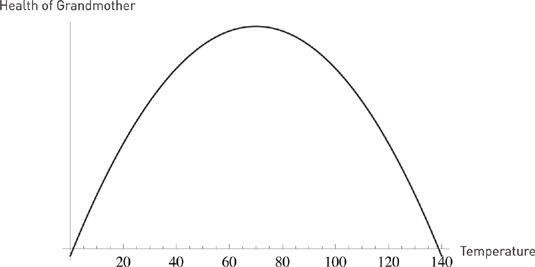
FIGURE 16. Megafragility. Health as a function of temperature curves inward. A combination of 0 and 140 degrees (F) is worse for your grandmother’s health than just 70 degrees. In fact almost any combination averaging 70 degrees is worse than just 70 degrees. The graph shows concavity or negative convexity effects—curves inward.
Take this for now as we rapidly move to the more general attributes; in the case of the grandmother’s health response to temperature: (a) there is nonlinearity (the response is not a straight line, not “linear”), (b) it curves inward, too much so, and, finally, (c) the more nonlinear the response, the less relevant the average, and the more relevant the stability around such average.
When to use it
Risk management: Assessing extreme events (e.g., flood heights) where average sea level rise underestimates storm surge damage.
Supply chain: Average lead time may be acceptable, but high variability causes stockouts or excess inventory.
Healthcare: A drug's average efficacy may be good, but high variability in patient response could be dangerous.
Climate policy: Global average temperature targets do not capture the increased frequency of heatwaves and cold spells.
FROM THEORY TO EVERYDAY LIFE
In practice
Grandmother and Temperature
A grandmother spends one hour at 0°F and one hour at 140°F, averaging a pleasant 70°F. Despite the average being ideal, the extreme variation causes severe harm or death. When a system is fragile (concave response), variability matters more than the average.
Investment Returns with Volatility
Consider an investment that returns +100% one year and -50% the next, averaging 25% per year. However, an initial $1,000 becomes $1,000 after two years (actually $1,000, since $1,000 → $2,000 → $1,000). The average return is misleading; the volatility destroys value due to the concave (risk-averse) nature of wealth utility.
A MOMENT TO REFLECT
Put it to work.
Can you identify a situation in your work or life where relying on an average hides dangerous variability? How would you measure the second-order effect?
Why does the grandmother example show a concave (negative convexity) response? What would a convex response look like, and how would it affect the importance of variability?
How might the concept of convexity effects change how you evaluate risk in a portfolio, a project, or a health decision?
Often confused with
CONTINUE THE CONVERSATION
Source texts
- Antifragile (Nassim Nicholas Taleb)