Negation of 'And' and 'Or'
With inclusive or, negating A and B gives not A or not B; negating A or B gives not A and not B. The rules describe the truth of compound statements. Applying them to causes requires a justified model of how the factors produce the outcome, and does not by itself settle responsibility.
THE IDEA
NEGATION OF “AND” AND “OR”
Suppose a model requires two factors together for an outcome. Making either necessary factor absent prevents that route to the outcome. The logical rule concerns negating a statement involving “and”. Whether the model captures the actual causes is a separate question.
For example, if you’re not a white man you could be a non-white man or you could be a white woman (or more generally a white non-male person); if we negate both the “white” and “man” parts we see that you could also be a non-white non-male person. We can see this in Venn diagrams as it is the region outside the intersection, as shaded here:
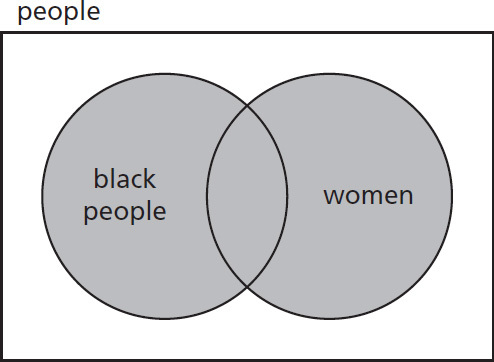
This consists of three regions:
-
white people who are not men,
-
men who are not white, and
-
people who are neither white nor men.
That is, it consists of people who are not white or not male, including people who are both non-white and non-male. In general:
(A and B) is false means A is false or B is false (or both).
We can avoid having to say “or both” all the time by agreeing that we’re talking about the inclusive or.
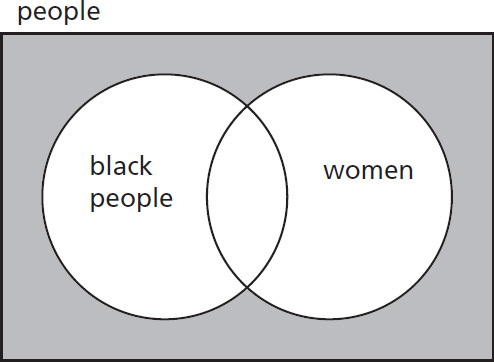
What about negating “A or B”? We can also go back to the question of income disadvantage: you are at an inherent disadvantage in Europe and the US if you are black or female. To escape this particular disadvantage, you must be not black and not female. (Of course, you might still have other disadvantages, such as being poor or sick.)
This is the very outside of the Venn diagram:
In general
(A or B) is false means A is false and B is false.
To sum up:
• Original statement: You are black and female.
Negation: You are not “black and female”. So you could be black but not female, female but not black, or neither.
• Original statement: You are black or female.
Negation: You are not “black or female”. So you are not black and you are not female. In more natural language you are neither black nor female.
In both cases it has to be the inclusive or in order to make a satisfying relationship between “and” and “or”, whether we’re negating “and” and finding “or”, or negating “or” to find “and”. This is one of the reasons mathematicians prefer defaulting to this type of “or” – because it makes for this very neat relationship with “and”.1
These Venn diagrams work best with a few sets. For larger combinations, tracing the logical statements can be clearer than drawing overlapping regions.
The logic that we have at our fingertips so far is called propositional logic. It involves propositions (or statements), connectives and truth values. It is a bit simple, but still quite powerful in human terms for analysing issues of blame and responsibility, as we will now see.
BLAME
If factors A and B cause a situation, which is to blame? We now know that to negate an “and” statement we only have to negate one of the individual statements. This means that just one part could be to “blame” for the statement being false, although both of them have to contribute to the statement being true.
If I break a glass I might say there were two contributing factors:
A: I dropped the glass.
B: The floor was hard.
In this simplified example, suppose the drop and the hard landing are both necessary for the break. Without either, the break does not occur by this route. Negating just one of those factors negates the statement “A and B”, but it doesn’t mean that one of those factors is to blame by itself. It is the combination that is to blame.
In reality with the glass there are many other factors including the weakness of the glass and the action of gravity. We can string as many statements as we like together using the “and” connective, and the negation will always work the same way:
(A and B and C and D) is false means A is false or B is false or C is false or D is false.
That is, negating any one factor negates the whole statement. So for example, if you are not a straight, white, rich, cisgendered male person, it could be because you’re not straight, not white, not rich, not cisgendered or not male. Losing any one of those privileges would mean you don’t have the full complement of these types of privilege, but it doesn’t mean that one of those privileges is more “to blame” than the others if you do have all that privilege.
This is a subtle point but a crucial one, I think, when we are considering who or what is to blame for something. For the student failing the exam we could also consider a lot of other factors: the exam was hard, the examiner was not lenient, the pass mark was set high, the student was sick that day. It is always easy to blame just one of those factors, on the grounds that changing one of them would have changed the result. If the outcome really requires all the factors, the model can join them with the logical connective “and”. In other cases, different routes can produce the same outcome, so the causal structure must be established rather than assumed.
I heard an interesting talk by software developer Jessica Kerr who summed this up as understanding the system rather than blaming the individual. So, instead of arguing about trying to attribute blame individually, it is more productive to understand how the system makes all those factors interact with each other to cause that outcome.
One of my favourite examples of this is from An Inspector Calls by J.B. Priestley. A woman has been found dead, and gradually more and more people are found to be implicated in her demise, in different ways, from personal to professional to incidental interactions. They all start arguing with each other about who is really to blame, when in fact it is an “and” situation. The mother and the father and the son and the daughter caused the situation between them, together with society and the world. Perhaps also it is an example of what Jessica Kerr said about understanding the system. Here there are two systems: the family and its interactions (for example, where Eric says “You are not the sort of father a chap could go to when he’s in trouble.”), and society and the way it treats poor women.
DIVORCE
Relationship breakdowns illustrate the difference between describing contributing factors and assigning responsibility.
An affair does not always end a relationship, so “affair implies divorce” is not a logical truth. For a simplified example, suppose Alex and Sam separate after an affair and a lack of forgiveness. We can identify the following factors without claiming they inevitably produce separation in every relationship:
A: Alex had an affair.
B: Sam does not forgive Alex.
X: Alex and Sam split up.
Sam and Sam’s friends probably blame Alex for having the affair. Perhaps Alex (and Alex’s friends) blame Sam for not forgiving Alex. Maybe they think having an affair is bad but that nobody’s perfect, and aren’t you supposed to love someone for who they are, faults and all?
The proposed model treats A and B together as contributing to X. Establishing that model requires more than naming the factors. Other circumstances might include:
C: they both refuse to go to couples therapy, or
D: they went but the couples therapist wasn’t very good.
But we could also ask why Alex had the affair in the first place. Maybe it was because Alex is a liar and a cheat and a good-for-nothing, always out for a cheap thrill. Or maybe Alex was very unhappy because Sam was being neglectful. Why was Sam being neglectful? Maybe because Sam had become comfortable in the relationship and is generally a lazy and uncaring person, or maybe it was because Sam suffered a family tragedy and has been beset with grief. Or maybe it was because Alex was being cold. Why was Alex being cold? And so on.
Likewise, we can also ask why Sam does not forgive Alex. Maybe because Sam is a mean and ungenerous person who holds people to unreasonable standards. Or maybe it is because the way that Alex conducted the affair was so extremely hurtful that there is no chance of forgiveness. Or maybe it’s because Sam has run out of goodwill because Alex has been treating Sam badly in other ways for some time. But why is that? And so on.
Alex may gain something from an action that hurts Sam. That is a conflict of interests, but it does not establish a zero-sum game in the technical sense, where the participants’ payoffs sum to a fixed total. Understanding what each person wants may reveal alternatives; it does not erase the consequences of the affair.
A relationship can involve many interacting factors. Mapping them may explain what happened, but the negation rules do not assign equal responsibility, excuse mistreatment or establish that Sam owes forgiveness. Causal explanation and moral judgment require different arguments.
When to use it
Analyzing responsibility in a project failure: instead of blaming one team member, consider all contributing factors (missing requirements, tight deadline, poor communication) as an 'and' situation.
Resolving a personal conflict: map out the multiple factors that led to the disagreement to understand the system rather than attributing blame to one side.
Improving public policy: when addressing social issues like poverty or inequality, recognize that multiple privileges and disadvantages interact, and changing one factor alone may not solve the problem.
FROM THEORY TO EVERYDAY LIFE
In practice
Breaking a glass
Suppose a glass breaks only when it is dropped and lands on a hard floor in this example. Removing either necessary condition prevents that modeled break. The conclusion depends on those causal assumptions, rather than following from the word and alone.
Failing an exam
A hard exam, strict marking, a high pass mark and illness may contribute to a student’s result. Whether changing any particular factor would have changed the outcome requires evidence; listing the factors does not establish that all were necessary.
An Inspector Calls
In J.B. Priestley's play, a woman's death is caused by multiple characters' actions (the father, mother, son, daughter) plus societal factors. Each person blames another, but it's an 'and' situation: all factors together caused the outcome.
Divorce after an affair
The example labels the breakup X, the affair A and the lack of forgiveness B. Treating A and B together as causes is a simplified model. It does not establish inevitability, equal blame or a duty to forgive.
A MOMENT TO REFLECT
Put it to work.
Think of a situation where you blamed one person for a negative outcome. What other factors might have been necessary for that outcome to occur?
How can understanding the 'and' logic of causation change the way you approach problem-solving in a team or relationship?
Where do two people’s interests conflict without the situation being strictly zero-sum? What alternatives could improve the outcome for both?
CONTINUE THE CONVERSATION
Source texts
- The Art of Logic How to Make Sense in a World that Doesn’t (Eugenia Cheng)