Nature's Optionality and Bricolage
Taleb uses bricolage, or making do by recombining available parts, to illustrate trial and error. He calls it optionality when failed attempts have limited costs and favorable results can be recognized and exploited for much larger gains.
THE IDEA
Nature and Options
The great French biologist François Jacob introduced into science the notion of options (or option-like characteristics) in natural systems, thanks to trial and error, under a variant called bricolage in French. Bricolage is a form of trial and error close to tweaking, trying to make do with what you’ve got by recycling pieces that would be otherwise wasted.
Jacob argued that even within the womb, nature knows how to select: about half of all embryos undergo a spontaneous abortion—easier to do so than design the perfect baby by blueprint. Nature simply keeps what it likes if it meets its standards or does a California-style “fail early”—it has an option and uses it. Nature understands optionality effects vastly better than humans, and certainly better than Aristotle.
Nature is all about the exploitation of optionality; it illustrates how optionality is a substitute for intelligence.
Let us call trial and error tinkering when it presents small errors and large gains. Convexity, a more precise description of such positive asymmetry, will be explained in a bit of depth in Chapter 18.
The graph in Figure 7 best illustrates the idea present in California, and voiced by Steve Jobs at a famous speech: “Stay hungry, stay foolish.” He probably meant “Be crazy but retain the rationality of choosing the upper bound when you see it.” Any trial and error can be seen as the expression of an option, so long as one is capable of identifying a favorable result and exploiting it.
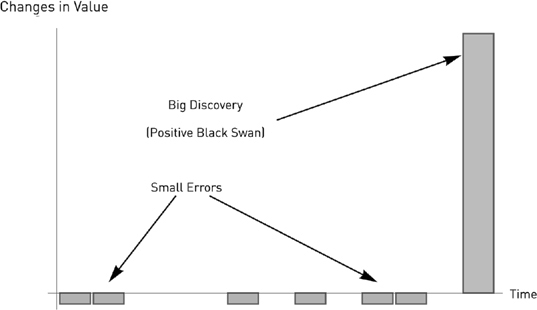 FIGURE 6. The mechanism of optionlike trial and error (the fail-fast model), a.k.a. convex tinkering. Low-cost mistakes, with known maximum losses, and large potential payoff (unbounded). A central feature of positive Black Swans: the gains are unbounded (unlike a lottery ticket), or, rather, with an unknown limit; but the losses from errors are limited and known.
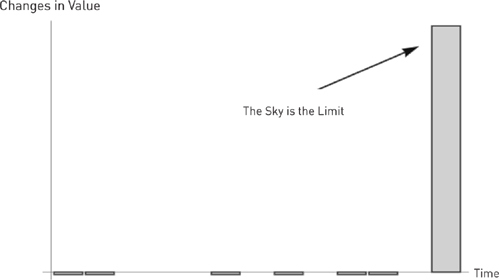 FIGURE 7. Same situation as in Figure 6, but in Extremistan the payoff can be monstrous.
When to use it
Venture capital: investing in many startups with small amounts, hoping for one big success.
Scientific research: running many small experiments to discover breakthroughs.
Career: trying different jobs or side projects to find a high-payoff opportunity.
Product development: A/B testing different features to see what works.
FROM THEORY TO EVERYDAY LIFE
In practice
Embryonic Spontaneous Abortion as Nature's Option
Taleb uses embryo loss as an analogy for selection without a detailed blueprint. His language presents nature as if it were choosing among options. The analogy concerns differential survival; it does not mean the process is deliberate or that pregnancy loss is a low-cost event for people.
Steve Jobs' 'Stay Hungry, Stay Foolish'
Steve Jobs' famous advice reflects the idea of being open to trial and error with convex payoffs: one should try many things with small downside but potentially large upside, and then exploit the successes. This is analogous to the optionality in nature.
A MOMENT TO REFLECT
Put it to work.
How can you apply the principle of 'fail early' to your personal projects?
In what areas of your life do you have optionality—low-cost trials with potential large gains?
How does nature's use of bricolage differ from human tendency to over-design?
Often confused with
CONTINUE THE CONVERSATION
Source texts
- Antifragile (Nassim Nicholas Taleb)