Mutually Exclusive Probability
For equally likely selections, divide the number of qualifying items by the total number of items. For example, if 30% of the jelly beans are red, a uniformly random draw has a 30% chance of selecting red. Mutually exclusive outcomes cannot occur together.
THE IDEA
Mutually Exclusive Probability
How do we calculate mutually exclusive probability? A useful vehicle for explaining this calculation is a jar containing 90 jelly beans: 45 red ones, 36 yellow, and 9 green. We’re going to reach into the jar and pick out one bean. We can visualize this more clearly with a scenario tree (Figure 13-1) in which we have three possible, mutually exclusive decisions or outcomes: red, yellow, and green.
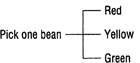
FIGURE 13-1
Assuming each bean has an equal chance of being selected, what is the probability, if I reach into the jar and blindly take out a single jelly bean, that it will be red? What probability yellow? What probability green?
One easy way to compute mutually exclusive probabilities is to think of them as percentages. For example, the probability of picking one red bean out of 90 in one try is equal to the percentage of the 90 that are red. Does that make sense? Maybe it’s clearer if I rephrase the sentence. If, in a different jar, 30 percent of the beans are red, then I have a 30 percent chance of picking a red bean on one try.
How, then, do we compute the percentage of red beans in the jar? I like to use the traditional IS-over-OF method: IS divided by OF. I learned it in grade school and have never found a better way to structure the arithmetic formula. (Yes, IS-over-OF is a structuring technique.) To do the calculation, we ask ourselves, “What percent is this number of that one?” We then divide the IS number by the OF number. For instance, what percent is 3 of 6? Or what percent of 6 is 3? IS (3) over OF (6): 3 divided by 6 equals .5 (50 percent).
One advantage in using the IS-over-OF formulation is that sometimes the context of a problem makes it difficult to determine which number is to be divided by which. I was taught, when encountering this dilemma, to transform the language of the problem into an IS-over-OF format. To wit, a bushel contains 40 apples, 10 of which are rotten. What percentage are rotten? Some people might be confused as to which number is the divisor and which the dividend. To find out, one simply rewords the question as follows: What percent is 10 of 40? IS-over-OF; 10 over 40 = .25 (25 percent). I love it! (God bless my grade school teachers.)
When to use it
Calculating the probability of drawing a particular card from a standard deck.
Determining the chance of selecting a specific type of product from a mixed inventory.
Estimating the likelihood of a particular outcome when rolling a die.
Using percentages to understand survey results.
FROM THEORY TO EVERYDAY LIFE
In practice
Jelly Bean Probability
A jar contains 90 jelly beans: 45 red, 36 yellow, and 9 green. If every bean is equally likely to be selected, the probability of picking a red bean is the percentage of red beans: 45/90 = 0.5 or 50%. Similarly, yellow: 36/90 = 40%, green: 9/90 = 10%. The outcomes are mutually exclusive and cover every bean in the jar, so their probabilities sum to 100%.
Apple Percentage
A bushel contains 40 apples, 10 of which are rotten. To find the percentage of rotten apples, use the IS-over-OF method: What percent is 10 of 40? 10/40 = 0.25 or 25%.
A MOMENT TO REFLECT
Put it to work.
How can the IS-over-OF method help you estimate probabilities in everyday decisions?
If you have a bag of marbles with different colors, how would you calculate the chance of picking a specific color?
What is the difference between outcomes being mutually exclusive and selections being equally likely? Which condition lets you calculate a chance by counting items?
CONTINUE THE CONVERSATION
Source texts
- The Thinkers Toolkit by Morgan D Jones