Multiple-Perspective Utility Analysis (Thirteen Steps)
A structured decision framework that evaluates options across multiple weighted perspectives by assigning utilities and probabilities, computing expected values, and ranking options based on total weighted expected value.
THE IDEA
The Thirteen Steps of Multiple-Perspective Utility Analysis
Step 1: Identify the options and outcomes to be analyzed.
Step 2: Identify and weight the perspectives to be analyzed.
Step 3: Construct an identical utility matrix (Figure 16-10) for each perspective—same options, same outcomes.
Perform Steps 4 through 7 with each matrix.
Step 4: From each matrix’s particular perspective, assign utilities from 0 to 100 to the outcome of each option-outcome combination (each cell of the matrix). There must be at least one 100.
Step 5: Assign a probability to the outcome of each option-outcome combination (each cell).
Step 6: Compute expected values for each option-outcome combination (each cell).
Step 7: Add expected values for each option and enter the totals in the “Total EV” column.
Step 8: Construct a single “merged” matrix (Figure 16-11) with the same options as in the perspective matrices.
Step 9: Enter opposite each option the total expected values for that option from the perspective matrices.
Step 10: Multiply the total expected values under each perspective by the perspective’s weight.
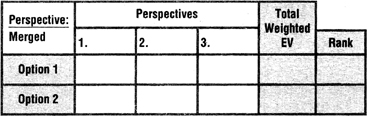 FIGURE 16-11
Step 11: Add the resulting products (weighted expected values) for each option and enter the sums in the “Total Weighted EV” column.
Step 12: Rank the options. The one with the greatest total weighted expected value is the preferred option.
Step 13: Perform a sanity check.
Keeping the values unweighted until Step 10 lets you compare each perspective’s estimates side by side before combining them. You can then vary the weights to see whether the ranking changes. The source illustrates this sensitivity analysis in Exercise 45, the “Planning Conference.”
When to use it
Investment decisions considering different risk preferences (e.g., conservative vs. aggressive).
Project selection in a company with diverse stakeholders (e.g., R&D, marketing, finance).
Personal life decisions like relocation or education choices evaluating cost, quality of life, and career opportunities.
Policy evaluation from economic, social, and environmental perspectives to find balanced solutions.
FROM THEORY TO EVERYDAY LIFE
In practice
Choosing a Career Path
When deciding between job offers, apply multiple perspectives such as financial stability, personal fulfillment, work-life balance, and career growth. For each perspective, assign utilities (0–100) to each job's outcomes (e.g., salary, satisfaction), probabilities to those outcomes, compute expected values, weight perspectives according to importance, and rank jobs by total weighted expected value.
Evaluating Business Strategies
A company compares cost reduction, innovation, and expansion from the perspectives of customers, profitability, employees, and environmental impact. Utilities, probabilities, and perspective weights produce a ranking. Changing uncertain inputs shows how much that ranking depends on the assumptions.
A MOMENT TO REFLECT
Put it to work.
How can you identify and weight the relevant perspectives for a decision you are currently facing?
What biases might influence the assignment of utilities and probabilities in each perspective?
How does performing a sanity check at the end help validate the analysis?
CONTINUE THE CONVERSATION
Source texts
- The Thinkers Toolkit by Morgan D Jones