Milestone Planning and Progress Tracking Risks
How milestones are planned and progress is tracked can inadvertently increase the risk of last-minute disappointments. Seemingly innocent choices in target setting and measurement criteria often push problems into the future, creating a 'hockey stick' effect that hides accumulating risk.
THE IDEA
Paying Attention to the Way Milestones Have Been Planned and Progress Is Tracked
Suppose we ask a team to ascend 6000 m up a mountain in three days, and we are asked to set goals and track progress. We have the following key choices:
- How we plan to climb the mountain?
- In equal stages for three days (2000 m a day) or, say,
- 1750 m/day for two days and then 2500 m on day three.19
- How we judge whether the team is ‘on track’?
- Only judge them as being on track (with a ‘green light’ rating) if they reach 100%+ of their daily target.
- Or give them a ‘green light’ rating if they reach, say, 90% or 95% of their target.
Let's consider the consequences of what seem like innocent choices:
- If we agree to a ‘slower start’ of 1750 m ascent for the first two days, then the 2500 m required on day three is 43% more than the first two days – potentially more demanding to achieve. Here, all other things being equal, we are increasing our chances for a last‐minute disappointment.
- If we set an equal ascent of 2000 m a day for three days, but allow a green traffic light for reaching 90% of the daily target, we could have a situation where the team climb 1800 m on days one and two (and still get a green rating), but then need to cover 2400 m on day three. This still means the team must go 33% quicker on the last day! So, again – all other things being equal – we are increasing the chances of a last‐minute surprise, with no ‘slack’ as we approach a deadline.
As we can see from both examples, it's surprisingly easy to inadvertently ‘set up’ the chances of a last‐minute disappointment by the way targets are set or the way progress is measured. So, whether it's climbing a mountain, flying over a mountain or reaching a project goal, if the ‘mountain’ we are trying to climb up or fly over is a certain height, the way we plan to ascend can really matter to whether we are going to safely ‘sail over’, ‘just make it’ or crash.
When I look at things that didn't go to plan, I quite frequently encounter organisations that missed the fact that risks were building up from the start. Reasons for this include: (i) ‘It'll take time for the project to get started and for things to be set up’ and (ii) ‘Achieving 90% is good enough; we can't be too hard on the project team at the beginning’. This highlights there is often more to goal setting, the way plans are formulated, and how progress is tracked than meets the eye (see Illustration 5.4). A slower and lower ‘hockey stick’ approach is very popular but can push problems into the future and contribute to the last‐minute surprises you might see.20
I am not advocating that targets and measures should be set in a specific way; instead, I am highlighting that target setting, and the way progress is tracked, contain their own risks, which can increase the chances of a surprise unless you are careful.
Further, the cause of targets and metrics being set in the way they are will often depend upon a range of other factors (e.g. pressure to meet a specific date from stakeholders, dependence on getting a contractor to start work quickly, the budget/headcount approval process, etc.) – highlighting the systemic nature of what might be happening.
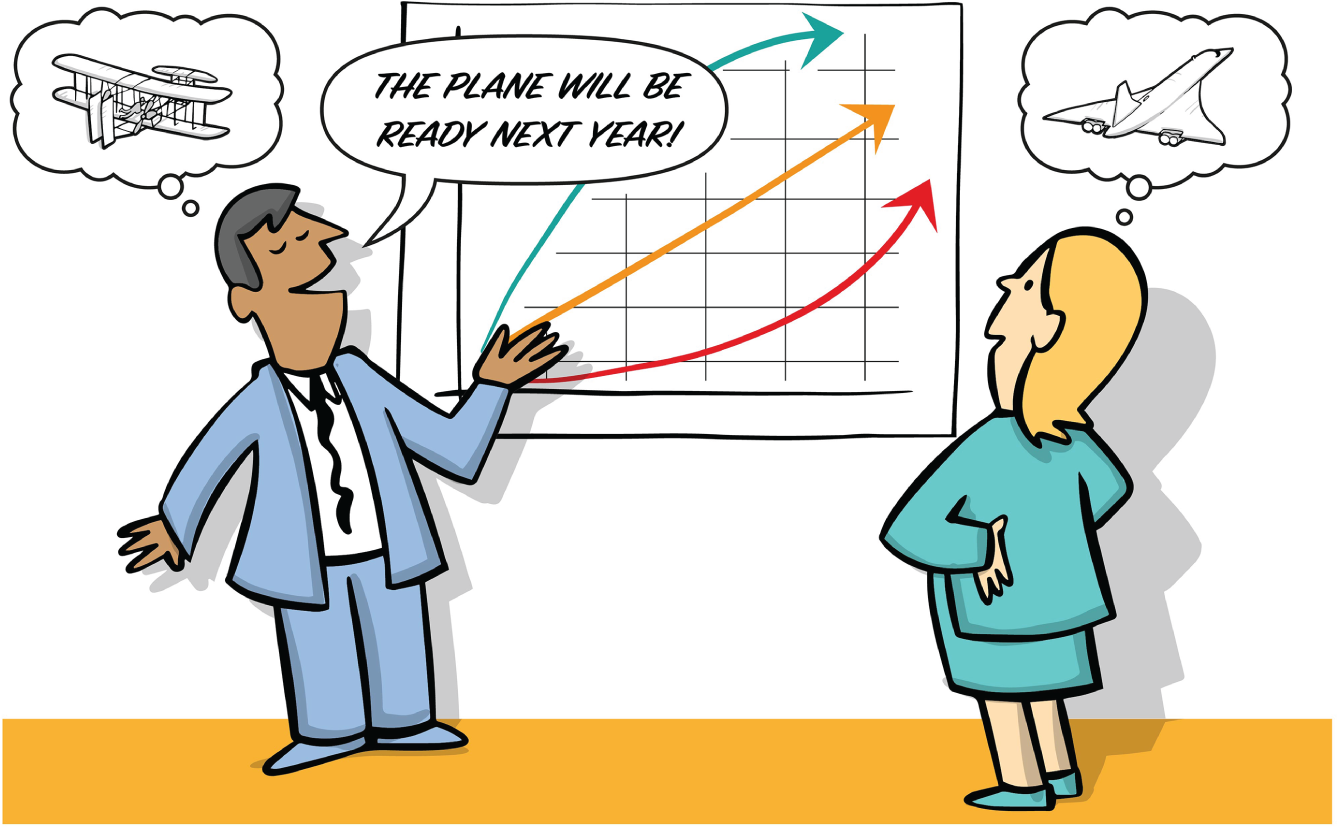
Illustration 5.4 How will you reach your goal?
When to use it
Planning a software development project with multiple sprints – avoid front-loading easy tasks and deferring hard ones.
Designing a sales quota system – avoid allowing 'partial credit' early that masks the need for a strong finish.
Setting personal fitness goals (e.g., running a marathon) – plan weekly distances so that late-week effort doesn't spike unreasonably.
Government infrastructure projects – examine how phased funding and progress reports might create a 'hockey stick' of work near deadlines.
FROM THEORY TO EVERYDAY LIFE
In practice
Uneven Mountain Ascent
Climbing 6000m over three days with a plan of 1750m/day for two days then 2500m on day three. The final day requires 43% more ascent than either earlier day. With comparable conditions and time available, that larger final stage increases the risk of falling short.
90% Green Light Trap
Setting equal daily targets of 2000m but allowing green light at 90% (1800m). After two days of 1800m, the team still needs 2400m on day three (33% faster), with no slack left.
A MOMENT TO REFLECT
Put it to work.
Think of a project you managed or observed: were the milestones front-loaded or back-loaded? Could that have hidden risk?
When setting progress metrics, do you allow 'green lights' for less than 100% completion? How might that create false confidence?
Consider the last time you had a last-minute surprise in a project. Could it have been foreseen by examining how milestones were planned and tracked?
CONTINUE THE CONVERSATION
Source texts
- Beyond the Five Whys Root Cause Analysis and Systems Thinking (James C. Paterson)