Making Biases Disappear: Conditions for Overcoming Representativeness and the Conjunction Fallacy
Statistical knowledge can help people correct an intuitive judgment when a task makes the relevant rule apparent. Frequency formats, direct comparisons, and attention to base rates reduced errors in the studies discussed here. The authors argue that repeated within-subject comparisons can themselves prompt correction, changing what an experiment reveals about intuition.
THE IDEA
Making Biases Disappear: A Task for System 2
Much has been learned over the years about variables and experimental procedures that reduce or eliminate the biases associated with representativeness. We next discuss conditions under which errors of intuition are successfully overcome, and some circumstances under which intuitions may not be evoked at all.
Statistical Sophistication. The performance of statistically sophisticated groups of respondents in different versions of the Linda problem illustrates the effects of both expertise and research design (Tversky and Kahneman, 1983). Statistical expertise provided no advantage in the eight-item version, in which the critical items were separated by a filler and were presumably considered separately. In the two-item version, in contrast, respondents were effectively compelled to compare “bank teller” to “bank teller and is active in the feminist movement.” The incidence of conjunction errors dropped dramatically for the statistically sophisticated in this condition, but remained essentially unchanged among the statistically naїve. Most of the experts followed logic rather than intuition when they recognized that one of the categories contained the other. In the absence of a prompt to compare the items, however, the statistically sophisticated made their predictions in the same way as everyone else does – by representativeness. As Stephen Jay Gould (1991, p. 469) noted, knowledge of the truth does not dislodge the feeling that Linda is a feminist bank teller: “I know [the right answer], yet a little homunculus in my head continues to jump up and down, shouting at me – ‘but she can’t just be a bank teller; read the description.’”
Intelligence. Stanovich and West (Chapter 24, this volume) and Stanovich (1999) observed a generally negative correlation between conventional measures of intelligence and susceptibility to judgment biases. They used transparent versions of the problems, which provide adequate cues to the correct answer and therefore provide a test of reasoning rationality. Not surprisingly, intelligent people are more likely to possess the relevant logical rules and also to recognize the applicability of these rules in particular situations. In the terms of the present analysis, high-IQ respondents benefit from relatively efficient System 2 operations that enable them to overcome erroneous intuitions when adequate information is available. When a problem is too difficult for everyone, however, the correlation is likely to reverse because the more intelligent respondents are more likely to agree on a plausible error than to respond randomly (Kahneman, 2000b).
Frequency Format. Relative frequencies (e.g., 1 in 10) are more vividly represented and more easily understood than equivalent probabilities (.10) or percentages (10%). For example, the emotional impact of statements of risk is enhanced by the frequency format: “1 person in 1000 will die” is more frightening than a probability of .001 (Slovic et al., Chapter 23, this volume). The frequency representation also makes it easier to visualize partitions of sets and detect that one set is contained in another. As a consequence, the conjunction fallacy is generally avoided in direct tests, in which the frequency format makes it easy to recognize that feminist bank tellers are a subset of bank tellers (Gigerenzer & Hoffrage, 1995; Tversky & Kahneman, 1983). For similar reasons, some base-rate problems are more easily solved when couched in frequencies than in probabilities or percentages (Cosmides & Tooby, 1996). However, there is little support for the more general claims about the evolutionary adaptation of the mind to deal with frequencies (Evans et al., 2000). Furthermore, the ranking of outcomes by predicted relative frequency is very similar to the ranking of the same outcomes by representativeness (Mellers, Hertwig, & Kahneman, 2001). We conclude that the frequency format affects the corrective operations of System 2, not the intuitive operations of System 1; the language of frequencies improves respondents’ ability to impose the logic of set inclusion on their considered judgments, but does not reduce the role of representativeness in their intuitions.
Manipulations of Attention. The weight of neglected variables can be increased by drawing attention to them, and experimenters have devised many ingenious ways to do so. Schwarz et al. (1991) found that respondents pay more attention to base-rate information when they are instructed to think as statisticians rather than clinical psychologists. Krosnick, Li, and Lehman (1990), exploited conversational conventions about the sequencing of information and confirmed that the impact of base-rate information was enhanced by presenting that information after the personality description rather than before it. Attention to the base-rate is also enhanced when participants observe the drawing of descriptions from an urn (Gigerenzer, Hell, & Blank, 1988), perhaps because watching the draw induces conscious expectations that reflect the known proportions of possible outcomes. The conjunction fallacy can also be reduced or eliminated by manipulations that increase the accessibility of the relevant rule, including some linguistic variations (Macchi, 1995), and practice with logical problems (Agnoli, 1991; Agnoli & Krantz, 1989).
The interpretation of these attentional effects is straightforward. We assume that most participants in judgment studies know, at least vaguely, that the base-rate is relevant and that the conjunction rule is valid (Kahneman & Tversky, 1982). Whether they apply this knowledge to override an intuitive judgment depends on their cognitive skills (education, intelligence) and on formulations that make the applicability of a rule apparent (frequency format) or a relevant factor more salient (manipulations of attention). We assume that intuitions are less sensitive to these factors, and that the appearance or disappearance of biases mainly reflects variations in the efficacy of corrective operations. This conclusion would be circular, of course, if the corrective operations were both inferred from the observation of correct performance and used to explain that performance. Fortunately, the circularity can be avoided – because the role of System 2 can be verified, for example, by using manipulations of time pressure, cognitive load, or mood to interfere with its operations.
Within-Subjects Factorial Designs. The critique here concerns designs in which each participant repeatedly encounters combinations of the manipulated variables. Factorial experiments can also use other arrangements. The relative virtues of between-subjects and within-subjects designs in studies of judgment are a highly contentious issue. Factorial designs have their dismissive critics (e.g., Poulton, 1989) and their vigorous defenders (e.g., Birnbaum, 1999). We do not attempt to adjudicate this controversy here. Our narrower point is that between-subjects designs are more appropriate for the study of heuristics of judgment. The following arguments favor this conclusion:
• Factorial designs are transparent. Participants are likely to identify the variables that are manipulated – especially if there are many trials and especially in a fully factorial design, in which the same stimulus attributes are repeated in varying combinations. The message that the design conveys to the participants is that the experimenter expects to find effects of every factor that is manipulated (Bar-Hillel & Fischhoff, 1981; Schwarz, 1996).
• Studies that apply a factorial design to judgment tasks commonly involve schematic and impoverished stimuli. The tasks are also highly repetitive. These features encourage participants to adopt simple mechanical rules that will allow them to respond quickly, without forming an individuated impression of each stimulus. For example, Ordóñez and Benson (1997) required respondents to judge the attractiveness of gambles on a 100-point scale. They found that under time pressure many respondents computed or estimated the expected values of the gambles and used the results as attractiveness ratings (e.g., a rating of 15 for a 52% chance to win $31.50).
• Factorial designs often yield judgments that are linear combinations of the manipulated variables. This is a central conclusion of a massive research effort conducted by Anderson and colleagues (see Anderson, 1996), who observed that people often average or add where they should multiply.
The authors argue that these repeated factorial comparisons are poorly suited to testing biases of neglect, because they draw attention to the manipulated factors and can make neglect less likely. Figure 2.3 illustrates this claim by several examples of an additive extension effect discussed further in the next section. The experiments summarized in the different panels share three important features: (1) In each case, the quantitative variable plotted on the abscissa was completely neglected in similar experiments conducted in a between-subjects or subtle design; (2) in each case, the quantitative variable combines additively with other information; (3) in each case, a compelling normative argument can be made for a quasi-multiplicative rule in which the lines shown in Fig. 2.3 should fan out. For example, Fig. 2.3C presents a study of categorical prediction (Novemsky & Kronzon, 1999) in which the respondent judged the relative likelihood that a person was a member of one occupation rather than another (e.g., computer programmer vs. flight attendant) on the basis of short personality sketches (e.g., “shy, serious, organized, and sarcastic”) and one of three specified base rates (10%, 50%, or 90%). Representativeness and base-rate were varied factorially within subjects. The effect of base-rate is clearly significant in this design (see also Birnbaum and Mellers, 1983). Furthermore, the effects of representativeness and base-rate are strictly additive. As Anderson (1996) argued, averaging (a special case of additive combination) is the most obvious way to combine the effects of two variables that are recognized as relevant, e.g., “she looks like a bank teller, but the base-rate is low.” Additivity is not normatively appropriate in this case – any Bayes-like combination would produce curves that initially fan out from the origin and converge again at high values. Similar considerations apply to the other three panels of Fig. 2.3 (discussed later).
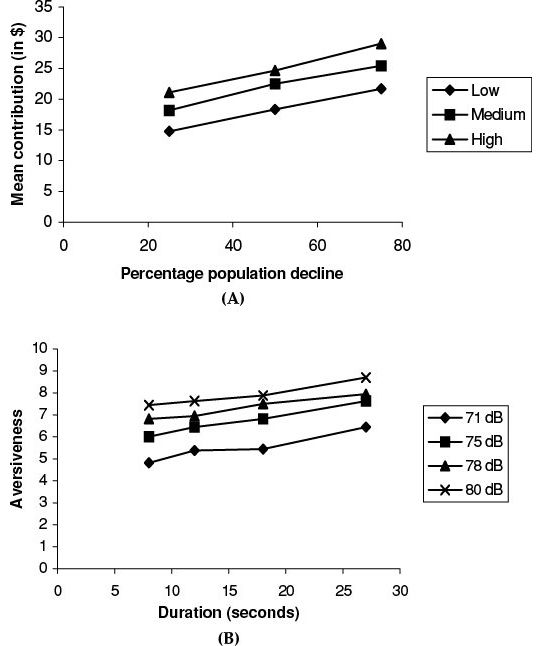
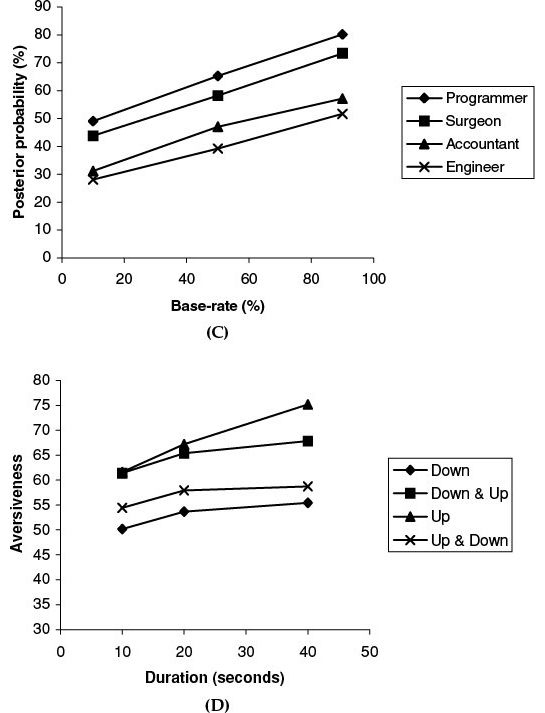
Figure 2.3. (A) Willingness to pay to restore damage to species that differ in popularity as a function of the damage they have suffered (from Kahneman, Ritov, & Schkade, 1999); (B) Global evaluations of aversive sounds of different loudness as a function of duration for subjects selected for their high sensitivity to duration (from Schreiber & Kahneman, 2000). (C) Ratings of probability for predictions that differ in representativeness as a function of base-rate frequency (from Novemsky & Kronzon, 1999); (D) Global evaluations of episodes of painful pressure that differ in temporal profile as a function of duration (Ariely, 1998).
Between-subjects and factorial designs often yield different results in studies of intuitive judgment. Why should we believe one design rather than the other? The main argument against the factorial design is its poor ecological validity. Rapidly successive encounters with objects of rigidly controlled structure are unique to the laboratory, and the solutions that they evoke are not likely to be typical. Direct comparisons among concepts that differ in only one variable – such as bank teller and feminist bank tellers – also provide a powerful hint and a highly unusual opportunity to overcome intuitions. The between-subjects design in contrast, mimics the haphazard encounters in which most judgments are made and is more likely to evoke the casually intuitive mode of judgment that governs much of mental life in routine situations (e.g., Langer, 1978).
When to use it
In medical diagnosis, considering both the representativeness of symptoms and the base rate of diseases.
In business, when evaluating job candidates, avoid the conjunction fallacy by considering the likelihood of a candidate having multiple traits.
In legal settings, to avoid overestimating the probability of a scenario based on a vivid description without considering base rates.
In everyday reasoning, when reading news stories, think about the conjunction of events and their actual probability.
FROM THEORY TO EVERYDAY LIFE
In practice
Linda Problem
In the classic Linda problem, Linda is 31, single, outspoken, and concerned with social justice. Participants judge whether she is more likely to be a bank teller or a bank teller active in the feminist movement. Choosing the conjunction as more likely violates set inclusion. The studies discussed here show that the response depends on presentation and statistical expertise.
Base-Rate Neglect in Occupational Prediction
Participants are given personality sketches (e.g., 'shy, serious, organized, and sarcastic') and base rates for occupations (e.g., 10%, 50%, or 90% that the person is a computer programmer vs. flight attendant). In between-subjects designs, base rates are often neglected, but in within-subjects factorial designs, participants combine representativeness and base rates additively, which is normatively inappropriate.
A MOMENT TO REFLECT
Put it to work.
How can you design a decision-making environment to reduce the impact of representativeness biases?
When assessing probabilities, how can you ensure that you don't neglect base rates?
What role does cognitive load play in susceptibility to the conjunction fallacy?
References
- Tversky, A., & Kahneman, D. (1983). Extensional versus intuitive reasoning: The conjunction fallacy in probability judgment. — Tversky, A., & Kahneman, D. (1983)
- Gould, S. J. (1991). Bully for Brontosaurus. — Gould, S. J. (1991)
- Stanovich, K. E., & West, R. F. (this volume). Individual differences in reasoning: Implications for the rationality debate. — Stanovich, K. E., & West, R. F.
- Stanovich, K. E. (1999). Who is rational? Studies of individual differences in reasoning. — Stanovich, K. E. (1999)
- Gigerenzer, G., & Hoffrage, U. (1995). How to improve Bayesian reasoning without instruction: Frequency formats. — Gigerenzer, G., & Hoffrage, U. (1995)
- Cosmides, L., & Tooby, J. (1996). Are humans good intuitive statisticians after all? Rethinking some conclusions from the literature on judgment under uncertainty. — Cosmides, L., & Tooby, J. (1996)
- Kahneman, D., & Tversky, A. (1982). On the study of statistical intuitions. — Kahneman, D., & Tversky, A. (1982)
- Anderson, N. H. (1996). A functional theory of cognition. — Anderson, N. H. (1996)
CONTINUE THE CONVERSATION
Source texts
- Heuristics and Biases The Psychology of Intuitive Judgment (Thomas Gilovich, Dale Griffin, Daniel Kahneman)