Luck vs. Skill: Fielding Outcomes
Annie Duke uses skill for the parts of an outcome influenced by our decisions and luck for influences outside our control. Learning from experience requires judging their contributions rather than treating a good or bad result as proof of a good or bad decision.
THE IDEA
Luck vs. skill: fielding outcomes
The way our lives turn out is the result of two things: the influence of skill and the influence of luck. For the purposes of this discussion, any outcome that is the result of our decision-making is in the skill category. If making the same decision again would predictably result in the same outcome, or if changing the decision would predictably result in a different outcome, then the outcome following that decision was due to skill. The quality of our decision-making was the main influence over how things turned out. If, however, an outcome occurs because of things that we can’t control (like the actions of others, the weather, or our genes), the result would be due to luck. If our decisions didn’t have much impact on the way things turned out, then luck would be the main influence.*
When a golfer hits a tee shot, where the ball lands is the result of the influence of skill and luck, whether it is a first-time golfer or Rory McIlroy. The elements of skill, those things directly in the golfer’s control that influence the outcome, include club choice, setup, and all the detailed mechanics of the golf swing. Elements of luck include a sudden gust of wind, somebody yelling their name as they swing, the ball landing in a divot or hitting a sprinkler head, the age of the golfer, the golfer’s genes, and the opportunities they received (or didn’t receive) up to the moment of the shot.
An outcome like losing weight could be the direct result of a change in diet or increased exercise (skill), or a sudden change in our metabolism or a famine (luck). We could get in a car crash because we didn’t stop at a red light (skill) or because another driver ran a red light (luck). A student could do poorly on a test because they didn’t study (skill) or because the teacher is mean (luck). I can lose a hand of poker because I made poor decisions, applying the skill elements of the game poorly, or because the other player got lucky.
Chalk up an outcome to skill, and we take credit for the result. Chalk up an outcome to luck, and it wasn’t in our control. For any outcome, we are faced with this initial sorting decision. That decision is a bet on whether the outcome belongs in the “luck” bucket or the “skill” bucket.
We can update the learning loop to represent this like so:
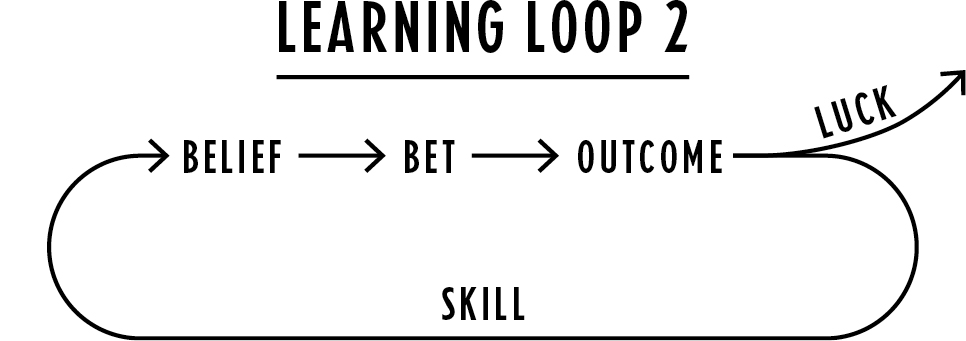
Think about this like we are an outfielder catching a fly ball with runners on base. Fielders have to make in-the-moment game decisions about where to throw the ball: hit the cutoff man, throw behind a base runner, throw out an advancing base runner. Where the outfielder throws after fielding the ball is a bet.
We make similar bets about where to “throw” an outcome: into the “skill bucket” (in our control) or the “luck bucket” (outside of our control). This initial fielding of outcomes, if done well, allows us to focus on experiences that have something to teach us (skill) and ignore those that don’t (luck). Get this right and, with experience, we get closer to whatever “-ER” we are striving for: better, smarter, healthier, happier, wealthier, etc.
It is hard to get this right. Absent omniscience, it is difficult to tell why anything happened the way it did. The bet on whether to field outcomes into the luck or skill bucket is difficult to execute because of ambiguity.
When to use it
Evaluating business outcomes to identify areas for improvement by distinguishing skill-driven results from luck.
Analyzing sports performance to focus on controllable factors and avoid overconfidence from lucky wins.
Personal development: learning from mistakes by distinguishing between bad decisions and bad luck.
FROM THEORY TO EVERYDAY LIFE
In practice
Golf Tee Shot
When a golfer hits a tee shot, where the ball lands results from skill (club choice, setup, mechanics) and luck (wind, noise, divot, genetics, opportunities).
Weight Loss
Losing weight could be due to skill (diet and exercise changes) or luck (sudden metabolism change or famine).
Car Crash
A driver may cause a crash by running a red light, or be hit by another driver who does so. Duke places the first decision in the skill category because it is controllable; the second driver’s action is outside the first driver’s control. Skill here includes poor decisions.
A MOMENT TO REFLECT
Put it to work.
When you experience a success or failure, how do you decide whether it was due to your skill or luck? What factors might bias your attribution?
Consider a recent outcome you attributed to skill. Could luck have played a larger role than you think?
How can you structure your decision-making process to better separate skill from luck in everyday outcomes?
CONTINUE THE CONVERSATION
Source texts
- Thinking in Bets Making Smarter Decisions When You Dont Have All the Facts (Annie Duke)