Local and Global Convexities (Technical)
A payoff can be concave over one range and convex over another. Taleb uses bounded biological harm and economic upside to illustrate why local curvature should not be treated as a property of every possible outcome.
THE IDEA
LOCAL AND GLOBAL CONVEXITIES (TECHNICAL)
Taleb’s argument uses death as a maximum on the chosen measure of harm to an individual organism:
Nothing is open-ended in nature—death is a maximum outcome for a unit. So things end up convex on one end, concave on the other.
In fact, there is maximum harm at some point in things biological. Let us revisit the concave figure of the stone and pebbles in Chapter 18: by widening the range we see that boundedness of harm brings convexities somewhere. Concavity was dominant, but local. Figure 28 looks at the continuation of the story of the stone and pebbles.
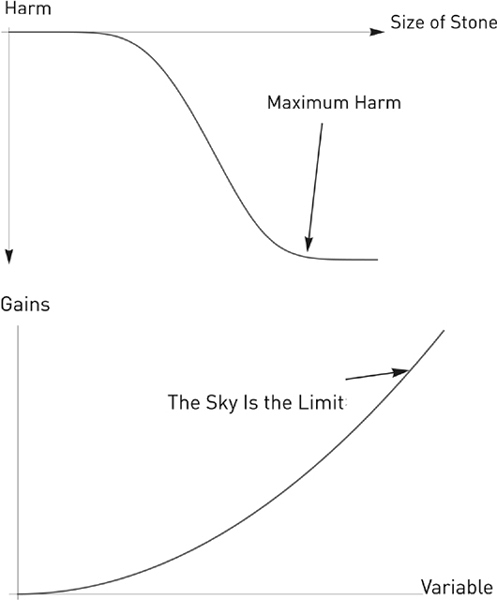
FIGURE 28. The top graph shows a broader range in the story of the stone and pebbles in Chapter 18. At some point, the concave turns convex as we hit maximum harm. The bottom graph shows strong antifragility, with no known upper limit (leading to Extremistan). These payoffs are only available in economic variables, say, sales of books, or matters unbounded or near-unbounded. I am unable to find such an effect in nature.
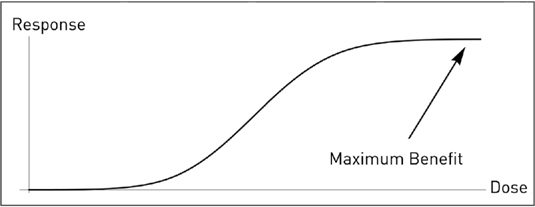
FIGURE 29. Weak Antifragility (Mediocristan), with bounded maximum. Typical in nature.
When to use it
Risk management: specifying the payoff, position size, and range of scenarios before deciding whether a loss is bounded.
Biology: the effect of stressors on organisms is bounded by death, leading to concave-dominant but eventually convex behavior.
Finance: examining the particular option and position to determine the shape of its payoff and limits on gains or losses.
Publishing: testing how changes in attention affect sales instead of assuming that any positive review makes an author antifragile.
FROM THEORY TO EVERYDAY LIFE
In practice
Bounded Harm in Biology
A biological organism experiences harm from stressors; beyond a certain point, the organism dies and harm cannot increase further. This boundedness creates a concave-to-convex transition at the extreme.
Unbounded Upside in Economics
A book’s sales can vary across a very wide range, which Taleb treats as effectively open-ended for the comparison. Sales still face practical limits, and a favorable review alone does not establish exponential growth or a convex response to variation.
A MOMENT TO REFLECT
Put it to work.
In what real-world situations do you encounter bounded harm that creates convexity at the extremes?
How can you distinguish between local concavity and global convexity in a system?
When is it useful to model an economic payoff as effectively unbounded, and what practical limit could make that model fail?
CONTINUE THE CONVERSATION
Source texts
- Antifragile (Nassim Nicholas Taleb)