Listen to the Stories People Are Telling
Anecdote circles invite employees and contractors to share concrete experiences of work. In the Cynefin approach, these stories help people interpret organizational dynamics and notice concerns that routine metrics may miss.
THE IDEA
Listen to the stories people are telling
In the Complex domain of the Cynefin Framework, people’s stories are considered complex adaptive systems. Working with stories about people’s work gives us context for the issues they face. We also get to learn about both what’s going well and what isn’t. Rather than bringing in the experts and asking hypothesis-informed questions, this is about gathering our internal experts (employees and contractors), and creating a safe space for them to interact, tell their stories, make sense of organizational dynamics and, depending on the method used (software or workshop), get to know each other.
Often stories will tell us what data will not. For example, research into pilot mental health and wellbeing uncovered, through the use of stories, something pilots were concealing. Pilots were creating false names and email addresses to avail themselves of support from psychotherapists. They concealed their identity because if it became known that they were experiencing mental health issues their license could be revoked. Stories can reveal details that existing surveys and aggregate data miss. Anonymous sharing may help people discuss sensitive experiences, provided the process gives them credible protection from repercussions.
One way to collect stories is to bring people together in a workshop setting and create a small ritual around the sharing of experiences. We can use “anecdote circles” to encourage people to share descriptive anecdotes from their working lives. Ideally we work with a diverse group of people and more than one facilitator in the room to ensure that a range of voices are heard, and this range of experiences can equally be understood from more than one perspective.
Ideally you want to frame the session with a topic, rather than a list of objectives or a too rigid set of questions. Given that asking people to simply “share a story” can be overwhelming for some and prompt too much of an evaluative response, we give some prompts as a catalyst for the session. Here are two prompts we’ve used that have worked well:
- Think back to your last week at work, think of one story from your experience when things were made either easier, or more challenging to work here.
- Which one story from your last week would you share with someone who does not work here? A story which best reflects what it is like to work here?
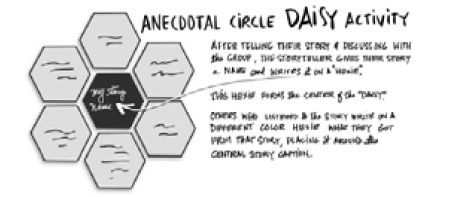
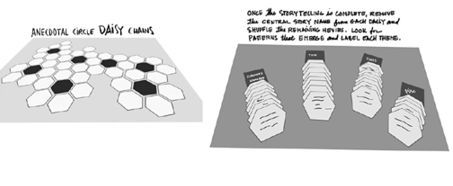
Figure 4. Anecdote Circles
The sharing of stories through this approach enables an open space for the group to then discuss their own feelings and experiences in relation to those of another. We generally hear “This is a luxury we’re rarely afforded.” By implementing lean processes, some senior executives have gone too close to the bone, cutting off perceived excesses and time-wasting activities. The result is that employees have fewer opportunities to interact.
Anecdote circles give employees time to share experiences and discuss what those experiences mean. Comparing accounts can reveal different interpretations of the same event and suggest changes to working practices.
When to use it
Uncovering concealed issues in high-risk professions (e.g., pilot mental health) where anonymity is critical.
Improving organizational culture by providing a forum for employees to share experiences and build mutual understanding.
Enhancing team collaboration and knowledge sharing through facilitated anecdote circles.
Identifying invisible barriers to productivity and innovation that are not captured by quantitative metrics.
FROM THEORY TO EVERYDAY LIFE
In practice
Pilot Mental Health Concealment
The source describes research in which pilots reported using false names and email addresses to seek psychological support because they feared losing their licenses. Story sharing surfaced concerns that routine records might miss.
Anecdote Circle Prompts
Two effective prompts for starting an anecdote circle: (1) Think back to your last week at work, think of one story from your experience when things were made either easier, or more challenging to work here. (2) Which one story from your last week would you share with someone who does not work here? A story which best reflects what it is like to work here?
A MOMENT TO REFLECT
Put it to work.
Think of a story from your last week at work that illustrates a challenge you faced. How might sharing that story with colleagues reveal systemic issues?
What story would you share with a new employee to convey the true culture of your organization?
How can you create a safe space for anonymous story sharing in your team to uncover hidden problems?
Often confused with
CONTINUE THE CONVERSATION
Source texts
- Cynefin - Weaving Sense-Making into the Fabric of Our World ED02 (Dave Snowden Sonja Blignaut Zhen Goh)