Limits to Growth Archetype
A systems archetype where growth initially accelerates due to reinforcing feedback, but eventually encounters balancing processes that slow or reverse the growth, leading to plateau or decline. Explains why many change efforts or innovations falter after initial success.
THE IDEA
PATTERN OF BEHAVIOR
In each of these structures, the limit gradually becomes more powerful. After its initial boom, the growth mysteriously levels off. The technology company may never recapture its capabilities for developing breakthrough new products or generating rapid growth.
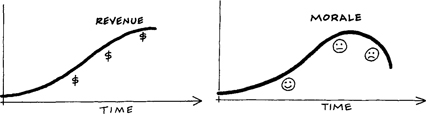
Eventually, growth may slow so much that the reinforcing spiral may turn around and run in reverse. The law firm or consulting firm loses its dominance in its market niche. Before long, morale in the firm has actually started on a downward spiral, caused by the reinforcing circle running in reverse.
Limits to growth structures often frustrate organizational changes that seem to be gaining ground at first, then run out of steam. For example, many change efforts fail, despite making some initial progress. As intended changes start to be implemented, problem solving and results start to improve, which strengthens commitment to the intended changes. But the more successful the changes become, the more threatening they can also become, and those threatened begin to undermine the change implementation. In The Dance of Change fieldbook,5 we identified several specific ways such balancing processes can thwart otherwise promising change initiatives: control-oriented managers who are threatened by new levels of openness and candor; delays in metrics that show costs of changes but take time to show benefits; polarization and competition between converts to a new way of doing things and people trying to conserve mainstream culture; and fragmented management structures that thwart relationship building among different groups of innovators.
As a consequence of the balancing forces, the implementation of desired changes rises for a time—then plateaus and typically declines. Often, the response of the advocates of the disappointing results makes things worse. The more aggressively the advocates try to drive their desired changes, the more people feel threatened and the more resistance arises.
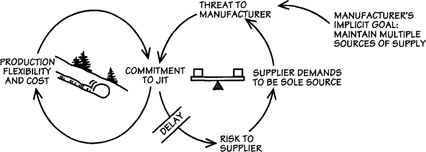
You see similar dynamics with implementing “Just in Time” inventory and other “lean” or “flexible” manufacturing systems, all of which depend on relationships of trust between suppliers and manufacturers. Initial improvements in production flexibility and cost are not sustained. Often, the supplier in these systems eventually demands to be a sole source to offset the risk in supplying the manufacturer overnight. This threatens the manufacturer, who is used to placing multiple orders with different suppliers or playing suppliers off against one another in bidding wars. The manufacturer’s commitment to the new supply system then wavers as will the supplier’s. Both sides may then hedge their risks by returning to multiple suppliers and multiple customers, undermining the trust this JIT arrangement requires.6
When to use it
Applying to organizational change management to anticipate and mitigate resistance.
Analyzing product life cycles to identify when growth will stagnate and plan for innovation.
Evaluating supply chain partnerships to design trust-building mechanisms that sustain lean systems.
Personal skill development: recognizing when practice plateaus and adjusting learning strategies.
FROM THEORY TO EVERYDAY LIFE
In practice
Technology Company's Lost Innovation
A technology company experiences initial rapid growth and breakthrough innovation, but gradually loses its ability to develop new products as limits (e.g., market saturation, organizational rigidity) become more powerful, causing growth to level off and eventually decline.
Organizational Change Initiative Stalled
A company implements a change program that initially improves problem-solving and results, strengthening commitment. But as changes become more successful, they threaten control-oriented managers, leading to resistance. The implementation plateaus and declines, and aggressive driving of the changes only increases resistance.
Just-in-Time Supply Chain Breakdown
A manufacturer adopts JIT inventory with a supplier. Initial improvements in flexibility and cost occur. But the supplier demands sole-source status to offset risk, threatening the manufacturer’s traditional practices. Both parties hedge, undermining trust and causing the system to revert to old methods.
A MOMENT TO REFLECT
Put it to work.
Think of a project or initiative you’ve been involved with that started strong but then plateaued. What limiting factors or resistance emerged?
In a business context, how might the limits to growth archetype apply to a company’s market expansion? What balancing processes could arise?
When faced with resistance in a limits-to-growth scenario, what are the unintended consequences of pushing harder against the limits?
CONTINUE THE CONVERSATION
Source texts
- The Fifth Discipline The Art Practice of the Learning Organization (Peter M. Senge)